By Virtual Cost Segregation
The best cost segregation study provider for rental property investors
 Built to IRS standards
 Audit support includedFlat price for every study3 to 5 business days
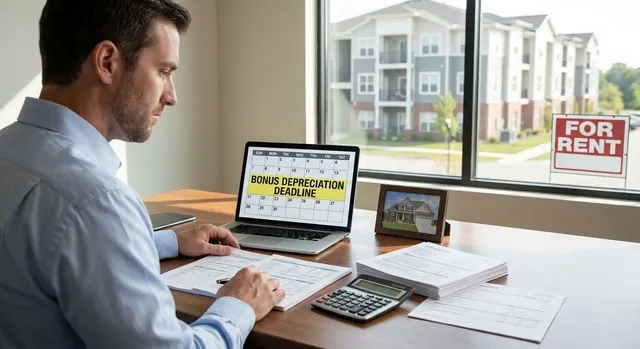
 Bonus depreciation eligibility for residential rental property comes down to three tests: the asset needs a tax recovery period of 20 years or less, it must be acquired and placed in service after January 19, 2025, and a cost segregation study has to separate it from the building's 27.5-year depreciation schedule before you can claim it. Get all three right under the One Big Beautiful Bill Act (OBBBA) and the qualifying assets get 100% bonus depreciation in 2026, deducted entirely in the year the property goes into service.
- Bonus depreciation eligibility for residential rental property requires a 20-year-or-less recovery period plus a placed-in-service date after January 19, 2025.
- OBBBA restored 100% bonus depreciation for qualifying property in 2026, reversing the phase-down that had bonus depreciation set at 40% for 2025.
- A cost segregation study is the mechanism that identifies which components of a rental actually qualify for bonus depreciation.
- Short-term rental owners who materially participate can apply bonus depreciation losses against W-2 income, not just passive rental income.
- Used property can qualify for bonus depreciation as long as you didn't previously use it and it wasn't bought from a related party.
Why This Matters
Most residential landlords assume depreciation just happens automatically over 27.5 years, and for the building shell, it does. But a rental property is made up of dozens of components with shorter IRS-recognized useful lives: appliances, carpet, decking, driveways, certain electrical and plumbing work tied to specific equipment. Those components carry 5, 7, or 15-year recovery periods, and that's exactly what makes them eligible for bonus depreciation.
Without a study that separates those components, the entire purchase price sits inside the 27.5-year bucket and none of it qualifies for bonus treatment. The OBBBA bonus depreciation rules changed the math for anyone closing on a residential rental in 2026, because the rate that applies depends entirely on when the property was placed in service.
Is My Residential Rental Property Eligible for Bonus Depreciation?
Run your property through these four checks. If you clear all four, the assets a cost segregation study identifies are eligible for bonus depreciation in 2026.
| Test | What It Means | Typical Outcome |
|---|---|---|
| Recovery period | Asset must be 5, 7, or 15-year property under MACRS | Personal property and land improvements qualify; the building itself does not |
| Placed-in-service date | Property must be acquired and placed in service after January 19, 2025 | Determines whether you get 100% or a lower phased rate |
| Original use or qualifying used property | You must be the first to use it, or it must meet the used-property rules | Most purchased rentals qualify as used property |
| Not from a related party | Can't buy the property from a spouse, parent, or controlled entity | Disqualifies most family transfers |
Residential rental property itself (the 27.5-year structure) never qualifies for bonus depreciation. What qualifies is the portion of the purchase price a cost segregation study reallocates out of that 27.5-year bucket into shorter-life categories.
Property Placed in Service After January 19, 2025: 100% Bonus Depreciation
Property acquired and placed in service after January 19, 2025 gets the full 100% bonus depreciation rate for 2026 under OBBBA. That means every dollar of reclassified value from a cost segregation study is deductible in year one, not spread over five or seven years.
Assume a $600,000 short-term rental where a study reclassifies 25% of the value, or $150,000, into 5, 7, and 15-year property. At 100% bonus depreciation, that entire $150,000 is deductible in the year the property is placed in service. For a high W-2 earner in the 37% tax bracket, that's roughly $55,500 in tax liability offset in a single year, assuming the loss is usable against ordinary income.
Property Placed in Service Before January 20, 2025: Lower or No Bonus Rate
Before OBBBA, the Tax Cuts and Jobs Act had bonus depreciation on a scheduled phase-down: 100% through 2022, 80% in 2023, 60% in 2024, 40% in 2025, and 20% in 2026. Property acquired before January 20, 2025 and placed in service in 2025 is still governed by the 40% rate under prior law, not the restored 100% rate.
This distinction matters if you closed on a rental in early 2025 before OBBBA passed. Both the purchase date and the placed-in-service date control which rate applies, so a property bought in December 2024 and placed in service in February 2025 gets 40%, while one bought and placed in service in March 2025 gets 100%.
Why Bonus Depreciation Eligibility Varies
Eligibility isn't a single yes-or-no answer. These factors shift how much of a residential rental actually qualifies:
- Property type and use - Airbnb, VRBO, and other short-term rentals often have more separable personal property (furniture, appliances, hot tubs) than long-term rentals, which increases the reclassified percentage
- Renovation history - a gut renovation adds new short-life assets that weren't there at original purchase, each with its own placed-in-service date
- Land value allocation - land itself never depreciates, so a higher land-to-building ratio reduces the pool of assets eligible for any depreciation, bonus or otherwise
- Documentation quality - a study without engineering-based cost estimates and site-specific detail is a common audit red flag, and thin documentation invites disallowance even when the underlying assets are technically eligible
- Placed-in-service timing - closing a purchase in December versus January can shift which tax year absorbs the deduction, and under a mid-quarter convention it can also affect the depreciation calculation for assets placed in service late in the year
- Active participation status - for short-term rental owners trying to offset W-2 income, eligibility for bonus depreciation is separate from eligibility to use the resulting loss against non-passive income, which depends on material participation
Does a Long-Term Rental Qualify for Bonus Depreciation the Same Way as a Short-Term Rental?
A long-term rental qualifies for the same bonus depreciation rate as a short-term rental when the placed-in-service date and asset classes are the same, but a cost segregation and bonus depreciation study for short-term rentals often reclassifies a higher percentage because furnished short-term rentals carry more personal property. Long-term rentals still benefit, just typically at a lower reclassified percentage.
Can I Claim Bonus Depreciation on Used Property?
Yes, used property can qualify for bonus depreciation as long as you didn't personally use it before acquiring it and it wasn't purchased from a related party under IRS attribution rules. This is why most purchased residential rentals, not just new construction, are eligible candidates for a cost segregation study.
Do I Need a Cost Segregation Study to Claim Bonus Depreciation?
Yes, in practice you need a cost segregation study to identify and support which components of a residential rental qualify for bonus depreciation, since the building itself is excluded and the IRS expects documentation behind any reclassified value. Without a study, most owners default to straight-line depreciation on the full purchase price and never claim bonus depreciation at all.
Find your eligible bonus depreciation
A flat-fee, engineering-based study identifies which components qualify.
Virtual Cost Segregation runs engineering-based studies for residential rentals, Airbnb, VRBO, and long-term properties, with no site visit required and a flat fee that includes audit support. That's separate from a CPA's tax filing, since the study is a supporting document your own CPA implements on your return.
FAQ
What makes residential rental property eligible for bonus depreciation in 2026?
A residential rental property becomes eligible for bonus depreciation in 2026 when a cost segregation study identifies components with a 20-year-or-less recovery period, and the property was acquired and placed in service after January 19, 2025. The building structure itself never qualifies; only the reclassified personal property and land improvements do.
Is bonus depreciation 100% in 2026?
Yes, bonus depreciation is 100% in 2026 for qualifying residential rental property acquired and placed in service after January 19, 2025 under OBBBA. Property placed in service earlier in 2025, before the cutoff, follows the prior 40% phase-down rate.
Does an Airbnb or VRBO qualify for bonus depreciation?
An Airbnb or VRBO qualifies for bonus depreciation on the components a cost segregation study reclassifies into 5, 7, or 15-year property, such as furniture, appliances, and outdoor amenities. The building shell still depreciates over 27.5 years and is not eligible for bonus treatment.
Can I use bonus depreciation to offset W-2 income?
Bonus depreciation losses can offset W-2 income when the owner materially participates in a short-term rental with an average stay of seven days or less, a strategy commonly called the STR loophole. Without material participation, the losses are generally passive and limited to passive income.
Does a property need to be new construction to qualify for bonus depreciation?
No, used property qualifies for bonus depreciation as long as the taxpayer did not previously use it and it wasn't acquired from a related party. Most purchased residential rentals, including existing homes, meet this standard.
What recovery period is required for bonus depreciation eligibility?
Assets need a recovery period of 20 years or less to be eligible for bonus depreciation, which covers 5, 7, and 15-year MACRS property classes. The 27.5-year residential building itself falls outside that window and is excluded.
How much of a rental property typically qualifies for bonus depreciation?
A common illustrative example reclassifies around 25% of a property's value into shorter-life asset classes eligible for bonus depreciation, though the actual percentage depends on the property's condition, furnishings, and improvements. A cost segregation study is what determines the specific figure for a given property.
Do I need a cost segregation study every year to keep claiming bonus depreciation?
No, a cost segregation study is typically a one-time engagement per property that establishes the reclassified asset schedule, and bonus depreciation on those assets is generally claimed in the placed-in-service year. Later renovations or new additions may need their own review.
One Last Thing
The 40% rate that applied to property acquired before January 20, 2025 and placed in service in 2025 wasn't a permanent fixture, it was the tail end of a phase-down that started at 100% in 2022 and was scheduled to hit 0% by 2027 before OBBBA reset it back to 100% for anything acquired and placed in service after January 19, 2025. If your property's acquisition or placed-in-service date falls on the wrong side of that line, the eligibility difference isn't marginal, it's the entire bonus depreciation deduction for that asset class in that year.