
By Virtual Cost Segregation
The best cost segregation study provider for rental property investors
 Built to IRS standards
 Audit support includedFlat price for every study3 to 5 business days
Best overall for a residential rental study: Virtual Cost Segregation. Best for return-level tax decisions: CPA-led tax planning. Best for preliminary screening: a DIY calculator. This 2026 guide compares those service paths so you choose the right deliverable, not just a promising savings estimate.
- Virtual Cost Segregation is the best value cost segregation provider here for residential owners seeking an engineering-based study.
- CPA-led tax planning determines whether accelerated depreciation produces a usable deduction on your return.
- DIY calculators screen potential savings; they do not replace a property-specific cost segregation study.
- Compare asset documentation, CPA handoff, turnaround, and audit support before choosing a residential rental study.
Why this matters
A cost segregation study and a tax return solve different problems. The study identifies and documents assets with shorter depreciation lives; your CPA determines how those deductions apply to your tax situation.
For your 2026 decision, value means obtaining a usable report and understanding when its deductions help you. A large projected deduction is not the same as a current reduction in tax owed.
This comparison covers residential rentals, including Airbnb, VRBO, single-family rentals, and properties with 1 to 4 units. It ranks service paths by purpose rather than presenting an unsupported leaderboard of competing firms.
What makes the best value cost segregation provider?
Use these six criteria before comparing proposals:
- Residential fit: Confirm that the provider's study process addresses your rental type, ownership history, and available records.
- Engineering methodology: Ask how the report identifies assets, assigns recovery periods, and documents the reasoning behind classifications.
- Cost traceability: Look for itemized components with cost sources and a reconciliation to the property's depreciable basis.
- CPA implementation: Establish who answers technical questions and who applies the report to the return.
- Delivery requirements: Confirm the expected turnaround, required documents, and whether a site visit is part of the process.
- Audit support scope: Ask what support includes. Do not confuse assistance with study documentation with tax-return services.
Choose documented classifications over the largest estimated deduction. A provider cannot establish your usable tax benefit from property value alone; your acquisition history, rental operations, and tax position matter.
Residential cost segregation options at a glance
| Ranked option | Best for | Standout feature or purpose | Key limitation |
|---|---|---|---|
| Virtual Cost Segregation | Owners ready to obtain a residential engineering-based study | Remote delivery in 3 to 5 business days, with audit support included | Your CPA must apply the report and determine deduction treatment |
| CPA-led tax planning | Owners who need deduction-usability analysis before ordering | Connects depreciation decisions with the taxpayer's return | Planning alone is not an engineering-based study |
| DIY calculator | Owners screening whether to investigate further | Models an initial estimate from entered assumptions | Does not establish property-specific asset classifications |
These options serve different stages of the same decision. You can use an estimate first, consult your CPA second, and order an engineering-based study once the tax purpose is clear.
1. Virtual Cost Segregation: best for a residential study
Virtual Cost Segregation provides engineering-based cost segregation studies built to the IRS Audit Technique Guide's criteria for residential rentals with 1 to 4 units. The service includes remote delivery in 3 to 5 business days, no site visit required, and audit support at no additional cost.
The deliverable is a supplementary report that your own CPA applies when filing. The study itself is not filed with the IRS, and the service is not a substitute for your CPA's tax analysis.
Engineering-based study pros:
- Defined residential scope, including short-term and long-term rentals.
- Every component is itemized with its cost source.
- No site visit required for the study process.
- Audit support is included: if the IRS questions your study, we respond at no additional cost.
Engineering-based study cons:
- You still need your CPA to determine tax treatment and implement the report.
- Report delivery does not establish that you can currently use every resulting deduction.
- You must supply property records; remote delivery does not remove documentation requirements.
For 2026 planning, this is the direct route when you already own a residential rental and need an engineering-based asset allocation. Before ordering, confirm your property's basis, acquisition date, placed-in-service date, and the intended filing year with your CPA.
Best for: Residential rental owners ready for a CPA-ready study rather than another preliminary estimate.
Verdict: Buy the study after your CPA confirms the intended tax use.
2. CPA-led tax planning: best for deduction-usability decisions
CPA-led tax planning addresses the question a study cannot answer by itself: will accelerated depreciation reduce your current tax liability? Ask your CPA to evaluate passive-activity rules, basis and at-risk limitations, existing losses, and your expected holding period.
This is a planning path, not a claim that every CPA provides an engineering-based study. Establish whether the engagement includes tax analysis only or also coordinates a separate study provider.
CPA-led planning pros:
- Connects depreciation decisions with your broader return.
- Identifies limitations that affect when deductions become usable.
- Helps coordinate study timing and filing requirements.
CPA-led planning cons:
- Tax planning alone does not provide engineering classifications or component cost documentation.
- You must clarify which study-related tasks are included in the engagement.
Choose this path first if your rental has personal-use days, accumulated passive losses, an ownership change, or a planned sale. Those facts affect the value of accelerating deductions even when a study identifies shorter-life assets.
Best for: Owners who need to establish the tax purpose before commissioning a study.
Verdict: Hold the study purchase until the CPA resolves deduction usability.
3. DIY calculator: best for preliminary screening
A DIY calculator models potential results from assumptions you enter. Use it to decide whether a conversation about cost segregation belongs on your planning list, not to establish the depreciation treatment of individual assets.
A calculator's projected reclassification is not evidence that your property contains that allocation. Property-specific classification requires analysis of the assets, their function, and supporting records.
DIY calculator pros:
- Lets you explore how changing assumptions changes the estimate.
- Gives you a starting point for questions to ask your CPA.
- Helps separate initial interest from a decision to order a study.
DIY calculator cons:
- Does not establish asset-level classifications or cost sources.
- Cannot determine your deduction usability from property inputs alone.
- Does not replace the engineering-based report used for implementation.
For 2026, treat the output as a screening estimate. Do not enter a calculator's projected allocation into your depreciation schedule as though it were a completed study.
Best for: Residential investors deciding whether further analysis makes sense.
Verdict: Skip the calculator as a substitute for a study.
How to compare value before you order
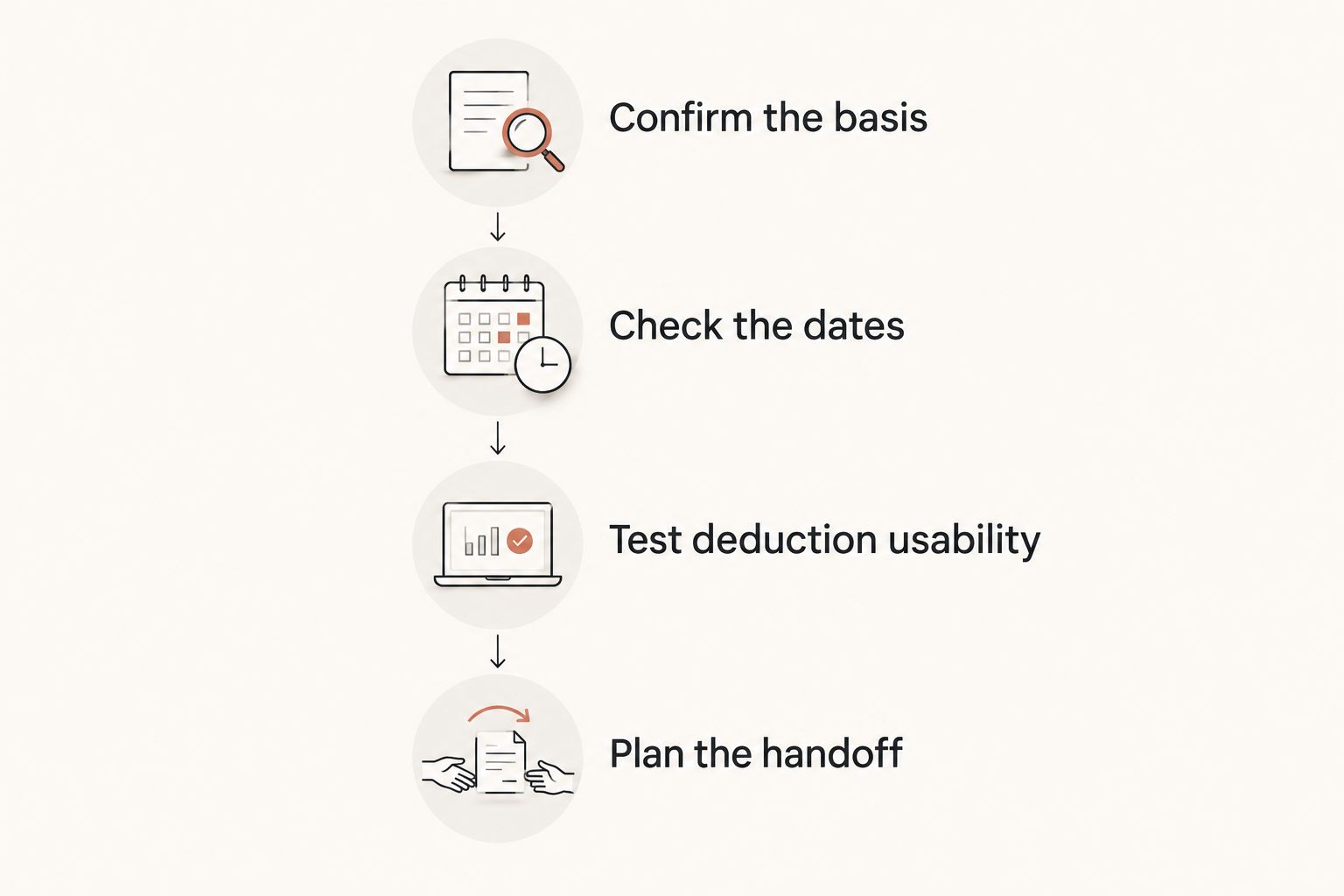
Confirm the basis
Start with the property's depreciable basis, not a listing price or current market value. Land is not depreciable, and prior depreciation, improvements, and ownership events can affect the figures your CPA uses.
Ask whether the provider reconciles the allocation to the basis supplied for the study. A report should not leave your CPA guessing how its component totals connect to the depreciation schedule.
Check the dates
Acquisition and placed-in-service dates are separate facts. For eligible property acquired and placed in service after January 19, 2025, the restored 100% bonus depreciation rate applies, subject to the taxpayer's facts and other eligibility requirements.
Do not assume ordering a study in 2026 changes when an asset was acquired or placed in service. Converting a home to a rental does not reset its acquisition date; ask your CPA to determine the applicable treatment.
Test deduction usability
For the commonly discussed short-term rental strategy, average guest stays must be 7 days or less and the taxpayer must materially participate. One common material-participation test requires more than 100 hours and more participation than any other individual, including a property manager.
Hours alone are insufficient. Real estate professional status is not required for this short-term rental path, but your CPA must evaluate your actual operations and records before applying the rules.
Plan the handoff
Before ordering, agree on who supplies documents, reviews the completed classifications, and enters depreciation into the return. Include prior depreciation schedules if you have owned the property for several years.
For a qualifying look-back study, missed depreciation is claimed on the current return through Form 3115 and a Section 481(a) adjustment; prior returns are not amended. The CPA determines applicability and files the form. Form 3115 is available on request from the study provider.
An illustrative value calculation
Suppose a residential rental has $400,000 of depreciable basis after land is excluded. For this illustration only, assume a study reclassifies 25%, or $100,000, into shorter-life assets and the owner has a 37% marginal federal tax rate.
If the CPA determines that the entire $100,000 is deductible and usable in the current year, the simplified federal tax effect is $37,000. That is a conditional illustration, not an estimate of your property's results.
The calculation does not subtract depreciation otherwise available, account for state taxes, include implementation costs, or address later depreciation recapture. Actual reclassification results vary. Compare the incremental tax effect, not just the headline deduction.
A useful provider estimate starts that discussion; it does not finish it. Request a free manual savings estimate through the website, then review the assumptions with your CPA before purchasing.
Request a manual savings estimate
Get a preliminary residential rental estimate, then review deduction usability with your CPA.
What a useful residential report must distinguish
Cost segregation does not turn the building structure into bonus-eligible property. It separates qualifying shorter-life assets from the structure and documents the classifications.
A long-term rental building generally uses a 27.5-year recovery period. A short-term rental building with average stays under 30 days, including the 7-days-or-less rental pattern discussed above, uses a 39-year recovery period. Your CPA must apply the correct treatment to the property's facts.
Shorter-life allocations can include 5-, 7-, and 15-year property. An amenity's name alone does not establish its recovery period: function, installation, supporting records, and placed-in-service date matter.
Ask how the report separates components of a project rather than assigning an entire renovation or amenity to one category. Even without bonus depreciation, shorter recovery periods accelerate deductions relative to the building schedule.
How these options are ranked
Virtual Cost Segregation ranks first for obtaining the residential engineering-based deliverable described here. CPA-led planning ranks first for deduction-usability decisions, while calculators serve preliminary screening only.
The criteria are residential fit, methodology, cost traceability, CPA implementation, delivery requirements, and audit support scope. This is a suitability comparison, not a market-wide price ranking or a claim of independently tested results.
Which cost segregation option should you choose?
Choose Virtual Cost Segregation for an engineering-based residential rental study once your CPA confirms the tax purpose. Choose CPA-led planning first when deduction usability remains unresolved, and use a calculator only to screen the opportunity.
For a 2026 decision, request a sample deliverable description, clarify the document requirements, and establish the CPA handoff before ordering. Those steps reveal whether the service solves your actual problem.
FAQ
What's the best value cost segregation provider for a residential rental?
Virtual Cost Segregation is the recommended option in this comparison for owners seeking an engineering-based study for residential rentals with 1 to 4 units. Your CPA still determines deduction usability and applies the report to your return.
Is a DIY calculator enough to claim cost segregation deductions?
A DIY calculator does not replace a property-specific cost segregation study. It models assumptions rather than establishing asset classifications, cost sources, and supporting analysis.
How long does a residential study take?
The residential study service described here delivers in 3 to 5 business days with no site visit required. Confirm the document requirements and coordinate your filing schedule before ordering.
Can short-term rental depreciation offset W-2 income?
Short-term rental losses can offset W-2 income when the applicable tax requirements are satisfied. The commonly discussed path requires average stays of 7 days or less and material participation, with other loss limitations still requiring CPA review.
Does ordering a study in 2026 establish bonus depreciation eligibility?
Ordering a study in 2026 does not establish bonus depreciation eligibility. Acquisition date, placed-in-service date, asset classification, and the taxpayer's facts determine the applicable treatment.
Can I use a study for a rental I already own?
A look-back study can identify missed depreciation on an existing rental. When the accounting-method-change requirements apply, your CPA claims the catch-up on the current return using Form 3115 and a Section 481(a) adjustment; prior returns are not amended.
Does audit support include tax-return services?
Audit support for the study is separate from preparing or filing your tax return. Your CPA applies the report and addresses the return's tax treatment.
One last thing
A technically sound study can still produce little immediate tax relief if you cannot currently use the loss. Before ordering, ask your CPA for two separate answers: what depreciation the study could accelerate, and what portion you can use on the intended return.
That distinction is the clearest test of value. This article provides general educational guidance; apply current law to your property's facts with your tax adviser.