
By Virtual Cost Segregation
The best cost segregation study provider for rental property investors
 Built to IRS standards
 Audit support includedFlat price for every study3 to 5 business days
 Virtual Cost Segregation is best for residential rental owners who need an engineering-based cost segregation study without a site visit. For your 2026 decision, compare that service with CPA-led tax planning, a preliminary savings estimate, and standard depreciation: each solves a different problem.
- Virtual Cost Segregation provides engineering-based cost segregation studies for residential rentals with one to four units.
- Choose CPA-led planning first when short-term rental participation, acquisition dates, or loss limitations need review.
- Use DIY calculators for preliminary estimates, not property-specific depreciation classifications.
- Standard depreciation remains an option when your CPA finds accelerated deductions do not justify a study.
Why this matters
Choosing a study provider is not the same as choosing a tax strategy. A report identifies depreciation classifications; your CPA determines how those classifications apply to your return and whether you can use the resulting deductions.
Virtual Cost Segregation provides engineering-based studies for residential rental properties with 1 to 4 units, including Airbnb, VRBO, and long-term rentals. Delivery takes 3 to 5 business days, no site visit is required, and audit support is included.
For a high W-2 earner, the bigger question comes first: will an accelerated deduction reduce current taxable income or become a suspended loss? Start with deduction usability, then select the study. A larger depreciation figure is not automatically a larger current tax benefit.
Cost segregation alternatives at a glance
These options are alternatives at different stages of the decision, not interchangeable services. Compare the deliverable before comparing the provider.
| Option | Best for | Standout deliverable | Main limitation |
|---|---|---|---|
| Engineering-based residential study | Owners ready for property-specific depreciation analysis | Component classifications and supporting cost documentation | Does not replace tax planning or return preparation |
| CPA-led tax planning | Owners unsure whether deductions will be usable | Review of participation, timing, basis, and tax limitations | Tax planning alone is not an engineering study |
| Manual estimate or DIY calculator | Owners deciding whether to investigate further | Preliminary savings scenario | Does not establish final classifications or tax benefits |
| Standard depreciation | Owners whose CPA recommends keeping the existing approach | Depreciation without a cost segregation reallocation | Does not identify embedded shorter-life components through a study |
In 2026, the practical choice is often a sequence rather than a contest. Ask your CPA about usability, review an estimate, and order an engineering study if the facts support proceeding.
1. Virtual Cost Segregation: best for a residential engineering study
Virtual Cost Segregation provides flat-fee, engineering-based cost segregation studies built to the IRS Audit Technique Guide's criteria. The service fits owners of single-family rentals and residential properties with up to 4 units who want a supplementary report their own CPA can apply.
The distinction is documentation. The study itemizes components with their cost sources rather than treating an estimated reclassification percentage as the finished answer.
Where the service shines
- Residential scope: The service addresses short-term and long-term residential rentals with 1 to 4 units.
- Remote delivery: No site visit is required.
- Defined turnaround: Delivery takes 3 to 5 business days.
- CPA handoff: Your CPA receives a supplementary, audit-defensible report to apply when filing.
- Audit support: Support is included at no additional cost.
Where the service falls short
- It is not a CPA service and does not prepare your tax return.
- The study does not establish material participation or determine whether losses offset W-2 income.
- Estimates do not establish the final study results or your actual tax benefit.
- You still need source records and a CPA who will review and implement the report.
Those boundaries matter. An engineering report supplies classification support; it does not resolve every tax issue attached to owning an Airbnb.
Engineering study versus tax planning
| Dimension | Engineering-based study | CPA-led planning |
|---|---|---|
| Main question | Which property components have shorter recovery periods? | How do deductions affect this taxpayer's return? |
| Supporting work | Component identification and cost documentation | Review of tax facts, limitations, and filing requirements |
| Filing role | Supplementary report | CPA applies the report when filing |
| Participation review | Does not establish qualification | CPA evaluates participation facts and records |
Best for: Residential rental owners ready to obtain a property-specific study and coordinate implementation with their CPA.
Verdict: Buy only after your CPA confirms the study fits your tax plan.
2. CPA-led tax planning: best for checking deduction usability
CPA-led planning is the right first step when you do not yet know whether accelerated depreciation will help on your current return. That uncertainty is especially important for owners with substantial W-2 income, a co-host, personal use of the rental, or an existing depreciation schedule.
A tax consultation and an engineering study answer different questions. Ask explicitly whether the engagement includes a property-specific study or only a review of tax treatment.
Where CPA-led planning shines
- Connects depreciation to your overall return rather than considering the rental in isolation.
- Reviews average guest stays, participation records, acquisition timing, and placed-in-service facts.
- Identifies whether a current-year filing or an accounting-method change needs attention.
- Helps evaluate state treatment, loss limitations, and a possible future sale.
Where CPA-led planning falls short
- A tax-planning engagement is not automatically an engineering-based cost segregation study.
- A preliminary depreciation estimate does not replace component-level documentation.
- You must clarify who obtains the study and who implements its findings.
For a 2026 purchase decision, ask your CPA to explain the expected deduction, the portion usable now, and the treatment of any remaining loss. Keep those questions separate; they are not the same number.
Best for: Owners whose main uncertainty is tax eligibility or implementation rather than study delivery.
Verdict: Hold the study order until the tax review is complete.
3. Manual estimates and DIY calculators: best for preliminary screening
An estimate helps you decide whether a study deserves further attention. It does not classify the property for filing.
Virtual Cost Segregation offers a free manual savings estimate when owners inquire through the website or by email. Like calculator outputs, these estimates show typical figures rather than a promised result.
Where estimates shine
- Give you an initial scenario to discuss with your CPA.
- Help separate a potentially useful study from a decision that needs more investigation.
- Make assumptions about basis, tax rates, and deduction usability visible.
Where estimates fall short
- They do not establish actual component classifications.
- They do not prove bonus depreciation eligibility or material participation.
- A projected tax reduction can overstate current benefit if deductions are limited.
Best for: Owners still deciding whether to commission a residential study.
Verdict: Hold. Use an estimate to screen the decision, not to file.
4. Standard depreciation: best when acceleration is not the priority
Standard depreciation remains a legitimate option when your CPA recommends against accelerating deductions. Cost segregation changes deduction timing; it does not turn the entire purchase into a new deductible expense.
For a long-term residential rental, the building generally follows a 27.5-year recovery period. For a short-term rental with average stays under 30 days, including the 7-days-or-less strategy discussed below, the building follows a 39-year recovery period. Have your CPA confirm the classification against the property's use and your facts.
Where standard depreciation shines
- Keeps the building on its applicable recovery schedule without a study-based component reallocation.
- Avoids ordering a study before your CPA has identified a reason to accelerate deductions.
Where standard depreciation falls short
- Does not identify embedded shorter-life assets through an engineering study.
- Can defer deductions that a supported cost segregation analysis would accelerate.
Best for: Owners whose CPA finds that current deduction usability and ownership plans do not support ordering a study now.
Verdict: Hold if the tax analysis supports staying with the existing approach.
Why residential owners consider switching providers
Switch when the proposed deliverable does not meet your property's documentation and implementation needs. Do not switch merely because a preliminary projection shows a larger deduction.
Use these questions to evaluate any residential study proposal:
- Scope: Does the engagement address your rental property and its actual use?
- Cost sources: Will component allocations identify their supporting cost sources?
- Classification: Will the report explain why assets receive their assigned treatment?
- CPA handoff: What will your CPA receive, and who answers report questions?
- Audit support: What support is included, and what does that support involve?
- Timing: Will delivery leave time for CPA review before filing?
A provider change is justified by a better-fitting deliverable, not a bigger estimate. If the existing engagement already supplies the documentation and coordination your CPA needs, changing providers adds no automatic tax benefit.
The short-term rental tests come before the savings calculation
For the commonly discussed short-term rental strategy, average guest stays must be 7 days or less, and you must materially participate. Real estate professional status is not required for this route, but the short stays alone are insufficient.
One commonly used material participation test requires more than 100 hours and more participation than any other individual, including a property manager. Logging 100 hours alone does not satisfy that test. Other material participation tests exist; your CPA should evaluate the applicable one.
For 2026 planning, maintain records of the work performed, dates, hours, and other individuals' involvement. A co-host or manager changes the participation analysis even when you remain the owner.
The study does not answer these questions. It supplies depreciation classifications; participation records and tax analysis determine whether the resulting rental loss receives the treatment you expect.
Bonus depreciation: verify both dates
Under the One Big Beautiful Bill Act, signed July 4, 2025, eligible property acquired and placed in service after January 19, 2025 qualifies for 100% bonus depreciation. Both conditions matter, along with the asset's eligibility and the taxpayer's facts.
The restored rate has no scheduled end. The building structure does not qualify for bonus depreciation, and land is not depreciable.
A home bought before January 20, 2025 does not receive the restored rate merely because you convert it to a rental in 2026. Conversion does not reset acquisition. Ask your CPA to confirm the applicable treatment using the original purchase facts, including any binding contract.
Cost segregation can still accelerate deductions through eligible 5-, 7-, and 15-year recovery periods without bonus depreciation. For amenities, classification depends on function, documentation, placed-in-service timing, and your facts; an entire installation does not automatically receive one treatment.
Illustrative math: reclassification is not tax savings
Assume an illustrative residential rental has $400,000 of depreciable property basis, excluding land. Using a 25% illustrative reclassification assumption, $100,000 moves into shorter-life categories. Actual results vary.
At an assumed 37% tax bracket, a fully deductible $100,000 amount corresponds to $37,000 of federal income tax reduction before other effects. That is conditional arithmetic, not a prediction of the study's first-year deduction or your tax outcome.
Your CPA must determine the deduction available for the filing year and whether you can use it. State treatment, loss limitations, existing depreciation, and later sale consequences also affect the decision.
Compare usable tax benefit with the study and implementation costs, not the reclassified amount alone.
Build the CPA handoff before ordering
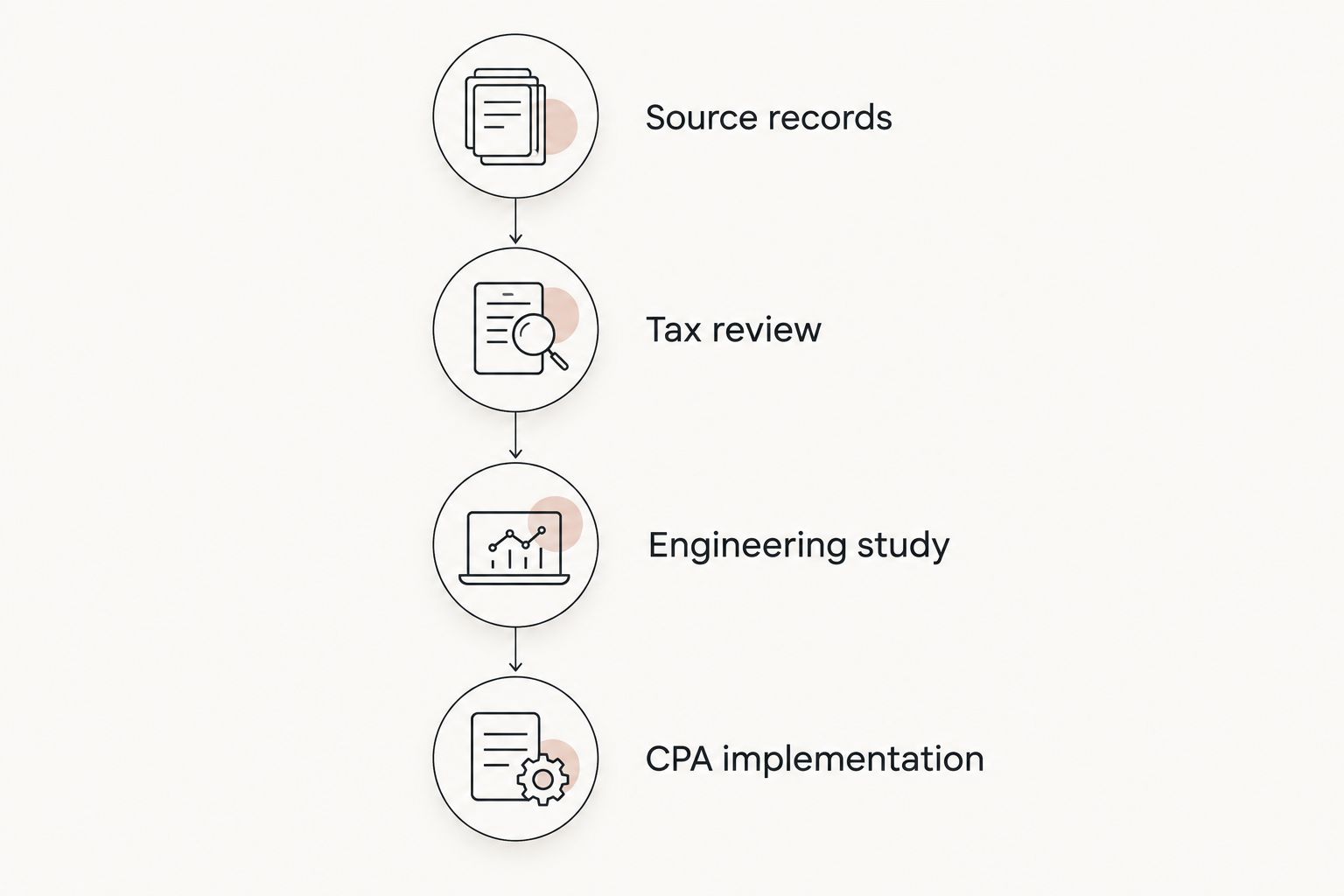
A clear handoff keeps the engineering work connected to the return. Use this sequence for your 2026 review:
- Source records: Gather closing documents, acquisition agreements, improvement invoices, existing depreciation schedules, and rental-use records.
- Tax review: Ask your CPA to evaluate basis, participation, acquisition timing, and deduction usability.
- Engineering study: Obtain the component analysis if the tax review supports proceeding.
- CPA implementation: Have your CPA review classifications and apply the report to the appropriate filing.
For a look-back study, missed depreciation is claimed on the current return with Form 3115 and a Section 481(a) adjustment; prior returns are not amended for that catch-up process. Your CPA evaluates the applicable accounting-method procedures and files the form. Form 3115 is provided on request with the service, not filed by the study provider.
Review how to coordinate an Airbnb cost segregation study with your CPA before committing to an engagement. The report is supplementary documentation, not a document you independently submit to the IRS.
FAQ
What's the best cost segregation option for a residential Airbnb owner?
Virtual Cost Segregation is best for residential rental owners who need an engineering-based study without a site visit. Your CPA should first confirm whether accelerated deductions fit your participation facts and tax plan.
Is a cost segregation study better than a CPA consultation?
Neither replaces the other. An engineering study classifies property components, while your CPA evaluates tax treatment and applies the report when filing.
Can I use a calculator instead of a cost segregation study?
A calculator is suitable for preliminary screening, not final property-specific classifications. Its assumptions do not establish your actual depreciation deduction or tax benefit.
Can short-term rental depreciation offset my W-2 income?
Short-term rental losses can offset W-2 income when the applicable participation rules and other tax limitations permit it. The commonly discussed route requires average guest stays of 7 days or less and material participation; your CPA must evaluate your facts.
What bonus depreciation rule should I check in 2026?
Eligible property acquired and placed in service after January 19, 2025 qualifies for 100% bonus depreciation under the restored rule. Both dates matter, the building structure does not qualify, and your CPA must confirm asset eligibility.
How long does a residential study take?
The service's stated delivery time is 3 to 5 business days, with no site visit required. Coordinate the order with your CPA so the report can be reviewed before filing.
Do I amend earlier returns after a look-back study?
For the look-back accounting-method catch-up process, missed depreciation is claimed on the current return using Form 3115 and a Section 481(a) adjustment, rather than amending prior returns. Your CPA evaluates the applicable procedures and files the form.
One last thing
The most useful question is not how much depreciation a study identifies. Ask your CPA: How much of the resulting deduction can I use on this return, and what changes when I sell?
Keep your existing provider if the engagement already meets your documentation, residential scope, and CPA coordination needs. Choose another approach only when it solves a specific gap. This is general educational guidance; your CPA must apply current law to your facts.