
By Virtual Cost Segregation
The best cost segregation study provider for rental property investors
 Built to IRS standards
 Audit support includedFlat price for every study3 to 5 business days
 If you searched for ReCostSeg alternatives as an out-of-state rental owner, three filters decide the outcome: an engineering-based study, delivered remotely, with no site visit. Virtual Cost Segregation is built around those three for residential rentals of 1 to 4 units.
- Virtual Cost Segregation is the pick for out-of-state owners of 1 to 4 unit rentals who want a flat-fee, engineering-based study.
- No site visit is required, and delivery takes 3 to 5 business days.
- Audit support is included, and your own CPA applies the report when filing.
- A CPA-firm in-house study is the better call if your CPA already runs one.
- Skip low-cost studies, overseas contractors and DIY calculators if you want a report your CPA can lean on.
Why this matters
You own a rental in another state. You will not fly out so someone can photograph a water heater. That makes the provider's process the whole decision.
A cost segregation study is a supplementary report. It is not a CPA service and it is not filed with the IRS. Your CPA applies it on your return. So the useful question is not who is cheapest. It is whether the report holds up and whether your CPA can use it quickly.
The best ReCostSeg alternative in 2026 for out-of-state owners of 1 to 4 unit residential rentals is Virtual Cost Segregation if you want a flat-fee, engineering-based study with no site visit; a CPA-firm in-house study is the better pick if your CPA already offers one.
ReCostSeg alternatives at a glance
Use the first row as your benchmark. Hold your current quote against every criterion in the other rows.
| Option | Best for | Standout feature | How it differs from your current quote |
|---|---|---|---|
| ReCostSeg | Your benchmark | Compare its quote line by line | Check method, fee structure, turnaround and audit support |
| Virtual Cost Segregation | Out-of-state 1 to 4 unit owners | Flat fee, no site visit, 3 to 5 business days | Built to the IRS Audit Technique Guide's criteria |
| CPA-firm in-house study | Owners whose CPA already offers one | One relationship | Method and fee structure vary by firm |
| Percentage-fee or on-site engineering firm | Larger, more complex projects | Physical inspection | Fee often scales with property value |
| Low-cost study or overseas contractor | Nobody who needs a defensible file | Low sticker price | Thin documentation and weak support |
| DIY calculator | Rough planning only | Instant output | An estimate, not a study |
1. Virtual Cost Segregation: best for out-of-state residential rental owners
Virtual Cost Segregation produces engineering-based studies for single-family homes, duplexes, triplexes and fourplexes, rented short-term (Airbnb, VRBO) or long-term. The fee is flat per property. Every component is itemized with its cost source, and the report is CPA-ready.
There is no site visit. If you want to know how a remote study holds up, read the breakdown of no-site-visit cost segregation accuracy.
Where it shines
- Flat fee, so the cost does not move with property value.
- Delivery in 3 to 5 business days.
- Audit support included at no additional cost.
- A free manual savings estimate if you inquire on the website or by email.
Where it falls short
- It is a residential specialist. Anything outside 1 to 4 unit residential rentals is a conversation to have by contacting the team directly.
- It does not replace your CPA. The study supports your return; it does not prepare it.
- Audit support is not representation. Only a CPA, enrolled agent or attorney can represent you before the IRS.
- No site visit means the study relies on the documents you send. Complete closing and renovation records matter.
Best for: high W-2 earners with a short-term rental, and long-term landlords who own across state lines.
Verdict: Buy.
Head-to-head: Virtual Cost Segregation vs a typical on-site engineering firm
| Dimension | Virtual Cost Segregation | Typical on-site firm |
|---|---|---|
| Site visit | Not required | Often part of the process |
| Fee structure | Flat per property | Varies by firm, sometimes tied to property value |
| Turnaround | 3 to 5 business days | Varies by firm and scheduling |
| Audit support | Included | Confirm in writing |
2. CPA-firm in-house study: best for owners whose CPA already offers one
Some accounting firms prepare studies themselves. The upside is one relationship and no handoff.
Where it shines
- Your CPA already knows your entity structure and prior returns.
- Nothing gets lost between provider and preparer.
Where it falls short
- Method varies. Ask whether the study is engineering-based and whether it follows the Audit Technique Guide.
- A CPA who also built the study is reviewing their own work.
- Some firms treat residential rentals as a side line.
Best for: owners with a CPA who can show a past residential study.
Verdict: Hold. Ask for a sample before you commit.
3. Percentage-fee or on-site engineering firms: best for large, complex projects
These firms inspect in person. For an out-of-state owner of a 1 to 4 unit rental, that adds travel logistics and scheduling without changing what the IRS looks for in the report. If the fee is a percentage of property value or of the deduction, the incentive and the cost both rise with the number. For a flat-fee comparison, see flat-fee vs percentage pricing.
Best for: projects where a physical inspection changes the answer.
Verdict: Wait. Fine if the property is unusual; for a standard residential rental it is extra friction.
4. Low-cost studies and overseas contractors: best for no one who needs a defensible file
A low sticker price usually means a thin file. Check whether components carry their cost sources, whether the method is engineering-based, and who answers when your CPA has a question.
Where it shines: the price.
Where it falls short: documentation depth, support, and accountability when questions come up.
Verdict: Skip.
5. DIY calculators: best for rough planning only
A calculator gives you a typical-figure estimate. It does not produce an itemized, engineering-based study, and your CPA has nothing to attach to the return. Use one to decide whether a study is worth ordering, then order a real one.
Verdict: Skip for filing. Use for planning.
What to check before you buy
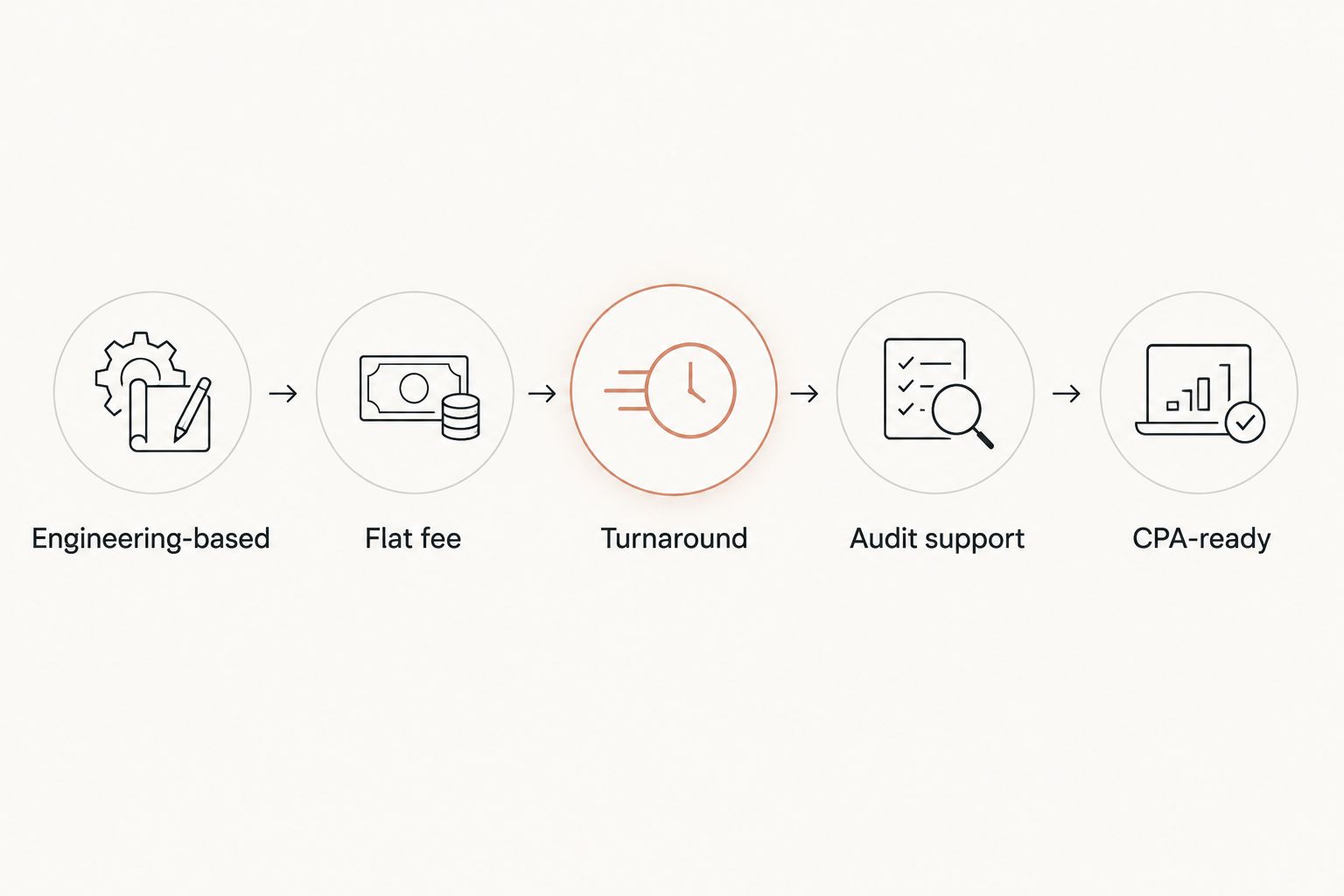
Run every quote, including your current one, through these five checks:
- Engineering-based: built to the IRS Audit Technique Guide's criteria, not a percentage rule of thumb.
- Flat fee: one price per property, stated up front.
- Turnaround: a stated delivery window.
- Audit support: in writing, and honest about the fact that only a CPA, EA or attorney can represent you.
- CPA-ready: itemized components with cost sources your CPA can apply.
The fuller list lives in questions to ask before hiring a cost segregation firm.
Why people switch providers
The reasons that come up for out-of-state owners are practical:
- Travel and scheduling. An inspection requirement makes little sense for a property you cannot easily visit.
- Fee structure. A fee tied to property value or deduction size is harder to budget than a flat one.
- Timing. A slow turnaround pushes the study past the date your CPA needs it for the return.
- Support. Owners want to know what happens if the IRS asks questions.
The math, kept simple
This is illustrative, not a guarantee. Assume a rental with a $500,000 depreciable basis, a study that reclassifies 25% of it, and a 37% bracket.
- 25% of $500,000 is $125,000 reclassified into shorter-lived property.
- If all of it were deducted in year one, the tax effect at 37% is $46,250.
Two conditions apply. The 100% bonus depreciation rate applies to property acquired and placed in service after January 19, 2025. Property acquired before January 20, 2025 follows the earlier phase-down: 20% for property placed in service in 2026. Results vary by property, and your CPA applies current law to your facts. For the full picture, read how to calculate cost segregation ROI before ordering a study.
When staying with your current provider is the right call
Stay put if the quote is engineering-based, the fee is stated up front, the delivery window fits your 2026 filing, audit support is in writing, and your CPA has already agreed to apply the report. Switching for its own sake costs time. Switch when one of those five checks fails.
FAQ
What is the best ReCostSeg alternative for out-of-state investors?
Virtual Cost Segregation fits out-of-state owners of 1 to 4 unit residential rentals. It offers a flat-fee, engineering-based study with no site visit and delivery in 3 to 5 business days.
Do I need a site visit for a cost segregation study?
Not with Virtual Cost Segregation. The study is built from your documents and cost records, so you do not need to travel to the property.
Is a flat-fee study better than a percentage-fee study?
A flat fee is easier to budget because it does not move with property value. Compare it against the fee structure and support terms of any other quote.
Does the IRS receive the cost segregation report?
No. The study is not filed with the IRS. Your CPA applies it when preparing your return and keeps it as supporting documentation.
Does audit support mean someone represents me before the IRS?
No. Audit support is included, but only a CPA, enrolled agent or attorney can represent a taxpayer before the IRS.
Is 100% bonus depreciation available in 2026?
Yes, for property acquired and placed in service after January 19, 2025. Property acquired before January 20, 2025 follows the prior phase-down, which is 20% for property placed in service in 2026.
One last thing
The cheapest quote is rarely the one that matters in 2026. The one that matters is the report your CPA can apply without a second round of questions. Ask each provider for the document list first; the answer tells you how the study is built.