
By Virtual Cost Segregation
The best cost segregation study provider for rental property investors
 Built to IRS standards
 Audit support includedFlat price for every study3 to 5 business days
Best overall: Virtual Cost Segregation for an engineering-based residential rental study. Best for unresolved tax questions: a CPA-coordinated study engagement. Best for preliminary screening: a DIY calculator, not a filing-ready study. For veterans comparing providers in 2026, rental use, supported asset classifications, and usable deductions matter more than the VA loan label.
- Comparing the best cost segregation providers for veterans with VA loan rentals starts with rental use and CPA review.
- Virtual Cost Segregation is the best fit for owners seeking an engineering-based residential rental study with separate CPA implementation.
- VA financing does not establish depreciation eligibility or make rental losses deductible against wages.
- Converted homes need acquisition-date and conversion-basis review before bonus depreciation is calculated.
Why this matters
A VA loan is financing, not a separate depreciation method. Your loan balance and down payment do not determine the property's depreciable basis, and veteran status does not establish whether rental losses offset other income.
The distinction matters when you move out of a former home, rent part of an owner-occupied property, or operate an Airbnb. Choose the study provider after establishing what is rented and how your CPA will use the deductions. A larger depreciation calculation is not automatically a larger current tax benefit.
This 2026 guide compares service approaches rather than named competing firms. It separates engineering work, tax implementation, and preliminary estimates so you buy the work your property actually needs.
What makes the best provider for a VA-financed rental?
Use these criteria before comparing proposals:
- Residential scope: Confirm experience with single-family rentals, vacation rentals, and residential properties of 1 to 4 units.
- Engineering documentation: Require component classifications, cost sources, and a reconciliation to the property's depreciable basis.
- Conversion analysis: Establish purchase history, rental conversion date, and any continuing personal use.
- CPA handoff: Identify who applies the study, reviews loss limitations, and files the return.
- Defined support: Ask what audit support includes and who answers questions about the report.
- Usable timing: Match report delivery to your CPA's review schedule, not just the filing deadline.
Do not rank providers by the largest advertised deduction. The classification must follow the asset's function, supporting records, applicable dates, and your facts.
Provider approaches at a glance
| Ranked option | Best for | Standout feature | Key limitation |
|---|---|---|---|
| Virtual Cost Segregation | Owners ready for a residential engineering study | Engineering-based report, no site visit required, audit support included | Your own CPA must apply the report and assess tax treatment |
| CPA-coordinated study engagement | Owners with unresolved conversion or loss-use questions | Tax review and engineering work coordinated before filing | Confirm whether engineering work is included or separately engaged |
| DIY calculator | Owners deciding whether to investigate a study | Preliminary scenario screening | An estimate does not establish asset classifications or replace a study |
These are different purchasing routes, not interchangeable deliverables. Ask every provider to identify exactly what you receive and what remains your CPA's responsibility.
1. Virtual Cost Segregation: best for residential study delivery
Virtual Cost Segregation provides engineering-based cost segregation studies for residential rental properties of 1 to 4 units, including short-term and long-term rentals. Studies are built to the IRS Audit Technique Guide's criteria, require no site visit, and are delivered in 3 to 5 business days.
The service fits owners who need a supplementary report their CPA can apply. It is not a CPA service, and the study itself is not filed with the IRS.
Virtual Cost Segregation pros:
- Residential rental scope matches single-family and small residential ownership.
- Engineering-based work supports component-level depreciation treatment.
- No site visit is required.
- Audit support is included.
Service limitations:
- Your CPA must determine deduction eligibility and implement the report.
- A study does not resolve VA occupancy requirements or loan compliance.
- An estimate is not a prediction of your final tax benefit; results vary.
Best for: Veterans with documented rental use who want a residential study and already have, or will engage, a CPA for implementation.
Verdict: Buy after your CPA confirms basis, timing, and deduction usability.
2. CPA-coordinated engagement: best for complicated rental transitions
A CPA-coordinated engagement starts with tax questions before commissioning engineering work. This route suits a former primary residence, partial rental use, an existing depreciation schedule, or uncertainty about whether additional losses are currently deductible.
The CPA and study preparer perform different jobs. Require the engagement documents to identify who calculates asset costs, who reviews tax treatment, and who files the return.
CPA-coordinated engagement pros:
- Resolves conversion-basis questions before modeling deductions.
- Connects the report to passive activity and other loss limitations.
- Coordinates existing depreciation records with the new classifications.
CPA-coordinated engagement cons:
- A tax engagement does not automatically include an engineering study.
- Separate responsibilities require a clear document handoff.
- A CPA's preliminary estimate is not necessarily a component-supported study.
Best for: Veterans whose former home has changed use or whose tax position needs review before ordering.
Verdict: Buy the tax review first; commission the study after the unresolved questions are settled.
3. DIY calculator: best for initial screening
A DIY calculator helps you explore whether accelerated depreciation deserves further attention. Treat its output as a planning estimate, not a depreciation schedule.
A calculator cannot establish your property's component costs from a few headline inputs. It also cannot resolve rental conversion basis, personal-use allocation, or material participation merely because you enter an income figure.
DIY calculator pros:
- Helps frame questions for your CPA.
- Separates exploratory planning from commissioning a report.
- Makes assumptions easier to discuss when you retain the inputs.
DIY calculator cons:
- Estimated percentages do not document individual assets.
- Outputs do not establish whether losses are currently deductible.
- A calculator is not a substitute for an engineering-based report.
Best for: Owners deciding whether to request a property-specific estimate.
Verdict: Hold at screening; skip calculator-only implementation.
VA financing: separate the loan from the tax analysis
Your VA loan does not create a special cost segregation asset class. Keep lender requirements separate from depreciation decisions, and ask your lender about occupancy or rental-use restrictions before changing the property's use.
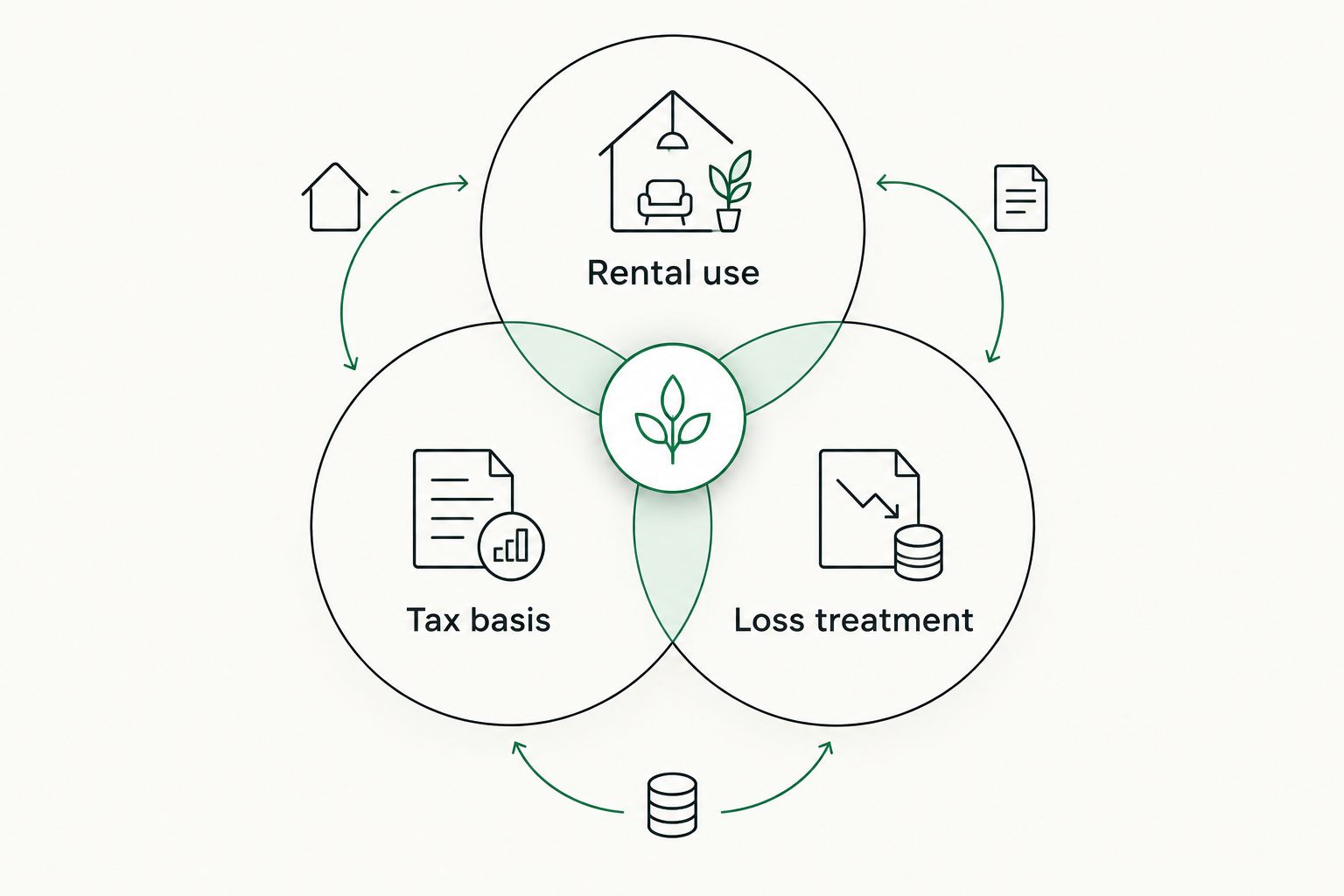
For the tax analysis, organize three distinct questions:
- Rental use: What portion of the property is used to earn rental income?
- Tax basis: What amount is depreciable after excluding land and applying conversion rules?
- Loss treatment: When can you use the resulting deductions?
A property financed with little initial equity can still have depreciable basis. Conversely, paying down principal does not create additional depreciation merely because your equity increases.
For an owner-occupied property with a rented portion, allocate costs between personal and rental use using a supportable method. Do not assume the entire property belongs in the study's depreciable rental basis.
Converted homes need a separate basis review
If you convert your former residence to a rental in 2026, give your CPA the original closing documents, improvement records, conversion date, and support for fair market value at conversion. For depreciation, converted personal property generally uses the lower of adjusted basis or fair market value at conversion, with land excluded.
Moving out does not reset the acquisition date. A home bought before January 20, 2025 and converted later does not receive the restored full bonus treatment merely because rental use begins later; the applicable rate depends on purchase history and must be confirmed with your CPA.
The underlying principle of cost segregation for residential rental properties is separating qualifying components from the building, not increasing basis because financing or occupancy changed. Your provider needs the conversion facts before estimating accelerated deductions.
Keep renovations separate from the original purchase records. Newly installed assets require their own analysis of cost, function, acquisition timing, and placed-in-service date.
Bonus depreciation and rental use in 2026
Under the OBBBA, eligible property acquired and placed in service after January 19, 2025 can qualify for 100% bonus depreciation. Both conditions matter, and binding-contract timing requires CPA review.
The building structure never qualifies for bonus depreciation. A long-term rental building generally uses a 27.5-year recovery period; a short-term rental building with average stays under 30 days uses a 39-year recovery period under the transient-use treatment addressed here.
Cost segregation identifies components with potentially shorter recovery periods, including 5-, 7-, and 15-year property. Classification and bonus eligibility depend on the asset's function, documentation, dates, and taxpayer facts, not simply its presence in an Airbnb.
For a high W-2 earner, deduction usability is a separate test. The commonly discussed short-term rental approach requires average guest stays of 7 days or less and material participation. One material participation test requires more than 100 hours and more participation than any other individual, including a property manager; 100 hours alone is insufficient.
Real estate professional status is not required for that short-term rental approach. Your CPA must assess the applicable tests and other limitations without treating veteran status as a qualification.
Illustrative math: reclassification is not tax savings
Assume a residential rental has $400,000 of depreciable property value after excluding land. For this illustrative example only, assume a study reallocates 25%, or $100,000, to shorter-lived assets.
At an assumed 37% federal marginal bracket, $100,000 of deductions would correspond to $37,000 of federal tax reduction only if the entire deduction is currently allowable and usable at that rate. This is arithmetic, not a study result or an estimate for your property.
The actual comparison must also account for depreciation you would have claimed without the study. Reclassification accelerates deductions; it does not make the same cost deductible twice.
Ask your CPA to compare your 2026 return with and without the proposed acceleration. Include suspended losses, state treatment, expected holding period, and potential depreciation recapture when the property is sold.
What to send before ordering
Prepare the records before requesting a property-specific estimate:
- Purchase closing statement and acquisition-contract history.
- Land allocation and adjusted-basis records.
- Rental conversion date and evidence the property was ready and available for rent.
- Improvement invoices, photographs, and available plans.
- Existing depreciation schedules and personal-use records.
- Guest-stay records and participation logs when relevant.
If the property has been rented for years, ask about a look-back study. Missed depreciation is claimed on the current return through Form 3115 and a Section 481(a) adjustment; prior returns are not amended for that catch-up approach. Your CPA determines the applicable procedure and files the form.
You can request a manual savings estimate before commissioning a report. Estimates use typical figures, results vary, and your CPA should review the assumptions before you act.
How these options are ranked
The ranking prioritizes residential scope, engineering documentation, CPA implementation, conversion handling, and clearly defined support. It does not rank firms by advertised savings or claim a market-wide performance comparison.
The default choice is an engineering-based residential study with independent CPA implementation. Move CPA review ahead of the study when basis, rental use, or deduction usability remains unresolved; use calculators only for screening.
FAQ
What's the best cost segregation provider for a veteran with a VA loan rental?
Virtual Cost Segregation is the best fit in this comparison for owners seeking an engineering-based residential rental study with separate CPA implementation. Have your CPA confirm rental basis, acquisition history, and deduction usability before ordering.
Does a VA loan prevent cost segregation?
VA financing does not by itself prevent cost segregation. Tax treatment depends on rental use and depreciable assets, while occupancy and loan-compliance questions belong with your lender.
Can I depreciate my entire home if I rent only part of it?
You cannot treat the personal-use portion as rental depreciation. Your CPA must establish a supportable allocation of basis and expenses between rental and personal use.
Does converting my old home to a rental reset its acquisition date?
Converting a home to a rental does not reset its acquisition date. For a home bought before January 20, 2025, ask your CPA to determine the applicable bonus treatment from its purchase history rather than the conversion date alone.
Can a veteran use rental depreciation to offset W-2 income?
Veteran status alone does not make rental losses deductible against W-2 income. Your CPA must assess passive activity treatment, material participation where applicable, and other loss limitations.
Do I need a site visit for a residential cost segregation study?
A site visit is not required for this residential study service. Provide the requested property records so the preparer can support component costs and classifications.
Does the study provider file my tax return?
The study provider supplies a supplementary report, not a tax return. Your own CPA applies the report, reviews eligibility, and files the required tax forms.
One last thing
The most valuable provider question is not how much depreciation the report identifies. It is whether your CPA can explain when you can use it. Before ordering in 2026, ask for a comparison that separates accelerated deductions from current tax savings.