
By Virtual Cost Segregation
The best cost segregation study provider for rental property investors
 Built to IRS standards
 Audit support includedFlat price for every study3 to 5 business days
 Best overall for a self-directed IRA with a debt-financed rental: a CPA-coordinated, engineering-based cost segregation provider, but only after the CPA confirms a taxable-income reason for the study. Best for a personally owned residential rental: Virtual Cost Segregation. Best preliminary screen: a DIY calculator, which cannot replace an itemized study.
- The best cost segregation providers for self-directed IRA investors start with a CPA review of IRA-level taxable income.
- Virtual Cost Segregation is best for personally owned residential rentals, not an assumed IRA-to-W-2 tax break.
- Debt financing can change an IRA rental's tax analysis; an all-cash IRA rental needs a different assessment.
- A DIY calculator can screen a property, but it does not classify and document its assets for filing.
Why this matters
A self-directed IRA can own a residential rental, but its tax position is not the same as yours. Accelerated depreciation inside the IRA does not become a deduction on your personal return simply because you direct the investment. That is the central distinction in any 2026 provider comparison for IRA investors.
Start with cost segregation for self-directed IRA real estate investors if you need to separate the account-level question from personal rental tax planning. Then ask your CPA whether the IRA has income for which additional depreciation would matter. Debt-financed rental income can create an unrelated business taxable income issue; the financing and tax calculations need review before you pay for a study.
The property still needs analysis. A provider can identify components with shorter recovery periods, but classification alone does not establish that the IRA will receive a useful current tax result. In 2026, choose the tax question first and the study provider second.
What makes the best cost segregation provider for an IRA investor?
- IRA-level tax fit: The provider should accept a CPA-defined scope rather than assume depreciation offsets the account holder's wages.
- Engineering-based classification: Ask how the study identifies individual assets, assigns costs and records cost sources. A percentage estimate is not an asset schedule.
- Residential property experience: A single-family rental or a property of 1 to 4 units calls for analysis of its actual building components, furnishings and site improvements.
- Documentation your CPA can use: The report must let the CPA review basis, acquisition and placed-in-service dates, recovery periods and any proposed bonus depreciation treatment.
- Clear division of responsibility: The study provider prepares the supporting analysis; the CPA determines its treatment on the applicable return.
- No assumed personal benefit: If the investment sits inside an IRA, reject a projection that simply applies the owner's personal income-tax bracket to the study's estimated deductions.
These criteria put a CPA-coordinated study ahead of a fast ordering process when the IRA's tax treatment is unresolved. They also explain why the ranking changes when you own the rental personally rather than through the account.
The options at a glance
| Option | Best for | Standout feature | Key limitation |
|---|---|---|---|
| CPA-coordinated engineering-based provider | An IRA rental where the CPA identifies a reason to analyze depreciation | Study scope starts with the IRA's filing question | No named provider can be ranked on IRA-specific work from the information available here |
| Virtual Cost Segregation | A personally owned residential rental of 1 to 4 units | Engineering-based, itemized study delivered without a site visit | No stated basis to assume its study will produce a personal deduction from IRA ownership |
| DIY calculator | Early screening before a provider or CPA review | Tests assumptions without commissioning a study | Does not establish asset costs or filing treatment |
1. CPA-coordinated engineering-based provider: best for an IRA rental with a defined tax question
Best for: A residential rental held in a self-directed IRA when a CPA has identified a specific IRA-level use for the depreciation analysis.
This is a selection method, not an endorsement of an unnamed firm. Have the CPA identify the return, income and basis questions first. Then seek a provider that can deliver an engineering-based asset schedule for that residential property and answer questions about its classifications and cost sources.
For a debt-financed property, the CPA needs to assess whether unrelated debt-financed income rules affect the IRA. A cost segregation study changes the timing and classification of depreciation; it does not settle whether that depreciation produces an IRA-level tax benefit or how much of an expense applies to debt-financed income. Do not ask a provider to calculate a personal W-2 offset from an asset the IRA owns.
CPA-coordinated provider pros:
- Starts with the income and filing question that could make the study useful.
- Lets the CPA specify the documents and asset detail needed for the return.
- Keeps asset classification separate from decisions about the IRA's tax treatment.
CPA-coordinated provider cons:
- CPA review comes before a meaningful savings estimate.
- Provider quality still depends on the actual report and its cost documentation.
- An all-cash IRA rental does not become a clear study candidate merely because shorter-life assets exist.
Ask for a sample description of how the provider documents furnishings, building components and land improvements. Also ask who answers the CPA's follow-up questions. A list of asset categories without assigned costs and supporting sources is a weak handoff.
Verdict: Hold until the CPA defines the IRA-level reason for ordering. Once that question is clear, buy the engineering-based study that answers it.
2. Virtual Cost Segregation: best for a personally owned residential rental
Best for: An investor who owns a residential rental outside a self-directed IRA and wants an itemized study for a CPA to apply.
Virtual Cost Segregation prepares engineering-based studies for residential rental properties of 1 to 4 units, including short-term and long-term rentals. Its process uses no site visit, itemizes components with cost sources and delivers the study in 3 to 5 business days. Audit support is included, while your CPA remains responsible for applying the report when filing.
That makes Virtual Cost Segregation a clear fit for a directly held single-family rental or a small residential rental when the owner and CPA have identified a tax-planning use. Virtual Cost Segregation is best for personally owned residential rentals, not for assuming an IRA study will offset your W-2 income. Nothing in the service description establishes a separate IRA-specific workflow, so confirm the proposed scope before treating it as an IRA choice.
Virtual Cost Segregation pros:
- Engineering-based analysis designed around the IRS Cost Segregation Audit Technique Guide's criteria.
- Components are itemized with their cost sources for CPA review.
- No site visit required for its residential rental studies.
- Audit support is included with the study.
Virtual Cost Segregation cons:
- A study cannot determine your personal or IRA-level tax result on its own.
- The service is not a CPA service and does not file a tax return.
- An IRA-owned property's tax position requires separate CPA review before any benefit estimate has meaning.
In 2026, your ownership structure matters as much as the building's asset mix. Do not move an estimate prepared for an individually owned rental into an IRA decision without revisiting who owns the property and which return reports its income.
Verdict: Buy for a personally owned qualifying residential rental when your CPA has confirmed the filing plan. Hold on an IRA-owned rental until the IRA-level scope is agreed.
3. DIY calculator: best for an initial screening question
Best for: An investor deciding which questions to take to a CPA before commissioning a study.
A calculator can model what happens when part of a property's depreciable basis moves from the building into shorter-life assets. It cannot inspect the property's records, establish item-level costs or decide whether depreciation inside a self-directed IRA changes a return. Treat the output as a scenario, not a study result.
For a personally held rental, an illustrative model can assume 25% of property value is reclassified and a 37% personal tax bracket, as long as both are labeled assumptions. Do not apply that personal-bracket calculation to an IRA-owned rental. The IRA's ownership and tax treatment require a different analysis.
DIY calculator pros:
- Helps you frame questions about basis and timing.
- Makes assumptions visible before you speak with a provider.
- Lets you compare scenarios without treating either as an actual study result.
DIY calculator cons:
- Does not assign documented costs to individual assets.
- Cannot determine IRA filing treatment or personal deductibility.
- A modeled reclassification percentage is not a finding about your property.
Verdict: Hold as a screening tool. Skip it as a substitute for an engineering-based report or CPA advice.
The ownership test comes before the provider shortlist
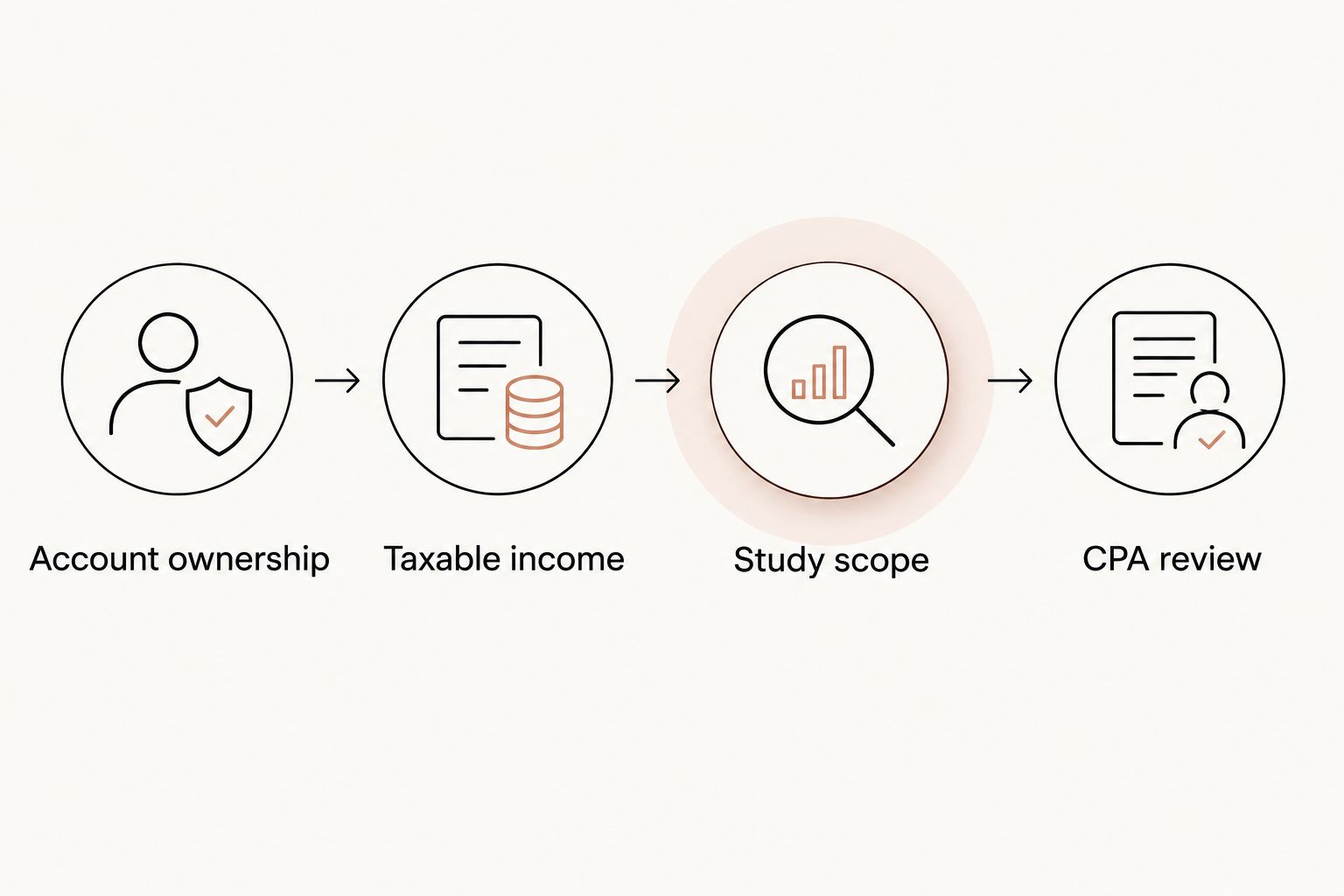
Before requesting a 2026 study, establish four facts. They decide whether you are asking about an IRA tax position or your own rental deductions:
- Account ownership: Does the self-directed IRA own the rental, or do you own it outside the account?
- Taxable income: Has the CPA identified income and a filing position for which additional IRA-level depreciation matters?
- Study scope: Which depreciable property, improvements and records will the provider analyze?
- CPA review: Who will apply the classifications, dates and elections to the appropriate return?
A short-term rental does not erase this ownership test. For a personally owned property, the short-term rental rules can matter to whether a loss offsets other income: the commonly discussed exception requires average guest stays of 7 days or less and material participation. One commonly used participation test requires more than 100 hours and more hours than any other individual, including a property manager. Those personal-return questions do not turn IRA-owned depreciation into your personal deduction.
For the study itself, the building structure and shorter-life assets must be separated correctly. A long-term rental building is generally 27.5-year residential rental property. A short-term rental building with average stays under 30 days is generally 39-year nonresidential property, even when the property is a house. Identifiable assets can have 5-, 7- or 15-year recovery periods depending on their function and facts; the building structure does not qualify for bonus depreciation.
The 2026 bonus question also needs precise dates. The restored 100% bonus rate applies to eligible property acquired and placed in service after January 19, 2025. It does not mean every component in a study qualifies, and it does not answer whether an IRA benefits from the deduction. Give both dates and the ownership records to the CPA rather than choosing a provider from a projected bonus figure.
How we ranked these options
The ranking follows the decision the investor actually faces. For an IRA-owned residential rental, IRA-level tax use comes first, report quality second and ordering convenience third. For a personally owned rental, an itemized engineering-based report moves up because the CPA can assess its treatment on the owner's return. A calculator finishes last because it cannot document a property-specific allocation.
No named outside firm is ranked here without evidence of its IRA-specific process. The first entry describes the provider requirements to verify with your CPA; it does not claim that an unidentified firm meets them. That is a more useful 2026 shortlist than implying every residential study provider solves the same IRA filing problem.
Which cost segregation option should you choose?
If the IRA owns the rental, choose the CPA review first. If that review identifies an IRA-level use for depreciation, select an engineering-based provider whose report answers the CPA's documented questions. A debt-financed rental deserves particular attention to the account's income and filing treatment.
If you own the residential rental personally, choose Virtual Cost Segregation when its 1-to-4-unit study scope fits the property and your CPA is ready to apply an itemized report. Use a calculator only to prepare questions, never to claim a deduction or approve a provider's classifications.
FAQ
What's the best cost segregation provider for a self-directed IRA investor?
The best choice is an engineering-based provider selected after your CPA identifies an IRA-level tax use for the study. IRA ownership alone does not establish that accelerated depreciation will reduce your personal taxes.
Can depreciation from an IRA-owned rental offset my W-2 income?
No. Depreciation on a rental owned by a self-directed IRA is not a personal deduction simply because you control the account. Ask your CPA to assess the IRA's own tax and filing position.
Does debt financing change the case for an IRA cost segregation study?
Yes, debt financing can raise an unrelated debt-financed income question for an IRA-owned rental. Your CPA must assess whether and how depreciation affects that account-level calculation before you order a study.
Is Virtual Cost Segregation the best choice for an IRA-owned rental?
Virtual Cost Segregation is a clear option for a personally owned residential rental of 1 to 4 units. For IRA ownership, confirm the study scope with a CPA first rather than assuming the same personal tax benefit.
Can an IRA investor use a calculator instead of a cost segregation study?
A calculator can screen assumptions but cannot replace an itemized, property-specific study. It also cannot decide whether a deduction affects the IRA's tax return.
Does a short-term rental inside an IRA qualify its owner for a W-2 offset?
No personal W-2 offset follows simply from owning the short-term rental through an IRA. The IRA owns the property, so your CPA must assess the account's tax position separately from the owner's personal-return rules.
What should I give my CPA before choosing a provider in 2026?
Give your CPA the ownership documents, financing details, acquisition and placed-in-service dates, and property records. The CPA can then define the filing question the provider's asset schedule needs to answer.
One last thing
Ask who owns the depreciation before asking how much a study might accelerate. In 2026, that single question separates a potentially useful IRA-level study from a personal tax-savings estimate that belongs to a different owner.