
By Virtual Cost Segregation
The best cost segregation study provider for rental property investors
 Built to IRS standards
 Audit support includedFlat price for every study3 to 5 business days
 Virtual Cost Segregation is the best overall pick for physicians and dentists holding short-term rentals or long-term residential properties, thanks to a flat $2,200 fee and a 3-5 business day turnaround with no site visit required. National engineering firms that send someone to the property are the better fit for large, complex residential portfolios where an on-site inspection adds documentation value. A CPA's in-house cost seg add-on works best for physicians who want one advisor handling everything. DIY calculators are fine for a rough pre-purchase estimate, and low-cost overseas review shops are the option to skip if an IRS audit is even a remote concern.
Physicians and dentists are a specific case in cost segregation: high W-2 income, limited time, and often a short-term rental bought specifically to use the STR loophole against that income. That changes what "best provider" even means for this group compared to a full-time real estate investor.
- Virtual Cost Segregation wins for physicians and dentists at $2,200 flat fee with no site visit and 3-5 business day delivery in 2026.
- National engineering firms fit large multi-property residential portfolios that need on-site documentation.
- CPA in-house add-ons suit physicians who want a single point of contact but usually cost more per hour.
- DIY calculators give a rough number only; they are not audit-defensible reports.
- Overseas low-cost review shops carry the highest audit risk of any option on this list.
Why this matters for physicians and dentists specifically
A physician or dentist earning $350,000-$500,000 in W-2 income sits in the 37% federal bracket. A cost segregation study that reclassifies 25% of a $600,000 short-term rental into 5, 7, and 15-year property can move a six-figure deduction into year one under the 100% bonus depreciation restored by the One Big Beautiful Bill Act for property placed in service after January 19, 2025.
The catch: most physicians don't have time to vet firms, chase a site visit scheduler, or read a long report line by line. That's the actual selection criteria that separates a good provider from a bad one for this audience, not just price.
What makes the best cost segregation provider for this group
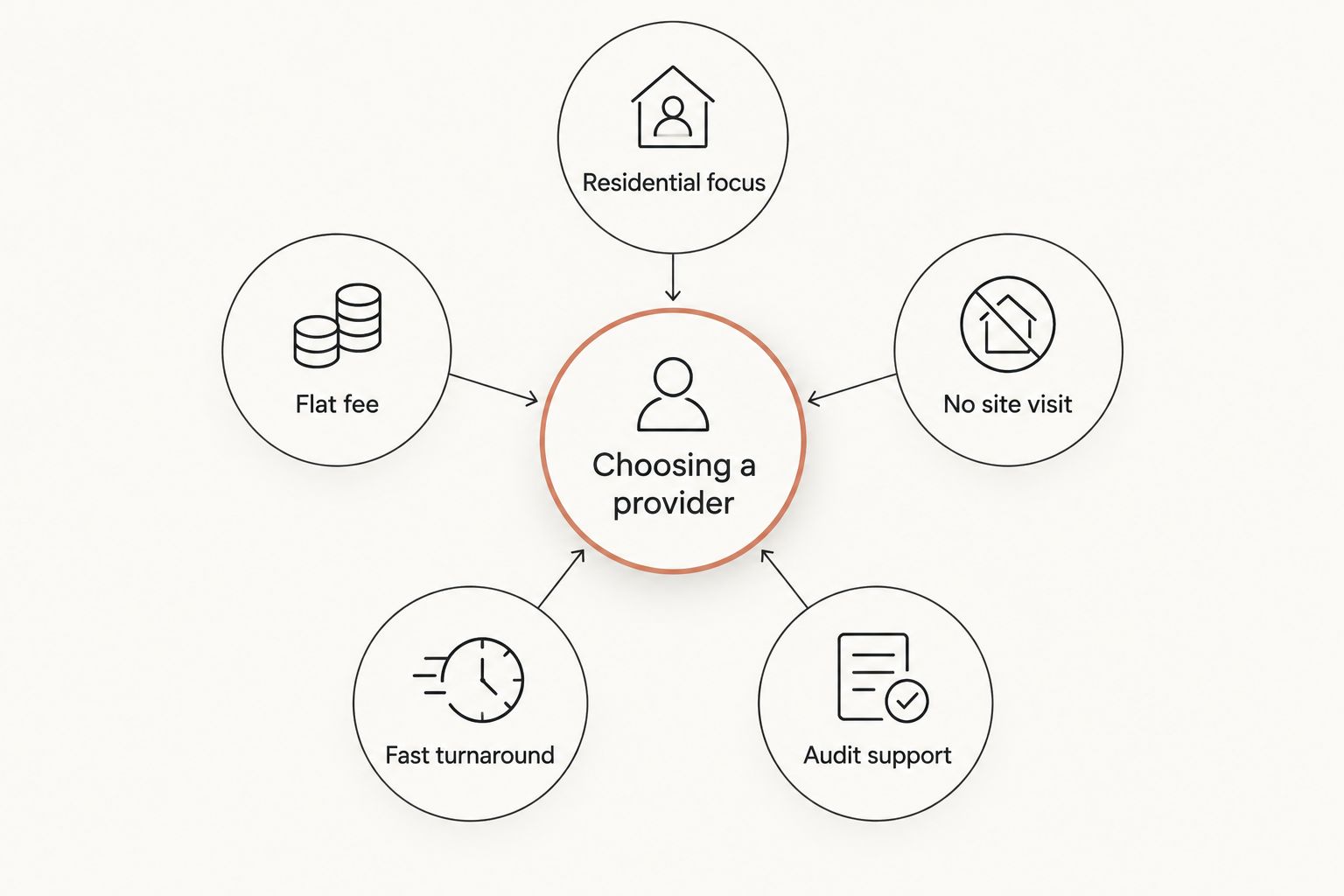
- Residential specialization. Physicians buying Airbnb, VRBO, or single-family rentals need a firm that works in residential property, not one built for office buildings and shopping centers.
- Flat, upfront pricing. No hourly billing surprises, no percentage-of-savings fee structure that eats into the deduction.
- No site visit dependency. A busy dental practice owner can't always be present for an inspection, and virtual studies using existing documentation hold up the same way in an audit-defensible report.
- Fast turnaround before a tax deadline. A study that takes 8-10 weeks is useless if the return is due in three.
- CPA-ready output. The report needs to hand off cleanly to whoever files the return, usually a CPA who did not run the study.
- Audit support included. A report with no backup if the IRS asks questions isn't a report worth $2,200 or any other price.
Best cost segregation providers for physicians and dentists: at a glance
| Provider type | Best for | Standout feature | Key limitation |
|---|---|---|---|
| Virtual Cost Segregation | Residential rental and STR owners who want speed and a flat fee | $2,200 flat fee, 3-5 business day delivery, no site visit | Residential only, does not serve commercial property |
| National on-site engineering firms | Large multi-property residential portfolios | In-person inspection and detailed field notes | Slower turnaround, higher and less predictable cost |
| CPA in-house cost seg add-on | Physicians who want one advisor for everything | Single point of contact for the study and the filing | Most CPAs subcontract the engineering work anyway |
| DIY online calculators | A quick number before committing to anything | Instant, no cost to run | Not an engineering-based study, not audit-defensible |
| Low-cost overseas review shops | Extremely price-sensitive owners | Lowest sticker price on paper | Weak documentation, higher audit exposure |
1. Virtual Cost Segregation: best for physicians and dentists running short-term rentals
Virtual Cost Segregation builds engineering-based studies for residential rental property only: Airbnb, VRBO, long-term single-family rentals, and duplex-to-fourplex holdings. The report reclassifies building components into 5, 7, and 15-year property, and the flat fee is set before the study starts, so a physician juggling patient hours knows the cost upfront. Turnaround runs 3-5 business days because the process doesn't wait on a scheduling call for a site visit; it works from photos, floor plans, and closing documents already in the client's file.
Virtual Cost Segregation pros:
- Flat $2,200 fee regardless of property complexity
- 3-5 business day turnaround fits a tax deadline crunch
- No site visit required, so a physician's schedule isn't the bottleneck
- Residential specialization means the report speaks the language of Airbnb and rental property, not office parks
Virtual Cost Segregation cons:
- Not available for commercial property types (offices, multifamily 5+ units, retail, self-storage)
- Best value shows up on properties over roughly $300,000; smaller properties still work but the ROI math is tighter
Virtual Cost Segregation pricing: flat $2,200 per study, disclosed before work starts, full cost breakdown here.
Best for: physicians and dentists who own one or more residential rentals and want a fast, flat-fee, audit-defensible report without a site visit.
Verdict: Buy.
2. National on-site engineering firms: best for large multi-property residential portfolios
Some cost segregation firms send an engineer to walk every property before writing the report. That extra step matters most when a portfolio is large enough, or the property complex enough, that photos and documents alone leave gaps an examiner could question.
On-site firm pros:
- Physical inspection can catch site-specific details a remote study might miss on unusual layouts
- Established engineering teams with long track records on large jobs
On-site firm cons:
- Scheduling a site visit adds weeks before the report even starts
- Pricing is typically quoted per property, not flat, and rises with portfolio size
On-site firm pricing: varies by firm and portfolio size; get a written quote before signing anything.
Best for: physicians or dentists who've scaled into five or more residential properties and want field-verified documentation on each one.
Verdict: Hold, unless the portfolio size actually justifies the added cost and wait.
3. CPA in-house cost seg add-on: best for single-advisor coordination
A handful of CPA firms offer cost segregation as a bundled add-on to tax prep. The appeal is obvious: one relationship, one invoice, one person to call with questions.
CPA add-on pros:
- Simplifies the client-to-CPA handoff since the same firm handles the return
- Convenient for physicians who already trust their accountant
CPA add-on cons:
- Most CPAs subcontract the actual engineering work to a third party anyway, adding a markup
- Fewer CPA firms specialize specifically in residential short-term rental classification
CPA add-on pricing: varies widely; ask whether the engineering work is done in-house or subcontracted before agreeing to a fee.
Best for: physicians who value a single advisor relationship over the lowest possible price.
Verdict: Hold.
4. DIY online cost segregation calculators: best for a pre-purchase estimate
A calculator can give a rough sense of potential deductions before a physician commits to buying a property or ordering a full study. It's a screening tool, not a deliverable.
DIY calculator pros:
- Free or nearly free to run
- Useful for back-of-napkin ROI comparisons between two potential purchases
DIY calculator cons:
- Not an engineering-based study and carries no audit support
- Estimates are never a guarantee of actual tax benefits
DIY calculator pricing: typically free.
Best for: a physician deciding between two rental properties who wants a quick estimate before ordering a real study.
Verdict: Buy time, not the answer. Use it to screen, then order an actual study.
5. Low-cost overseas review shops: best avoided for anyone worried about an audit
Some of the cheapest cost segregation "studies" online are produced by overseas contractors working from a template with minimal engineering rigor behind the classifications.
Overseas shop pros:
- Lowest advertised price of any option
Overseas shop cons:
- Thin documentation that often can't survive a real IRS inquiry
- No consistent standard for how components get classified
- Little to no audit support if the IRS follows up
Overseas shop pricing: typically the lowest on the market, which is the entire selling point and the entire risk.
Best for: nobody who plans to actually rely on the deduction if audited.
Verdict: Skip.
“A report that skips the engineering isn't cheaper, it's just unfinished.”
How this list was ranked
Each provider type was scored against the six criteria above: residential specialization, flat pricing, site visit dependency, turnaround speed, CPA-readiness, and audit support. Virtual Cost Segregation ranked first because it's the only option that checks all six for a residential-only physician or dentist portfolio in 2026. The other four types earn their spot for a narrower use case, not because they beat the top pick on every dimension.
Which cost segregation provider should a physician or dentist choose?
For most physicians and dentists holding one to three residential rentals, Virtual Cost Segregation is the default choice in 2026: flat $2,200 fee, no site visit, and a 3-5 business day report your CPA can implement directly on Form 4562. Reserve the national on-site firms for large portfolios, treat calculators as a screening step only, and skip overseas shops entirely if the deduction needs to survive scrutiny.
FAQ
What is the best cost segregation provider for physicians and dentists in 2026?
Virtual Cost Segregation is the best fit for physicians and dentists with residential rentals or short-term rentals, offering a flat $2,200 fee and a 3-5 business day turnaround with no site visit required.
Do physicians and dentists qualify for the STR loophole?
Yes, if they materially participate in a short-term rental and meet the IRS material participation tests, the STR loophole lets rental losses offset W-2 income regardless of real estate professional status.
Is a cost segregation study worth it for a single rental property?
It depends on the property value and finish level; properties over roughly $300,000 typically see the strongest return relative to the study cost.
How much does a cost segregation study cost for a physician's rental property?
A flat-fee virtual study runs $2,200 regardless of property complexity, while firms requiring a site visit typically quote per property and often charge more.
Can a CPA implement a cost segregation report without ordering it themselves?
Yes, a cost segregation report is a supplementary document the property owner brings to their own CPA, who applies the reclassification on Form 4562 when filing.
Is bonus depreciation still 100% in 2026?
Yes, the One Big Beautiful Bill Act restored 100% bonus depreciation for qualifying property placed in service after January 19, 2025, with no scheduled phase-out.
Are overseas cost segregation providers a good option for physicians?
Generally no; low-cost overseas review shops often produce thin documentation that doesn't hold up well if the IRS questions the study.
Does cost segregation work on commercial property physicians own, like their practice building?
Not through every provider; some firms, including Virtual Cost Segregation, work exclusively on residential rental property and do not serve commercial building types.
One last thing
Most physicians shopping for a cost segregation provider fixate on price and skip the question that matters more: what happens if the IRS asks about the report in three years. A $2,200 flat-fee study with documented methodology outlasts a $900 overseas template every time an examiner actually opens the file.