
By Virtual Cost Segregation
The best cost segregation study provider for rental property investors
 Built to IRS standards
 Audit support includedFlat price for every study3 to 5 business days
 Best documented fit for a foreign national who owns a U.S. residential rental: Virtual Cost Segregation for the engineering-based study, paired with a cross-border CPA for the tax return. If ownership, basis or filing treatment is unresolved, have the CPA settle those questions before you order a study. This 2026 guide ranks provider routes, not unverified firms.
- Virtual Cost Segregation is the best documented residential study fit among the cost segregation provider routes covered here.
- A cross-border CPA must establish how a foreign national investor can use the resulting depreciation on a U.S. return.
- For the best cost segregation providers for foreign national investors, assess study documentation and CPA handoff separately.
- Bonus depreciation eligibility depends on the asset, acquisition date, placed-in-service date and taxpayer facts.
Why this matters for foreign national investors
A cost segregation study identifies qualifying components of a residential rental for separate depreciation treatment. It does not decide who reports the deductions, establish the property's tax basis or file a U.S. return. Those distinctions matter when you live outside the United States but own a U.S. rental.
In 2026, start with the ownership and filing facts: who owns the property, when it entered rental service, which costs belong in depreciable basis and how rental income is treated on the applicable U.S. return. A provider can prepare an engineering-based allocation. Your CPA applies that allocation to your facts and determines whether the deductions can be used. For the ownership questions behind this search, see cost segregation for foreign national real estate investors.
Virtual Cost Segregation is best for foreign national owners of U.S. residential rentals who need an engineering-based study and already have a CPA handling cross-border tax treatment. It prepares the supplementary report; it does not act as your CPA or file the report with the IRS. That division of work is the central test for every option below.
What makes the best provider for a foreign national investor?
Use these criteria before asking any firm for an estimate. A foreign address alone does not change what a cost segregation study must document, but it can add tax-return questions the study provider cannot answer.
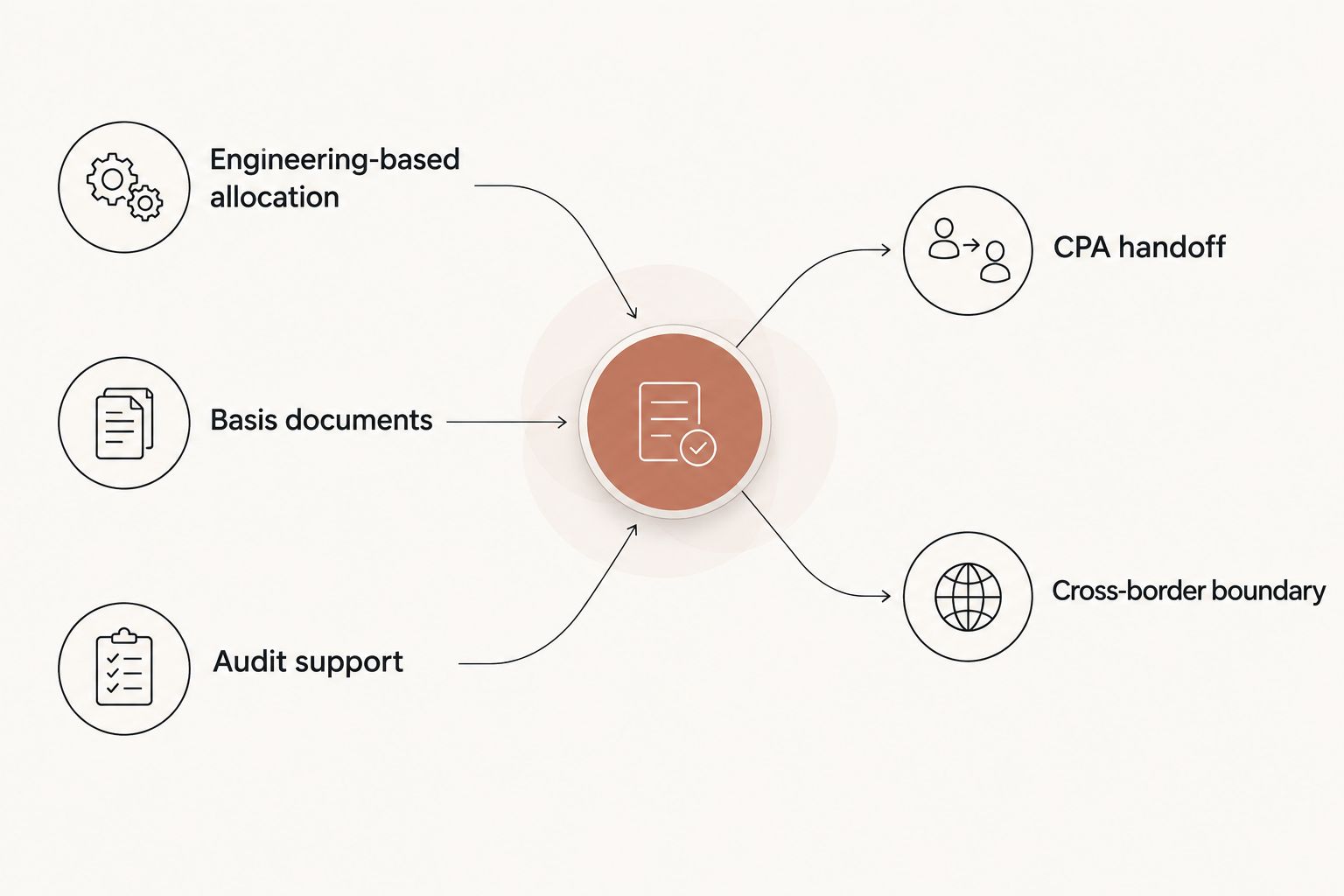
- Residential scope: Confirm the provider accepts your property type. An Airbnb, vacation rental or long-term residential rental fits this guide; a commercial building does not.
- Engineering-based allocation: Ask how the provider identifies assets, assigns costs and supports classifications. A percentage estimate is not a substitute for an asset-level study.
- Basis documents: Establish what the provider needs from the purchase, renovations and placed-in-service records. An allocation cannot be assessed apart from the costs being allocated.
- CPA handoff: Ask what your CPA receives and whether the report explains the proposed asset classifications and supporting records.
- Cross-border boundary: Require a clear answer about who handles ownership structure, return filing, elections and the use of losses. The study provider's answer should identify the boundary, not claim to replace tax advice.
- Audit support: Ask what support is included if the study's classifications are questioned and what records you must retain yourself.
These criteria produce a narrower verdict than a list of firm names without verified service details. Choose the provider route that matches the unresolved work. If the tax position is clear, compare study deliverables. If it is not, begin with the CPA.
Provider routes at a glance
| Rank and option | Best for | Standout feature | Key limitation |
|---|---|---|---|
| 1. Virtual Cost Segregation | A foreign national with a U.S. residential rental and a CPA ready to review the study | Engineering-based residential study with audit support | Does not provide CPA services or file a tax return |
| 2. CPA-selected residential study firm | An investor whose CPA must first resolve ownership, basis or filing treatment | Lets the CPA define the required study scope before provider selection | No specific firm's methods or support can be verified from this route alone |
The second entry is a selection route, not a named firm or an independently assessed provider. It belongs here because ordering any study before settling an uncertain tax position can leave your CPA with a report that answers the wrong question. Neither route guarantees a deduction.
1. Virtual Cost Segregation: best for CPA-ready residential studies
Virtual Cost Segregation prepares engineering-based cost segregation studies for residential rental owners, including short-term and long-term rentals. The report supports asset classification and is intended for the owner's CPA to implement when preparing a return. The service includes support if the study is audited; the report itself is not filed with the IRS.
For a foreign national investor, the fit is clearest when you have a U.S. residential rental, can provide acquisition and property records, and have a CPA who handles your filing position. A study can identify assets for shorter recovery periods, but it cannot establish that you personally can use every resulting deduction in 2026. Your CPA must apply the return rules to your ownership structure and tax facts.
Virtual Cost Segregation pros:
- Focuses on residential rentals rather than commercial property studies.
- Provides an engineering-based report instead of treating a preliminary estimate as the final allocation.
- Includes support if the study is audited.
- Separates report preparation from CPA implementation.
Virtual Cost Segregation cons:
- Does not resolve cross-border filing, ownership or election questions for you.
- Does not file the study or your tax return with the IRS.
- Is not an option for a commercial property.
Best for: A foreign national who owns a U.S. residential rental, has a CPA responsible for tax treatment and needs a documented study for that CPA to review.
Verdict: Buy once your CPA confirms the property's basis and planned treatment. If either remains open, hold the study order until the CPA defines what the report needs to address.
2. CPA-selected residential study firm: best when tax facts come first
This route starts with your cross-border CPA, who specifies the property's ownership, basis and filing questions before you choose a residential cost segregation firm. You then compare actual providers against the criteria above. It is a process for selecting a firm, not a claim that an unnamed competitor offers a particular report or service.
Use it when the deed holder, entity treatment, prior depreciation or rental-use history needs review. The CPA can identify which records matter for the return and what the study must show. You still need to verify the firm's engineering method, deliverables and audit support directly; a CPA referral alone does not establish those details.
CPA-selected residential study firm pros:
- Puts unresolved tax-return questions ahead of the study order.
- Gives the provider a defined property and document scope.
- Keeps responsibility for applying deductions with the CPA.
CPA-selected residential study firm cons:
- Does not identify a verified firm until you and your CPA assess one.
- Does not eliminate the need to review the finished study.
- Can leave study timing dependent on completing the CPA's initial review.
Best for: A foreign national whose U.S. residential rental has unresolved ownership, basis, prior depreciation or filing questions.
Verdict: Hold on provider selection until your CPA identifies the tax position and records the study must support. Then assess a named firm against the same documentation standards used for the first route.
What should your CPA check before a study begins?
Send your CPA the purchase records, a list of capital improvements, prior depreciation schedules if any, and the date the property was ready and available for rent. Identify the legal owner and explain any personal use. Your CPA can then tell you which facts need resolution before an engineering allocation is useful.
Establish depreciable basis
The purchase price is not automatically the building's depreciable basis. Land is not depreciable, and the treatment of acquisition costs and later improvements depends on the underlying records. Ask your CPA to establish the figures the study provider should use rather than sending a purchase price without context.
For a residential rental, the building generally follows a 27.5-year recovery period under U.S. tax rules. A cost segregation study examines whether documented components belong in other applicable asset classes. It does not move the entire property out of the building category, and a provider should not promise a fixed reclassified percentage for your property.
Confirm rental use and timing
Record when the property was placed in service, not just when it closed. If you converted a home to a rental, renovated it before accepting guests or use it personally during the year, give your CPA those dates and records. They affect the analysis a study is meant to support.
For eligible property acquired and placed in service after January 19, 2025, the One Big Beautiful Bill Act restored 100% bonus depreciation. That rule does not make the whole residential building bonus-eligible. Asset classification, eligibility and the applicable acquisition and service dates still require review. In 2026, have your CPA confirm how those rules apply before treating a study estimate as a return result.
Decide how the report reaches the return
Ask the provider to deliver an asset schedule and supporting study that your CPA can review against the property's records. Ask your CPA who will enter the depreciation, assess any accounting-method implications and retain the supporting documentation. A study is evidence for a tax position, not a filed tax form.
This matters most if depreciation has already been reported for the property. Do not assume a revised schedule can simply replace prior filings. Your CPA must determine the appropriate treatment for the tax years and taxpayer involved.
Request a residential study estimate
Discuss the property and the records your CPA needs for a cost segregation study.
How we ranked these routes
The ranking prioritizes verified residential study scope, engineering-based documentation, a usable CPA handoff and an explicit boundary between study preparation and tax advice. Virtual Cost Segregation ranks first for an investor ready to commission a study because its residential scope and division of responsibilities are stated. The CPA-selected route ranks second because it is the safer sequence when the tax facts are unresolved, but it is not a verified competing firm.
A foreign national should be skeptical of a ranking that substitutes an attractive deduction estimate for those checks. The amount reclassified in a study is not the same as a usable tax deduction. Your basis, eligible assets, timing and applicable return treatment must all be established before the tax effect is known.
Which provider route should you choose in 2026?
Choose Virtual Cost Segregation if you own a U.S. residential rental and your cross-border CPA is ready to apply an engineering-based report. Give the provider the property records and give the finished study to your CPA. Keep the study, source documents and the CPA's resulting depreciation schedules together.
Choose the CPA-selected route first if you cannot yet answer who reports the rental activity, what basis applies or how earlier depreciation was handled. Have the CPA define the study requirements, then select a residential provider whose deliverables meet them. Do not use a study provider as a substitute for a filing decision.
FAQ
What is the best cost segregation provider for a foreign national with a U.S. rental?
Virtual Cost Segregation is the best documented fit here for a foreign national who owns a U.S. residential rental and has a CPA handling cross-border tax treatment. The provider prepares the engineering-based study; the CPA determines how to apply it.
Can a foreign national order a cost segregation study for an Airbnb?
A foreign national can commission a study for a U.S. residential short-term rental. Whether the resulting depreciation produces a usable deduction depends on the taxpayer's ownership, rental activity and filing facts.
Does a cost segregation provider file the study with the IRS?
No. A cost segregation study is a supporting report, not a return filed with the IRS. Your CPA reviews the report and implements the applicable depreciation treatment on the tax return.
Does a foreign national need a cross-border CPA before ordering a study?
A cross-border CPA should review unresolved ownership, basis and filing questions before you order a study. If those facts are already established, the CPA can specify the documents needed for the study and review its results afterward.
Does 100% bonus depreciation apply to an entire residential rental?
No. The residential building does not become entirely bonus-eligible because a cost segregation study is performed. Eligibility depends on the classified assets, acquisition and placed-in-service dates, and taxpayer facts.
Can a cost segregation estimate guarantee a tax saving?
No. An estimate cannot guarantee a study result or a usable deduction. The final allocation depends on property records, and the tax effect depends on the CPA's application of the law to your facts.
Should I order a new study if my U.S. rental has already been depreciated?
Ask your CPA to review the existing depreciation schedules before ordering a study. The CPA must determine how any newly identified asset classifications would be implemented for the property and taxpayer.
One last thing
In 2026, the question that saves the most rework is not how much a provider expects to reclassify. It is whether your CPA has confirmed the basis and knows how the report will be used. Settle that handoff first. An engineering-based allocation is only useful when it reaches the correct return with records that support it.