By Virtual Cost Segregation
The best cost segregation study provider for rental property investors
 Built to IRS standards
 Audit support includedFlat price for every study3 to 5 business days
Best default: Virtual Cost Segregation for a remote residential study. Best for properties needing physical inspection: an inspection-led engineering provider. Best for a complicated filing handoff: a CPA-coordinated engineering engagement. For a co-hosted Airbnb in 2026, choose the study provider separately from the professional who determines whether you can use the resulting deductions.
- Virtual Cost Segregation is the default residential study pick for co-hosted Airbnb owners whose CPA handles tax implementation.
- Compare the best cost segregation providers for co-hosted Airbnb properties on documentation, engineering methodology, and CPA handoff.
- A co-host's work hours matter to material participation; a depreciation report does not establish your eligibility.
- Choose physical inspection when your property's components cannot be documented adequately through records and photographs.
Why this matters
A co-host can handle guest messages, maintenance coordination, and turnovers while you retain responsibility for the investment. That division of work matters for taxes. A cost segregation study classifies property costs; it does not establish that your rental loss can offset W-2 income.
For 2026 planning, separate the size of the depreciation deduction from your ability to use that deduction. An engineering report addresses the first question. Your CPA evaluates the second using your rental activity, participation, basis, and other applicable limitations.
The best provider choice starts with that separation. A larger projected deduction is not a better outcome if the projection ignores your co-hosting arrangement.
What makes the best provider for a co-hosted Airbnb?
Use these criteria before comparing proposals:
- Engineering methodology: Require asset-level classifications, recovery periods, and documented cost sources rather than an unexplained allocation.
- Residential scope: Confirm the engagement fits your house, condo, cabin, or other residential rental and its ownership structure.
- Property evidence: Ask how the provider identifies components using closing documents, renovation records, photographs, and other supporting material.
- CPA handoff: Require a report your CPA can reconcile to the existing depreciation schedule and apply to the return.
- Clear responsibilities: Separate study preparation, participation analysis, return preparation, and audit support in the engagement terms.
- Practical timing: Match delivery to your CPA's review deadline, not merely the filing deadline.
Co-hosting does not change the need for property-specific evidence. It adds another set of records: who performed the operational work, when, and for how long.
Provider options at a glance
This comparison ranks engagement types, not named competing firms. The alternatives are selection routes with requirements you should verify before signing.
| Rank and option | Best for | Standout feature or requirement | Key limitation |
|---|---|---|---|
| 1. Virtual Cost Segregation | Remote studies for residential rental owners | Engineering-based report, no site visit required, delivery in 3 to 5 business days | Your CPA must assess eligibility and implement the report |
| 2. Inspection-led engineering provider | Properties requiring physical verification | Require an inspection scope tied to unresolved component questions | A visit does not replace cost documentation or participation records |
| 3. CPA-coordinated engineering engagement | Existing depreciation schedules or complicated implementation | Require coordination between engineering analysis and tax implementation | Confirm which professional owns each task; coordination alone is not engineering evidence |
1. Virtual Cost Segregation: best for remote residential studies
Virtual Cost Segregation provides engineering-based cost segregation studies for residential rentals of 1 to 4 units, including Airbnb and VRBO properties. Studies follow the IRS Audit Technique Guide's criteria, require no site visit, and are delivered in 3 to 5 business days.
That scope fits an owner who wants a property study while retaining an existing CPA. Audit support is included, but the engagement is not a CPA service. The report is supplementary documentation that your CPA applies when preparing the tax return; the study itself is not filed with the IRS.
Virtual Cost Segregation pros:
- Residential rental scope includes both short-term and long-term rentals.
- Engineering-based analysis follows the Audit Technique Guide's criteria.
- No site visit is required.
- Audit support is included at no additional cost.
Limitations:
- The study does not establish material participation or whether losses can offset wages.
- Your CPA remains responsible for return implementation and taxpayer-specific analysis.
- A remote engagement still requires supporting property information; it does not eliminate recordkeeping.
Best for: Residential owners who want a remote cost segregation study and already have a CPA responsible for tax planning and filing.
Verdict: Buy after your CPA confirms the study fits your tax plan.
2. Inspection-led providers: best for unresolved property conditions
Choose an inspection-led engineering provider when records and photographs leave material questions about what is installed. For example, renovation invoices might combine several types of work without separating component costs or identifying locations.
Do not assume an inspection automatically produces a better report. Ask what the visit will resolve, how observations become cost allocations, and which source documents remain necessary. The selection criterion is evidence quality, not the presence of a site visit by itself.
Inspection-led provider pros to require:
- A written inspection scope addressing your property's documentation gaps.
- Component identification connected to photographs and location notes.
- Cost allocations supported by identified sources.
Inspection-led provider limitations:
- Physical observation does not establish acquisition dates, tax basis, or ownership history.
- An inspection cannot prove how much work you performed relative to your co-host.
- Access arrangements add a task for you or your co-host to coordinate.
Best for: Owners whose property cannot be documented adequately through the available records and photographs.
Verdict: Hold until the provider explains exactly what physical inspection adds.
3. CPA-coordinated engagements: best for complex implementation
A CPA-coordinated engineering engagement connects the property analysis with the professional responsible for your tax return. Choose this route when the existing depreciation schedule, ownership history, or accounting-method treatment needs attention before the report can be applied.
Require genuine engineering work rather than a tax estimate presented as a study. Coordination should clarify responsibilities: who classifies assets, who reconciles prior depreciation, and who determines the filing treatment.
CPA-coordinated engagement pros to require:
- Agreement on the property's depreciable basis before classifications are finalized.
- Reconciliation between study results and existing asset schedules.
- A defined handoff for applicable forms, elections, and adjustments.
CPA-coordinated engagement limitations:
- A CPA estimate alone is not a substitute for property-specific engineering support.
- Multiple professionals still need clear task ownership and deadlines.
- Coordination does not resolve missing co-host participation records.
Best for: Owners with an existing depreciation schedule or filing questions that need resolution alongside the engineering study.
Verdict: Buy the coordinated scope when your CPA identifies a specific implementation need.
The co-host test comes before the deduction forecast
For the short-term-rental exception commonly called the STR loophole, average guest stays must be 7 days or less, and the owner must materially participate to pursue nonpassive treatment under this approach. Real estate professional status is not required for this route.
One commonly used material participation test requires more than 100 hours and more participation than any other individual, including a co-host or property manager. Reaching 100 hours alone is not enough. Other material participation tests exist, so your CPA must apply the appropriate test to your facts.
For your 2026 records, distinguish three issues:
- Guest stays: Retain booking records supporting the average stay calculation.
- Owner hours: Record dates, tasks, and time spent performing operational work.
- Co-host hours: Keep records of the co-host's work so your CPA can evaluate the comparison where relevant.
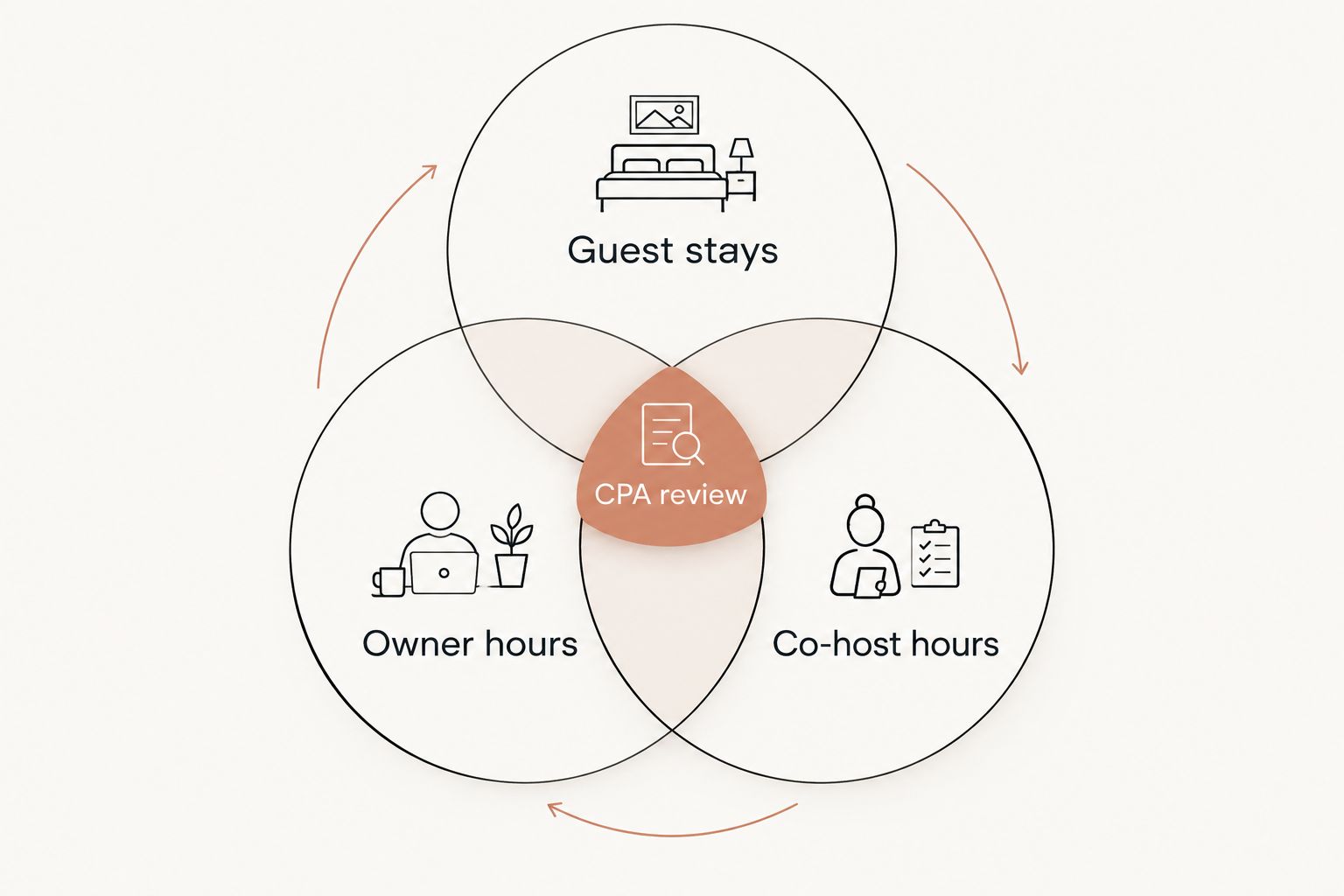
Do not select a provider because it predicts a wage offset without reviewing these distinctions. A cost segregation report cannot turn a heavily delegated rental into a materially participated activity. Your CPA determines the treatment from the evidence.
Check depreciation timing before accepting an estimate
For 2026 planning, eligible property acquired and placed in service after January 19, 2025 can qualify for 100% bonus depreciation under the One Big Beautiful Bill Act. Both dates matter. The restored rate has no scheduled phase-down or end date.
The building structure does not qualify for bonus depreciation. Cost segregation identifies eligible shorter-lived components, including assets assigned 5-, 7-, or 15-year recovery periods when supported by their function, documentation, and applicable tax rules.
Under the short-stay building treatment used here, an Airbnb with average stays under 30 days has a 39-year building recovery period. A long-term residential rental building generally uses 27.5 years. Your CPA should confirm the applicable classification rather than carry over a prior schedule without review.
A home purchased before January 20, 2025 does not gain a new acquisition date when converted to a rental. Do not apply the restored full bonus treatment to that conversion; ask your CPA to determine the rate from the purchase history and applicable rules.
Compare usable deductions, not headline estimates
Ask each provider to identify the assumptions behind its estimate. Land must remain outside depreciable basis, and existing furniture or renovation assets need reconciliation so the same costs are not counted twice.
Illustrative example: Assume a residential property has a $400,000 depreciable basis after excluding land. Reallocating an illustrative 25% produces $100,000 of shorter-lived assets. If the full $100,000 were deductible and usable against income taxed at an assumed 37% marginal federal rate, the arithmetic would be $37,000 of federal tax effect.
That is conditional math, not a forecast. Actual classifications, deduction timing, loss limitations, state treatment, and later disposition consequences change the result. Results vary.
A DIY calculator is useful for initial screening, but it is not a property-specific engineering report. Best for: deciding whether to request a manual estimate. Its limitation is that an estimated allocation does not establish the classification or current deductibility of your actual components.
How this ranking works
The ranking prioritizes residential fit, engineering documentation, property evidence, CPA implementation, and clearly separated responsibilities. It does not rank providers by projected tax savings or treat turnaround as proof of study quality.
The default recommendation fits a remote residential engagement. The inspection-led route addresses evidence gaps; the CPA-coordinated route addresses implementation complexity. Choose the route that solves your actual bottleneck.
Which provider should you choose?
Choose Virtual Cost Segregation for a residential cost segregation study when remote documentation fits your property and your CPA handles implementation. Request an inspection-led proposal if physical verification is necessary. Put CPA coordination first when the existing tax schedule needs reconciliation.
Before ordering in 2026, send your CPA the closing statement, depreciation schedule, renovation records, booking history, and co-host agreement. Ask whether accelerating deductions supports your current tax position and expected holding period.
Then request a manual savings estimate. The estimate is an initial planning figure, not an assurance of the study result or your tax outcome.
FAQ
What's the best cost segregation provider for a co-hosted Airbnb?
Virtual Cost Segregation is the default pick here for residential owners seeking a remote engineering-based study with CPA implementation. Choose an inspection-led engagement instead when property conditions cannot be documented adequately from records and photographs.
Can I use cost segregation if I have an Airbnb co-host?
Yes, a co-hosting arrangement does not prevent a property from receiving a cost segregation study. Whether the resulting losses can offset other income depends on your participation, rental activity, and applicable tax limitations.
Does working more than 100 hours qualify me for the STR loophole?
More than 100 hours alone is insufficient under the commonly used comparative participation test. That test also requires more participation than any other individual, including a co-host or property manager; your CPA should evaluate the applicable tests.
Does a cost segregation study require an on-site inspection?
An on-site inspection is not required for every cost segregation engagement. The important question is whether the provider has sufficient property-specific evidence to support component identification, classifications, and cost allocations.
Can a study completed in 2026 recover missed depreciation?
A look-back study can support claiming missed depreciation on the current return through Form 3115 and a Section 481(a) adjustment, rather than amending prior returns. Your CPA determines whether the accounting-method change procedure applies and files the necessary documents.
Does the study provider file my tax return?
A cost segregation study is separate from tax return preparation. Your CPA applies the report, evaluates the relevant limitations, and handles filing; confirm responsibilities in writing before engaging a provider.
Does co-hosting change an Airbnb building's recovery period?
Co-hosting alone does not determine the building's recovery period. The property's use and applicable tax classification control; under the short-stay treatment discussed here, the building uses a 39-year recovery period and does not qualify for bonus depreciation.
One last thing
Keep your co-host's operational records as carefully as your renovation invoices. The invoices help support what gets depreciated. The participation evidence helps your CPA determine how the resulting loss is treated. A strong study solves only one of those problems.