By Virtual Cost Segregation
The best cost segregation study provider for rental property investors
 Built to IRS standards
 Audit support includedFlat price for every study3 to 5 business days
 Best overall for a separately owned residential rental: Virtual Cost Segregation. Best for applying a completed study to a tax return: your CPA. Best for preparing property evidence: your own records. None is a recommendation for a restaurant-property study: Virtual Cost Segregation serves residential rentals, not restaurant buildings.
- Virtual Cost Segregation is best for engineering-based cost segregation studies on residential rentals, not restaurant properties.
- Your CPA applies a completed residential study to the tax return; owner records help support the asset classifications.
- In 2026, bonus depreciation eligibility depends on each asset and its acquisition and placed-in-service dates.
- A larger depreciation deduction does not automatically offset W-2 income; passive-activity rules still apply.
Why the property type changes the answer
If you searched for the best cost segregation firms for restaurant properties, this is not a ranked list for that building. The options below address a different question: what to do if you own a residential rental in addition to a restaurant or another business. Start with the property's use, not the owner's occupation. A restaurant building and a separately owned single-family rental home require different provider searches.
For a residential rental, cost segregation identifies assets that warrant separate depreciation treatment instead of leaving every eligible cost in the residential building category. The report supplies classifications and supporting detail; your CPA determines how to use them on your return. A cost segregation report is not a tax return and is not filed with the IRS.
That distinction matters in 2026 because a study, tax-return implementation, and record gathering solve different problems. Comparing them as if they were three interchangeable firms would leave you without either a defensible study or a filing plan.
What makes the best residential cost segregation approach
Use these criteria before choosing who does what for your rental:
- Property fit: Confirm that the provider studies your residential rental type. Ownership of a restaurant does not make the restaurant property part of a residential study.
- Asset-level support: Look for an explanation of which costs belong to the building and which assets warrant separate classification. A blanket percentage is not asset documentation.
- Source records: Purchase documents, improvement costs, invoices, photographs, and placed-in-service information help substantiate the basis and use of each asset.
- CPA handoff: Your tax preparer needs usable asset schedules and sufficient detail to reconcile the study with prior depreciation and the current return.
- Tax-rule separation: Classification comes first. Bonus depreciation, passive-loss treatment, and any accounting-method change are separate questions tied to your facts.
These criteria also expose the main limitation of a simple calculator: an estimated deduction does not establish an asset's function, cost basis, or eligibility. Use an estimate to decide whether further work merits attention, not as a depreciation schedule.
Residential rental options at a glance
| Option | Best for | Standout role | Key limitation |
|---|---|---|---|
| Virtual Cost Segregation | Engineering-based study for a residential rental | Asset classification and a report for CPA review | Does not study restaurant or other commercial property |
| Your CPA | Applying the study to a tax return | Reconciles depreciation and taxpayer-specific tax treatment | Tax preparation alone does not create engineering support |
| Owner-prepared property records | Documenting acquisition and improvements | Gives the study provider and CPA source material | Records alone are not a cost segregation study |
Best for means best for the stated job, not that these options replace one another. A residential rental owner can need all three in sequence.
1. Virtual Cost Segregation: best for a residential rental study
An engineering-based cost segregation study examines the residential property's depreciable costs and assigns supportable asset classifications. The resulting report is supplementary documentation for the owner and CPA. It does not determine whether every resulting loss can be used against other income.
Virtual Cost Segregation pros:
- Focuses on residential rentals, including short-term and long-term rentals.
- Provides an engineering-based report rather than relying only on an owner-entered savings estimate.
- Includes support if the study is audited; the owner and CPA still retain responsibility for the tax filing.
- Does not require a site visit, which helps an owner coordinate a study for an out-of-state rental.
Virtual Cost Segregation cons:
- It is not an option for a restaurant building or another commercial property.
- It does not replace a CPA or file the report with the IRS.
- The study cannot guarantee a deduction, tax savings, or the ability to use a rental loss against W-2 income.
Best for: An owner who wants asset-level support for depreciation on a qualifying residential rental and has a CPA to review the tax treatment. Confirm the property's use and gather acquisition and improvement records before requesting an estimate. The estimate is a planning tool, not a promised study result.
Buy: Choose this route for a residential rental when you need a documented study and a CPA is ready to implement it. Skip: Do not order it for restaurant property.
2. Your CPA: best for return implementation
Your CPA's job is to apply the study to the taxpayer's actual return. That includes reconciling the report with the existing depreciation schedule, checking acquisition and placed-in-service dates, and determining whether the resulting deductions are currently usable. For property depreciated in prior years, the CPA also evaluates whether an accounting-method change is appropriate.
Your CPA pros:
- Sees the taxpayer's filing history, income, and existing rental losses.
- Can determine how the residential study's asset schedules flow into the return.
- Can evaluate passive-activity limits, bonus depreciation, and any required filing steps together.
Your CPA cons:
- A CPA's review does not, by itself, supply engineering-based asset measurements or classifications.
- Implementation depends on receiving the report and underlying property facts in time to review them.
- Tax treatment can differ from the gross deduction suggested by a planning estimate.
Best for: An owner with a completed residential study who needs the classifications evaluated and reported correctly. Ask your CPA what records are needed before assuming that the report alone settles every filing question.
Buy: Engage your CPA for return implementation. Skip: Do not treat tax preparation without supporting asset analysis as an equivalent replacement for a study.
3. Owner-prepared records: best for establishing the facts
You know when the rental became available for use and what changed after purchase. Gather the closing statement, improvement invoices, photographs, prior depreciation schedules, and records that distinguish rental use from personal use. These materials help a study provider identify costs and help a CPA reconcile the completed report.
Owner-prepared records pros:
- Establish a starting point for property basis and subsequent improvements.
- Help separate documented costs from estimates or recollection.
- Give both the study provider and CPA a consistent account of dates and property use.
Owner-prepared records cons:
- An invoice does not determine an asset's tax classification by itself.
- Missing historical costs or prior depreciation still require review.
- A personal spreadsheet is not an engineering-based cost segregation report.
Best for: Every residential rental owner before commissioning a study or asking a CPA to implement one. If you renovated the property, identify what was replaced, what was added, and when each item was placed in service. Keep the source document alongside each entry rather than supplying only a total.
Hold: Use your file to prepare the study and tax review, not to substitute for either. Skip: Do not convert an owner-made percentage estimate directly into a tax-return asset schedule.
How these options were ranked
For the job of producing a residential cost segregation study, the engineering-based provider ranks first because it addresses asset classification directly. The CPA ranks next for the distinct job of applying those classifications to the owner's tax return. Owner records rank third as essential inputs, not as a competing professional service.
This is a decision sequence, not a claim that one option can perform every task. In 2026, the wrong shortcut is to start with a desired deduction and work backward to asset labels. Start with documented costs and asset functions, then test tax eligibility with your CPA.
How the 2026 depreciation math fits together
Residential rental buildings generally use a 27.5-year recovery period. A study can identify components that warrant different treatment, but it does not make land depreciable or automatically turn every improvement into a short-life asset. Classification depends on the asset's function and supporting records.
Here is a deliberately simple illustration, not a savings forecast. For each $100 of depreciable property value after excluding land, assume a study supports reallocating 25%, or $25, to separately classified assets. If the entire $25 meets the applicable requirements for 100% bonus depreciation and the deduction is currently usable, a taxpayer in a 37% federal bracket would calculate $9.25 of federal tax at that rate on the $25 deduction. Those conditions must be checked; the arithmetic does not predict a refund or study outcome.
For property acquired and placed in service after January 19, 2025, the brand's stated 2026 planning rule is restored 100% bonus depreciation for eligible property. That rule does not apply to the residential building merely because a study exists. Your CPA must check each asset, its dates, prior depreciation, and the taxpayer's return before treating an estimated deduction as usable.
Separate the study from the W-2 tax question
A residential study can accelerate depreciation without changing whether a rental loss is passive. If your goal is to offset W-2 income from a separate job, ask your CPA to analyze the rental activity and your participation before assuming the deduction reaches wages. A large asset reclassification and an immediately usable loss are different conclusions.
For a short-term rental, keep records of guest stays and your own work on the property. For a long-term rental, discuss the applicable passive-activity rules and any existing loss carryovers. In either case, the 2026 return must reflect your facts, not a generic savings percentage. Restaurant business activity does not, by itself, establish the tax treatment of a separately owned residential rental.
Move from property records to the 2026 return
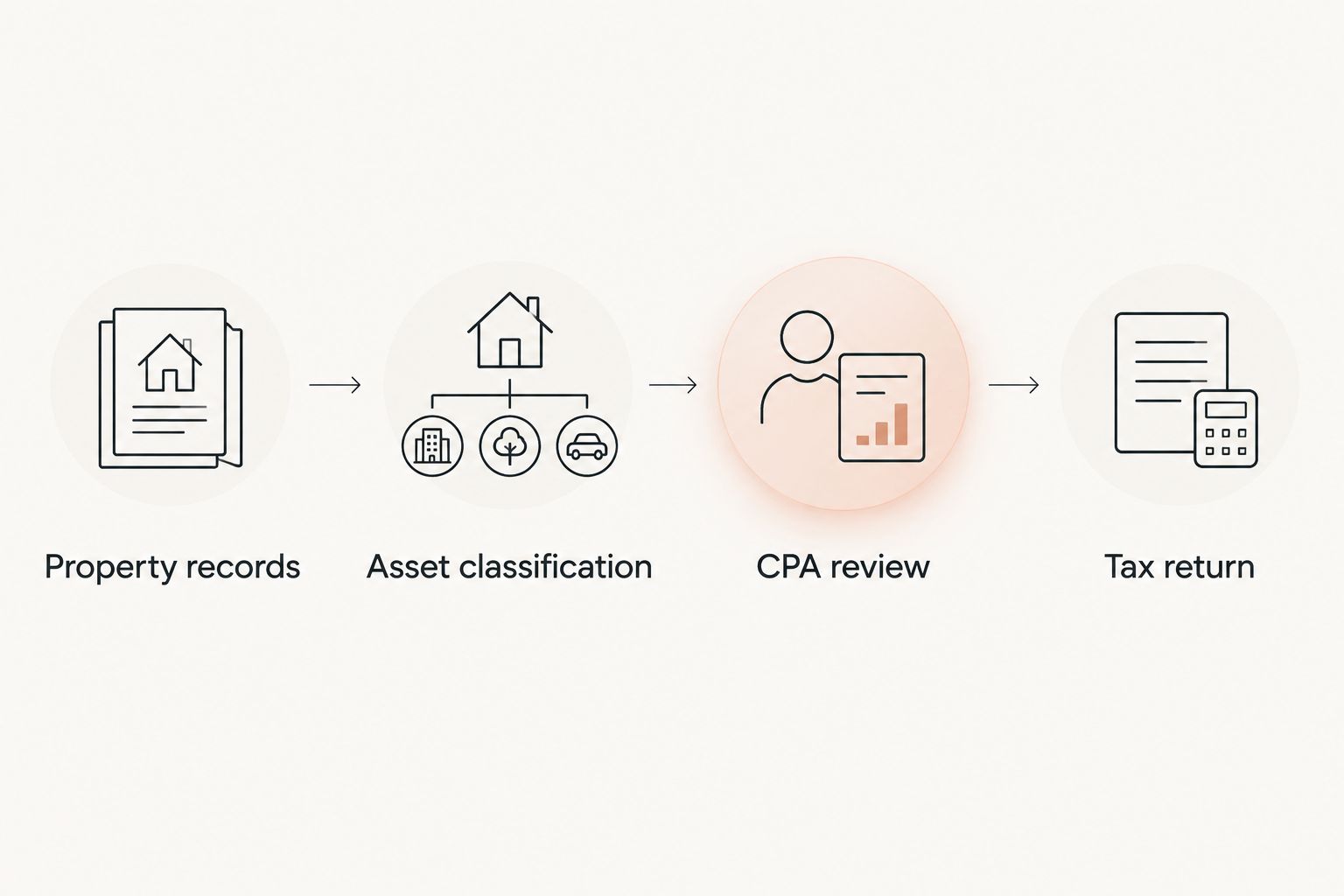
A clean handoff follows this order:
- Property records: Give the study provider acquisition documents, improvement costs, photographs, and the dates assets entered rental use. Identify personal use separately.
- Asset classification: Review the completed report for the correct property, costs, dates, and asset descriptions. Raise discrepancies before your CPA uses the schedules.
- CPA review: Supply the report with prior depreciation schedules and tax history. Ask your CPA to assess bonus eligibility, passive-loss treatment, and whether Form 3115 is appropriate for a change involving prior years.
- Tax return: Your CPA implements the supported treatment through the applicable return and depreciation reporting, including Form 4562 where required. Retain the report and source records with the tax file.
The sequence prevents a common 2026 handoff problem: the study provider knows the assets, while the CPA knows the taxpayer. Neither has the complete picture until the property documents, report, and filing history meet.
Which residential rental option should you choose?
Choose the engineering-based study for a residential rental that needs documented asset classification; involve your CPA before filing. Prepare the property records first, then review the report against them. If your immediate question is whether a deduction can offset W-2 income, start with the CPA's analysis of your rental activity rather than a calculator result.
Do not apply this ranking to a restaurant building. The ownership connection does not change the property's use, and the residential provider listed here does not study commercial real estate. For a qualifying residential rental, you can request a manual savings estimate before deciding on a study; treat it as an estimate only.
Review your residential rental
Request a manual savings estimate for your rental; results are not guaranteed.
FAQ
Does Virtual Cost Segregation study restaurant property?
No. Virtual Cost Segregation provides studies for residential rentals, not restaurant buildings or other commercial property. A separately owned residential rental is a different property to evaluate.
What is the best cost segregation option for my residential rental?
An engineering-based study is the best option when you need supported residential asset classifications. Your CPA must then decide how the report applies to your return.
Can my CPA file a cost segregation report with the IRS?
No. The report is supporting documentation, not a form filed on its own. Your CPA applies its supported classifications when preparing the applicable tax return.
Does a residential cost segregation study guarantee W-2 tax savings?
No. The study addresses asset classification, while passive-activity rules determine whether a resulting rental loss can offset W-2 income. Ask your CPA to assess your specific activity and participation.
Does every reclassified rental asset qualify for 100% bonus depreciation in 2026?
No. Bonus eligibility depends on the individual asset and applicable acquisition and placed-in-service requirements. The residential building does not qualify simply because a study reclassifies other assets.
What documents should I gather before a residential study?
Gather acquisition documents, improvement invoices, photographs, placed-in-service information, and prior depreciation schedules. Separate personal-use facts from rental-use facts for your CPA.
Do I need Form 3115 after a cost segregation study?
Not automatically. Your CPA determines whether an accounting-method change is appropriate based on the property's depreciation history and the treatment being changed.
One last thing
The most useful question before ordering a 2026 residential study is not how large the estimated deduction looks. It is whether your records establish the depreciable basis, asset use, and placed-in-service dates that your CPA needs. Resolve those facts first. They determine what the study can support and whether its classifications can be applied to your return.