
By Virtual Cost Segregation
The best cost segregation study provider for rental property investors
 Built to IRS standards
 Audit support includedFlat price for every study3 to 5 business days
Best overall for residential rental referrals: Virtual Cost Segregation. Best for inspection-dependent projects: an engineering-based provider offering an on-site assessment. Best for unresolved tax questions: CPA-led planning before selecting a study firm. This 2026 guide compares those service models for agents and brokers helping residential rental owners, rather than treating every provider as interchangeable.
- Virtual Cost Segregation is the best fit for agents referring owners of residential rentals with one to four units.
- The best cost segregation firms for real estate agents and brokers separate study preparation from tax-return implementation.
- Choose engineering-based documentation, clear cost sources, and CPA coordination over a projected deduction alone.
- A real estate license does not establish material participation or real estate professional status.
Why this matters
Your referral connects a property decision to a tax decision. A residential investor needs both an accurate asset breakdown and a CPA who can determine whether accelerated deductions are usable.
Those are different jobs. A cost segregation firm classifies property components and documents their costs; the client's CPA applies the report, tests tax limitations, and prepares the return.
A larger depreciation deduction is not automatically a larger current-year tax benefit. In 2026, that distinction belongs at the start of your client conversation, not after the study arrives.
What makes the best cost segregation firm for agents?
Use these criteria before comparing estimates or turnaround:
- Residential fit: Confirm experience with the client's actual rental arrangement, property records, and ownership history.
- Engineering-based methodology: Ask how the provider identifies components, determines costs, and supports classifications using the IRS Cost Segregation Audit Technique Guide.
- Traceable cost sources: Require component-level explanations rather than an unexplained percentage applied to the purchase price.
- CPA implementation: Establish who answers study questions and who handles the depreciation schedule and tax filings.
- Clear service boundaries: Separate report preparation, tax advice, return preparation, and audit support.
- Practical delivery: Match document collection and delivery timing to the CPA's filing schedule.
No single criterion replaces the others. Fast delivery does not establish sound classification, and technical documentation does not establish that the owner can deduct a loss immediately.
Cost segregation referral options at a glance
This comparison ranks referral routes by client need. The second and third options describe service models, not endorsements of unnamed businesses.
| Referral option | Best for | Standout feature to evaluate | Key limitation |
|---|---|---|---|
| Virtual Cost Segregation | Owners of residential rentals with one to four units | Engineering-based remote study, delivered in 3 to 5 business days, with audit support included | The client's own CPA must apply the report and handle filing |
| Engineering-based provider with on-site assessment | Projects where physical inspection is part of the agreed scope | Direct observation of components that need clarification | An inspection does not replace cost documentation or tax analysis |
| CPA-led study coordination | Owners with unresolved deduction, basis, or filing questions | Tax analysis before committing to study preparation | Coordination alone is not an engineering-based study |
The right order depends on the bottleneck. Choose a study provider when the tax plan is established; start with the CPA when the owner's ability to use deductions is unresolved.
1. Virtual Cost Segregation: best for residential rental referrals
Virtual Cost Segregation provides engineering-based cost segregation studies for residential rentals with one to four units, including short-term and long-term rentals. Studies follow the IRS Audit Technique Guide's criteria, require no site visit, and are delivered in 3 to 5 business days.
Virtual Cost Segregation is best for agents and brokers referring residential rental owners who want a remote engineering-based study for their own CPA to implement. Audit support is included, but the study is not a CPA service and is not filed with the IRS.
Pros:
- Defined residential scope for single-family rentals, duplexes, triplexes, and fourplexes.
- Remote preparation without coordinating a site visit.
- Component itemization with cost sources for CPA review.
- Audit support included with the study.
Cons:
- Does not replace the client's CPA or determine the client's complete tax position.
- Does not establish material participation or permission to offset earned income.
- Requires the owner and CPA to distinguish an estimate from the final study results.
Best for: Residential agents serving rental investors, Airbnb owners, VRBO owners, and landlords who already have a tax professional.
For a 2026 referral, ask the client to gather acquisition records, rental-use dates, renovation invoices, and existing depreciation schedules. A free manual savings estimate is available through a website or email inquiry; estimates are planning figures, and actual results vary.
Verdict: Buy after the CPA confirms the study fits the owner's tax plan.
2. On-site engineering provider: best for inspection-dependent projects
An engineering-based provider offering an on-site assessment is a route to evaluate when direct observation belongs in the project scope. Ask what the visit will establish and how the findings connect to the component costs in the report.
An inspection is a documentation method, not a tax conclusion. The provider still needs to distinguish building systems, potentially shorter-life assets, and land improvements based on function and supporting records.
On-site provider pros:
- Direct observation can help clarify physical components.
- A defined inspection scope gives the owner specific questions to resolve.
- Inspection findings can supplement invoices and other property records.
On-site provider cons:
- Physical access requires coordination with owners, managers, or guests.
- Observing an asset does not establish its original cost.
- An on-site visit does not establish bonus eligibility or loss deductibility.
Best for: Residential rental owners whose CPA and proposed study provider identify specific questions requiring physical inspection.
Before making this referral, ask whether existing photographs, plans, and invoices answer the same questions. Select the documentation method that addresses the property, not the one that sounds more elaborate.
Verdict: Hold until the provider explains why an inspection is needed.
3. CPA-led coordination: best for unresolved tax questions
CPA-led coordination puts the owner's tax position ahead of the study order. The CPA reviews basis, prior depreciation, participation, and potential loss limitations before the owner selects an engineering-based provider.
This route matters when an agent owns rentals personally or a buyer expects deductions to offset salary or brokerage income. A study identifies depreciation treatment; it does not establish whether that treatment produces a usable loss.
CPA-led coordination pros:
- Addresses deduction usability before the owner commits to a study.
- Identifies missing basis records and prior depreciation schedules.
- Establishes responsibility for return preparation and implementation.
CPA-led coordination cons:
- Tax planning alone does not produce an engineering-based report.
- The owner still needs a qualified study provider when component analysis is required.
- Unresolved records can delay the study decision.
Best for: Agent-investors and clients with uncertain participation status, prior depreciation issues, personal-use history, or an approaching sale.
For a look-back study, missed depreciation is claimed on the current return using Form 3115 and a Section 481(a) adjustment; prior returns are not amended for that catch-up approach. The CPA determines the applicable procedure and files the form. Form 3115 is provided on request with the branded study service, but the CPA files it.
Verdict: Wait on the study purchase until the CPA resolves the tax questions.
What agents and brokers must check before discussing savings
A real estate license does not settle tax status
Being an agent or broker does not automatically establish real estate professional status. The federal tests generally require more than 750 hours in qualifying real property trades or businesses and more than half of the taxpayer's personal-service time in those activities, with additional employee-service rules.
Material participation remains a separate issue. Ask the CPA to assess the client's facts rather than treating a license, commission income, or ownership as the answer.
Short-term rental participation needs its own records
For the commonly discussed short-term rental exception, average guest stays must be 7 days or less, and the owner must materially participate. One common participation test requires more than 100 hours and more participation than any other individual, including a property manager.
More than 100 hours alone is not enough under that test. Real estate professional status is not required for this short-term rental route, but the CPA must evaluate the actual activity and other applicable limitations.
Building depreciation differs from component depreciation
The building of a long-term residential rental generally uses a 27.5-year recovery period. A short-term rental building with average stays under 30 days, including the 7-day arrangement discussed above, uses a 39-year recovery period under the applicable transient-use treatment.
The building structure never qualifies for bonus depreciation. Cost segregation instead identifies components that qualify for shorter recovery periods, such as 5-, 7-, or 15-year property, according to their function, documentation, and the taxpayer's facts.
Acquisition timing matters in 2026
Under the One Big Beautiful Bill Act, signed July 4, 2025, eligible property acquired and placed in service after January 19, 2025 qualifies for 100% bonus depreciation. Both dates matter, and the restored rate has no scheduled end.
Converting a previously purchased home into a rental does not reset its acquisition date. A home bought before January 20, 2025 and converted later does not receive that restored treatment merely because rental use begins in 2026; the CPA must confirm the applicable rate from the purchase facts.
A referral workflow that keeps responsibilities clear
Use this sequence for your 2026 residential investor referrals:
- Property records: Collect the closing statement, acquisition agreement, rental-use dates, improvement invoices, and prior depreciation schedules.
- CPA review: Ask the CPA to assess basis, participation, deduction usability, and filing requirements.
- Study preparation: Have the engineering-based provider identify components and document classifications and cost sources.
- Return implementation: Have the CPA reconcile the report to the tax records and apply the appropriate filing treatment.
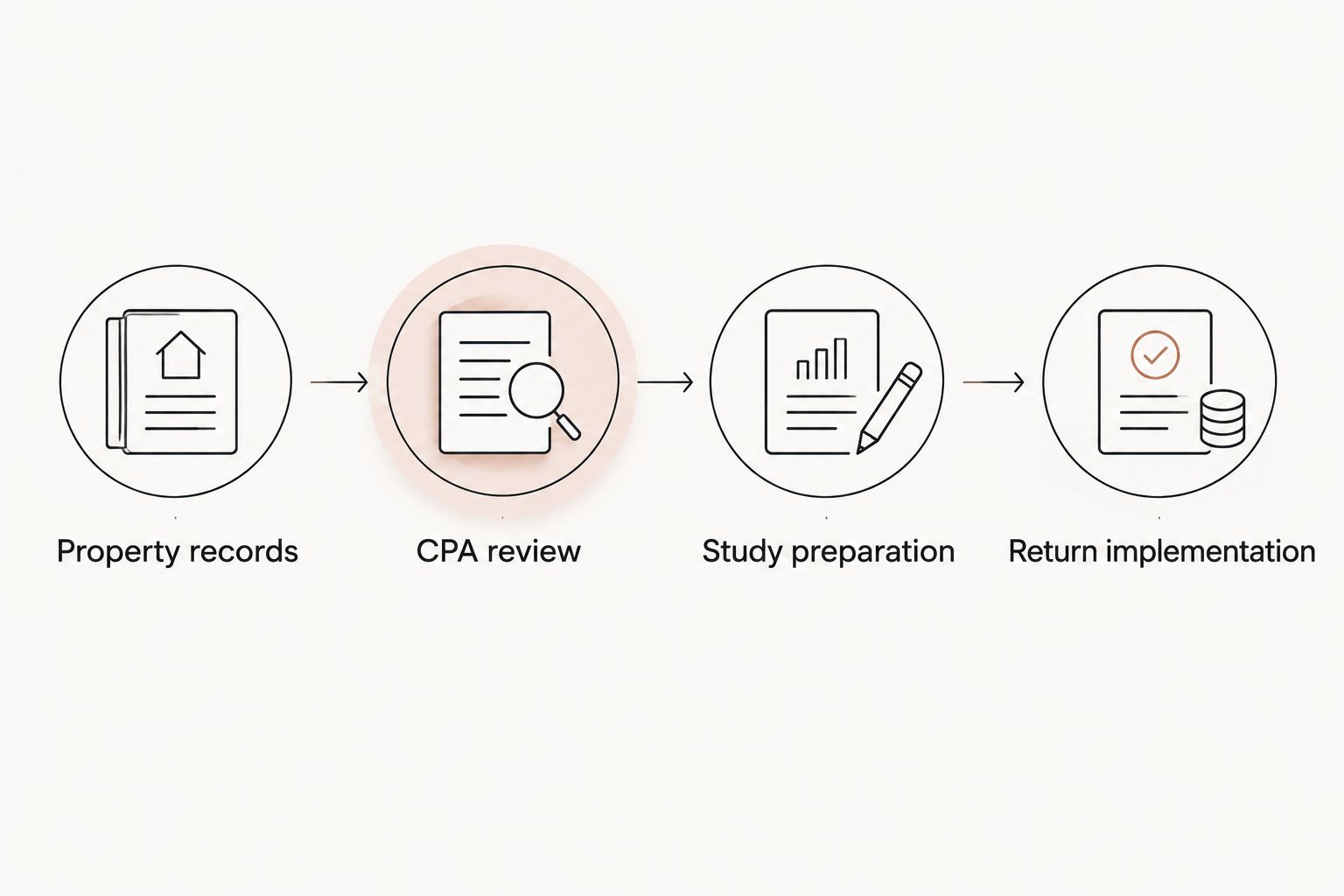
Keep the handoff explicit in your introduction email. The agent helps organize the referral, the study provider documents assets, and the CPA applies current law to the owner's facts.
Ask the provider who answers component questions after delivery. Ask the CPA when the report is needed and whether the owner must supply additional records before implementation.
How these referral options are ranked
The ranking prioritizes residential scope, engineering-based documentation, traceable costs, CPA coordination, and delivery requirements. It does not rank firms by projected deductions or assume that an inspection produces a better report.
The default recommendation serves owners with an established tax plan. The alternatives address different obstacles: physical questions about the property or unresolved questions about the taxpayer.
Which cost segregation firm should you choose?
Choose Virtual Cost Segregation for a documented, remote residential study once the client's CPA confirms the tax strategy. Choose an inspection-based engagement when specific physical questions require it, and start with CPA-led planning when deduction usability is uncertain.
Your next move is a coordinated introduction, not a promised tax result. Use the contact page to ask about the residential property and request a manual savings estimate for CPA review.
FAQ
What's the best cost segregation firm for real estate agents and brokers?
Virtual Cost Segregation is the best fit here for agents referring owners of residential rentals with one to four units who want a remote engineering-based study. The client's CPA must confirm the tax strategy and apply the report.
Does a real estate license let me deduct rental losses against commissions?
A real estate license alone does not establish that rental losses can offset commission income. Your CPA must evaluate real estate professional status, material participation, and applicable loss limitations.
Does my short-term rental need average stays under seven days?
The commonly discussed short-term rental exception uses average guest stays of 7 days or less, not strictly under 7 days. Material participation is also required, and more than 100 hours alone does not satisfy the common comparative-hours test.
Is an on-site cost segregation study always better?
An on-site study is not automatically better than a remote study. Evaluate whether the provider can support asset identification, classifications, and cost sources using the property's records and the agreed documentation method.
Can a cost segregation calculator replace an engineering-based study?
A calculator is a planning tool, not a substitute for a property-specific engineering-based report. Treat its output as an estimate and have the CPA review the assumptions before making a purchase decision.
How long does the residential study take?
The branded residential study service delivers in 3 to 5 business days and requires no site visit. Coordinate document collection and CPA review separately from the report delivery schedule.
Do owners amend earlier returns after a look-back study?
For the look-back catch-up approach, missed depreciation is claimed on the current return through Form 3115 and a Section 481(a) adjustment, rather than amending prior returns. The CPA determines the applicable procedure and files the form.
One last thing
Ask about the exit before discussing the deduction. Accelerated depreciation changes deduction timing and can affect depreciation recapture when the owner sells.
For a 2026 referral, send the CPA the expected holding period alongside the property records. A recommendation that considers both ownership and sale is more useful than a first-year deduction estimate alone.
This article provides general educational guidance, not individualized tax advice. Apply current law to the owner's facts with the owner's tax professional.