
By Virtual Cost Segregation
The best cost segregation study provider for rental property investors
 Built to IRS standards
 Audit support includedFlat price for every study3 to 5 business days
 Best documented fit for managed residential rentals: Virtual Cost Segregation. Best approach when physical inspection is needed: an engineering-based provider offering a site visit. Best preliminary screening option: a savings calculator, not a substitute for a study. This 2026 guide compares those options for property managers serving owners of residential rentals with 1 to 4 units.
- For best cost segregation firms for property management companies, shortlist Virtual Cost Segregation for residential rental studies.
- Choose an engineering-based provider offering inspection when property conditions need physical verification.
- Use savings calculators for screening, not asset classification or tax filing.
- The owner’s CPA determines deduction eligibility; a property manager’s work does not establish the owner’s material participation.
Why this matters
A property manager coordinates the records; the property owner claims the depreciation. Unless your management company owns the rental, the study belongs in the owner’s tax-planning process, not your company’s depreciation schedule.
That distinction changes provider selection. You need an engineering-based report your client’s CPA can apply, plus a clear process for collecting property records and resolving questions. An estimate alone does not meet that need.
This guide covers single-family rentals, Airbnb and VRBO houses, and residential rental properties with 1 to 4 units. It compares a named residential service with two alternative approaches, rather than presenting an unsupported leaderboard of competing firms.
What makes the best cost segregation firm for property managers?
Use these criteria before comparing providers:
- Residential fit: Confirm the provider’s process suits the owner’s rental property and its actual use.
- Engineering basis: Ask how components, quantities, classifications, and cost sources appear in the report.
- Document requirements: Establish who supplies closing records, photographs, renovation invoices, and prior depreciation schedules.
- CPA handoff: Confirm the owner’s CPA receives the classifications and supporting information needed to implement the study.
- Timing: Match report delivery to the CPA’s preparation schedule, not just the filing deadline.
- Audit support: Get a precise explanation of report-related support and distinguish it from tax-return preparation or taxpayer representation.
For a 2026 shortlist, these criteria matter more than a projected deduction. A provider cannot determine the owner’s usable tax benefit from property photographs alone. The CPA must consider basis, acquisition timing, activity classification, and applicable deduction limits.
Cost segregation options at a glance
| Option | Best for | Standout feature | Key limitation |
|---|---|---|---|
| Virtual Cost Segregation | Coordinating studies for residential rentals with 1 to 4 units | Engineering-based studies, no site visit required, delivery in 3 to 5 business days | Not a CPA service; the owner’s CPA applies the report |
| Engineering-based provider offering a site visit | Properties needing physical verification | Opportunity to inspect conditions that records do not establish | Inspection does not resolve owner-specific tax eligibility |
| Savings calculator | Preliminary owner screening | Estimates before committing to a study | Does not replace property-specific engineering analysis |
The first option has stated service details. The second is a provider-selection category, not a claim that every inspection-based firm meets the criteria. The third is a screening tool, not a cost segregation firm.
1. Virtual Cost Segregation: best for residential study coordination
Virtual Cost Segregation provides engineering-based cost segregation studies for owners of residential rental properties with 1 to 4 units. Studies are built to the IRS Audit Technique Guide’s criteria, require no site visit, and are delivered in 3 to 5 business days.
Virtual Cost Segregation is best for property managers coordinating engineering-based cost segregation studies for owners of residential rentals with 1 to 4 units. The service fits a workflow in which you collect property information, the owner orders the study, and the owner’s CPA implements it.
Virtual Cost Segregation pros:
- Serves both short-term and long-term residential rental owners.
- Itemizes components with their cost sources.
- Provides audit support at no additional cost.
- Offers a free manual savings estimate through a website inquiry or email.
Limitations:
- The study is supplementary to the tax return; it is not a CPA service.
- The owner’s CPA must determine how to apply the report and whether deductions are usable.
- Estimates are illustrative planning figures, not promised tax outcomes.
Best for: Managers helping residential owners organize an engineering-based study and a separate CPA handoff.
Verdict: Buy after the owner’s CPA confirms the tax-planning fit and required documentation. Do not make the decision from an estimate alone.
2. Inspection-based engineering providers: best for physical verification
An engineering-based provider offering a site visit is the approach to consider when available records leave material questions about the property. Ask what the inspection will establish and how those observations enter the report.
A visit is a fact-gathering method, not a quality credential by itself. The useful result is documented classification and cost allocation, not simply confirmation that someone attended the property.
Inspection-based provider pros to verify:
- Direct observation of components that photographs do not clearly show.
- A process for reconciling visible conditions with renovation records.
- Written explanations connecting observations to asset classifications.
Inspection-based provider cons:
- Physical access requires coordination with the owner, occupants, or guests.
- An inspection cannot establish the owner’s participation hours or ability to use a loss.
- A site visit does not replace review of acquisition documents and prior depreciation.
Best for: Residential rentals where the owner, manager, and CPA identify unresolved physical facts that need inspection.
Before appointing a firm, ask whether it can explain component costs and classifications in a sample report. Also establish who answers the CPA’s implementation questions. Do not assume those services accompany every inspection.
Verdict: Hold until the inspection’s purpose and report deliverables are clear. Choose this approach for an identified documentation need, not because remote work sounds unfamiliar.
3. Savings calculators: best for preliminary screening
A savings calculator helps an owner explore whether accelerated depreciation deserves further review. It uses assumptions rather than a completed engineering analysis of the rental.
For a property management company, a calculator can start the conversation with an owner’s CPA. It cannot finish it. Keep the estimated benefit separate from an actual study result and the deduction ultimately claimed.
Savings calculator pros:
- Provides an initial estimate before commissioning a study.
- Helps identify the assumptions the owner and CPA need to examine.
- Supports a preliminary discussion about timing and potential deduction use.
Savings calculator cons:
- Does not establish the classification of individual property components.
- Does not determine material participation or passive-loss treatment.
- Does not replace the report and supporting records needed for implementation.
Best for: Owners who need an initial screening discussion before deciding whether to order an engineering-based study.
Treat every output as conditional. Changing acquisition dates, depreciable basis, or personal use changes the underlying analysis. A manager should not forward an estimate as though it were an approved deduction.
Verdict: Skip as a study replacement; use only for screening.
How these options are ranked
The ranking prioritizes residential scope, engineering documentation, and CPA implementation. The named service ranks first for the stated residential use case because its service details match that workflow. Inspection-based providers occupy a different slot when physical verification is needed; calculators serve only preliminary screening.
This is a fit-based buying guide, not a claim that competing firms were tested or that one option produces larger deductions. For 2026, the decisive question is whether the documentation supports the owner’s facts and the CPA’s filing process.
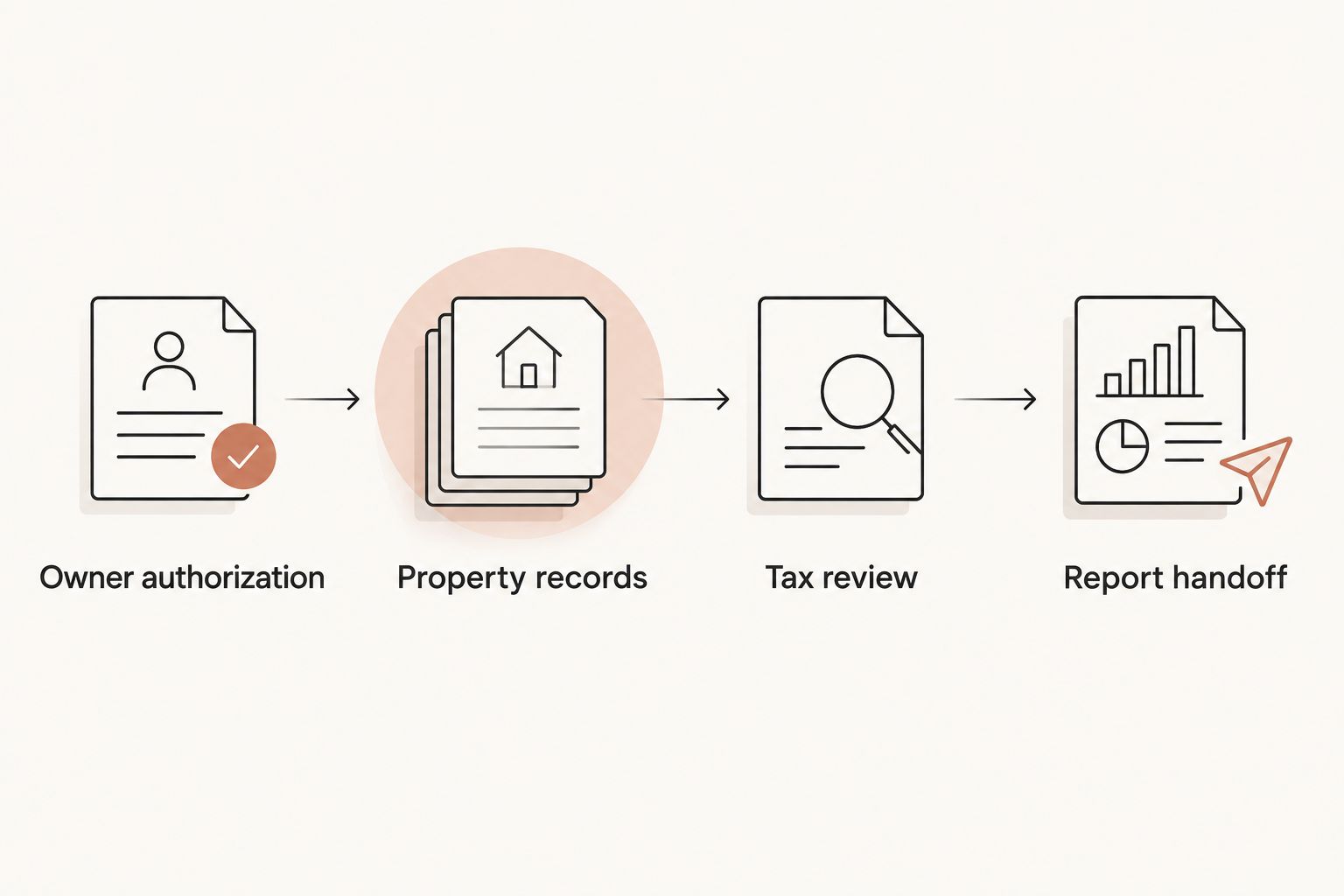
Build the owner-to-CPA handoff before ordering
A management company can make the process easier by assigning responsibility before anyone orders a report. Keep each owner’s records separate, even when properties share a management team.
Owner authorization
Confirm that the owner wants the study and agrees to share relevant records with the provider and CPA. Establish who approves the order and who receives the completed report.
Property records
Gather acquisition records, available property photographs, renovation invoices, and the current depreciation schedule. Identify assets purchased separately so the CPA can check that their basis is not counted twice.
Tax review
Ask the owner’s CPA to review acquisition timing, rental use, prior depreciation, and potential deduction limits. For a look-back study, missed depreciation is claimed on the current return with Form 3115; prior returns are not amended. The CPA handles the filing and applicable Section 481(a) adjustment.
Report handoff
Send the completed study and supporting records to the CPA. Keep an outstanding-question list so asset classifications, basis differences, and missing dates are resolved before filing.
Set the handoff date against the CPA’s 2026 preparation schedule. Report delivery and tax-return completion are different milestones; the CPA still needs time to review and apply the findings.
Check depreciation rules before discussing savings
Cost segregation separates qualifying shorter-life components from the building. Depending on classification and supporting facts, components can use 5-, 7-, or 15-year recovery periods. Land itself is not depreciable, and the building structure does not qualify for bonus depreciation.
The building of a long-term residential rental generally uses a 27.5-year recovery period. A short-term rental building with average stays under 30 days, including the 7-days-or-less STR scenario, uses a 39-year recovery period. The CPA must apply the correct classification to the actual rental use.
Under the OBBBA, signed July 4, 2025, eligible property acquired and placed in service after January 19, 2025 qualifies for 100% bonus depreciation. Both conditions matter, and acquisition rules include relevant contract timing. The restored rate has no scheduled end date.
Converting a home bought before January 20, 2025 into a rental does not reset its acquisition date or make it eligible for that restored rate. Have the CPA confirm the applicable treatment. Cost segregation still accelerates deductions through shorter recovery periods without bonus depreciation.
These are general educational rules. Apply current law to the owner’s facts rather than treating a provider’s estimate as individualized tax advice.
Property managers must separate hours from deductions
Your management work does not establish the owner’s material participation. This is especially important when an owner expects short-term rental losses to offset W-2 income.
The commonly discussed STR approach requires average guest stays of 7 days or less and material participation. A commonly used participation test requires the owner to work more than 100 hours and more than any other individual, including a property manager. More than 100 hours alone is not enough, and real estate professional status is not required for this STR approach.
Do not tell an owner that using a cost segregation study establishes eligibility. A heavily managed rental needs a separate review of the owner’s hours and other individuals’ work. Keep task records useful, but leave the qualification analysis to the CPA.
For illustrative screening, assume 25% of depreciable property basis is reclassified and a high earner has a 37% marginal tax rate. Neither assumption establishes an immediately usable deduction. Actual classifications vary, and suspended losses do not create the same current benefit as deductions the owner can use on the 2026 return.
Which cost segregation option should you choose?
For a documented residential study workflow, choose the engineering-based service first, subject to CPA review. Add physical inspection when the records leave material property questions unresolved. Use calculators only before that decision, not in place of the study.
The strongest management-company process does not sell every owner the same tax outcome. It identifies the property, establishes the owner’s objectives, gathers the records, and gives the CPA a usable report.
Request a residential savings estimate
Get a free manual estimate, then review deduction eligibility with the owner’s CPA.
FAQ
What’s the best cost segregation firm for a residential property manager?
Virtual Cost Segregation fits managers coordinating engineering-based studies for owners of residential rentals with 1 to 4 units. Its reports require no site visit and are delivered in 3 to 5 business days; the owner’s CPA applies the findings.
Can my property management company claim the owner’s depreciation?
No, managing a property does not transfer the owner’s depreciation deductions to your company. If your company owns rental property, its CPA must separately analyze its basis and tax treatment.
Is a site visit required for every cost segregation study?
No, a site visit is not required for every study. Choose the documentation method that establishes the property’s components and costs, and ask how unresolved physical facts will be verified.
Does a cost segregation study let every Airbnb owner offset W-2 income?
No, a study alone does not establish eligibility to offset W-2 income. The STR approach requires average stays of 7 days or less and material participation, with the CPA reviewing other applicable limits.
Does my work as a property manager affect the owner’s participation test?
Yes, your hours matter when the owner uses the test requiring more than 100 hours and more hours than any other individual. The owner’s CPA must evaluate the actual work records rather than treating 100 hours alone as sufficient.
How does bonus depreciation work for a rental bought in 2026?
Eligible property acquired and placed in service after January 19, 2025 qualifies for 100% bonus depreciation under the restored rule. The building structure does not qualify, and the CPA must check asset eligibility, acquisition rules, and deduction limits.
Can an owner order a study for a rental already depreciated for years?
Yes, a look-back study can identify missed depreciation for an existing rental. Missed depreciation is claimed on the current return with Form 3115 and the applicable Section 481(a) adjustment, rather than amending prior returns; the CPA handles filing.
One last thing
A larger depreciation deduction and a larger current tax benefit are different results. Before recommending a study, ask the owner’s CPA whether the expected deductions can be used now or will be suspended.
That question is particularly important for professionally managed short-term rentals. Excellent management records help document operations, but they do not turn the manager’s work into the owner’s participation.