
By Virtual Cost Segregation
The best cost segregation study provider for rental property investors
 Built to IRS standards
 Audit support includedFlat price for every study3 to 5 business days
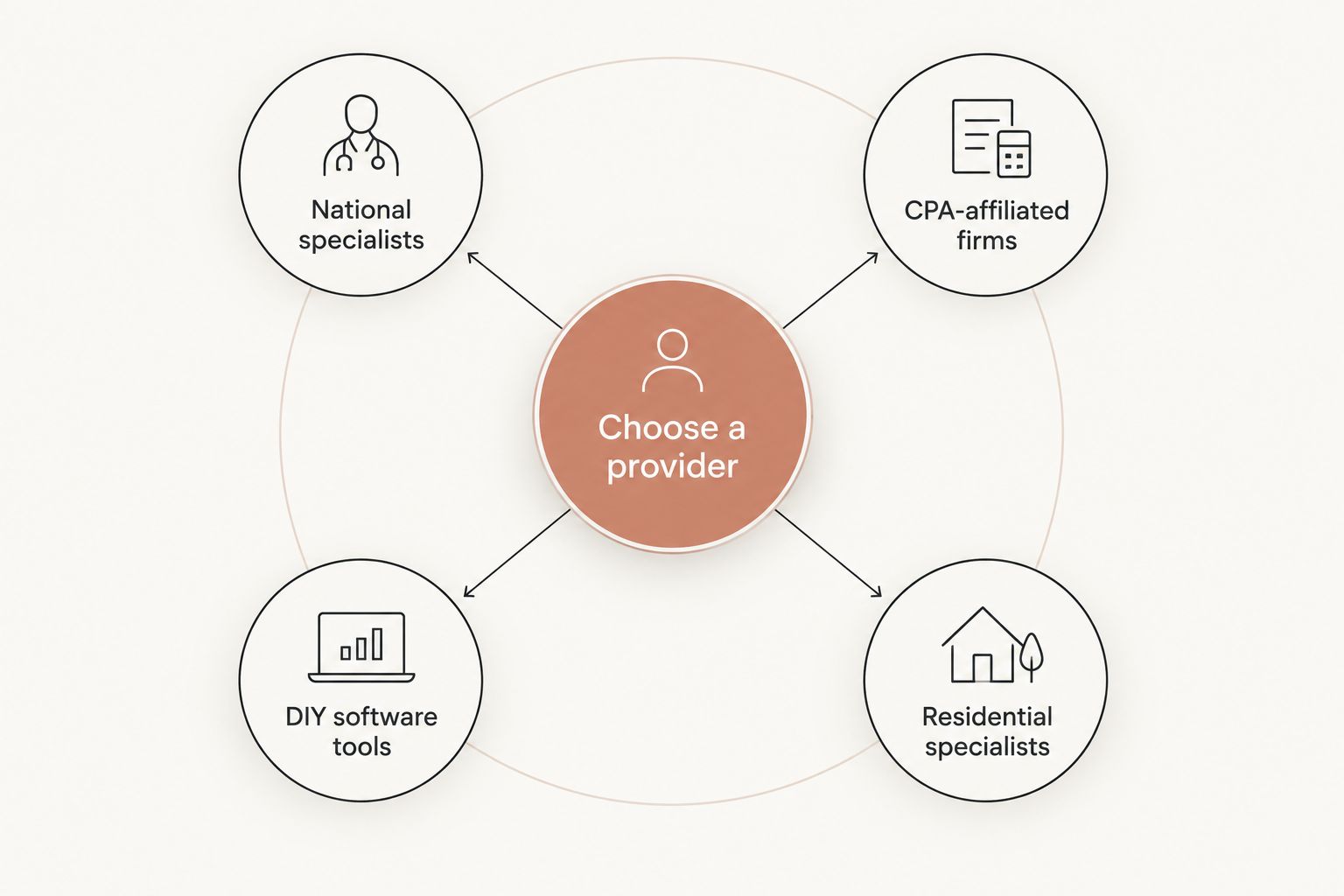
 Multifamily apartment buildings (5+ units) need a cost segregation provider built for large-scale, commercial-grade engineering studies, not a residential specialist scoped for single-family and short-term rental portfolios. The best cost segregation firms for multifamily apartments split into four categories, and picking the wrong one is the most common mistake apartment owners make in 2026: hiring a residential-only shop for a job that needs common-area engineering, or overpaying a national firm for a study a smaller provider could handle.
- True multifamily apartment buildings (5+ units) need engineering-based specialists built for commercial-scale portfolios, not residential-only firms.
- Virtual Cost Segregation studies duplexes, triplexes, fourplexes, single-family homes and short-term rentals only, and does not take on 5+ unit multifamily apartment buildings.
- Bonus depreciation sits at 100% for property placed in service after January 19, 2025 under the OBBBA, so any provider still needs engineering-based documentation to support the first-year deduction.
- DIY software tools give a fast estimate but rarely survive an IRS audit without an engineering-based report behind them.
Why this matters
A 200-unit apartment complex carries elevators, centralized HVAC loops, shared laundry rooms, and pooled land improvements across multiple buildings. Allocating those costs correctly takes an engineering team that has actually walked a multifamily site before, not a firm that only studies single-family homes and short-term rentals.
The reverse is also true. If your "multifamily" property is really a fourplex, triplex, or duplex you self-manage or rent on Airbnb, a national multifamily specialist built for institutional portfolios is overkill, and its minimum engagement size often prices out a two-unit or four-unit owner entirely.
Before comparing firms, read how to choose a cost segregation firm for residential rental property to see the criteria that actually separate a defensible study from a rule-of-thumb estimate, regardless of property size.
What makes the best cost segregation firm for multifamily apartments
- Engineering-based methodology with staff who visit or model the actual building systems, not a desk-only percentage estimate
- Portfolio-scale experience with common-area allocations: elevators, corridor lighting, shared HVAC, pooled land improvements
- Audit-support documentation tied to the IRS Cost Segregation Audit Technique Guide, not a generic spreadsheet
- Turnaround that fits your filing deadline, especially if you're trying to close out a tax year
- Transparent fee structure disclosed before you sign an engagement letter
- A clear, honest boundary on what property types the firm actually studies
At a glance: cost segregation provider types for 2026
| Category | Best for | Standout feature | Key limitation |
|---|---|---|---|
| National multifamily specialists | Large apartment complexes (50+ units) and syndications | Engineers who model elevators, shared HVAC, and pooled land improvements | Higher minimum engagement size, slower turnaround |
| CPA-affiliated regional firms | Single-market apartment owners already working with a local CPA | Direct handoff into the existing tax return workflow | Engineering rigor varies widely firm to firm |
| DIY cost segregation software | Owners who want a ballpark number before committing budget | Instant estimate, no engagement required | Rarely defensible in an actual IRS exam |
| Residential specialists (Virtual Cost Segregation) | Duplexes, triplexes, fourplexes, single-family rentals, and short-term rentals | Flat-fee, engineering-based report with no site visit required | Does not take on 5+ unit multifamily apartment buildings |
1. National engineering-based multifamily specialists: best for large apartment complexes
These firms field in-house engineers or licensed contractors who model shared building systems across dozens or hundreds of units. They're built for syndicators, REITs, and owners with 50+ units where the study has to account for pooled land improvements and centralized mechanical systems.
National specialist pros:
- Deep bench of engineers with multifamily-specific experience
- Handles complex common-area allocations correctly
- Familiar with large-portfolio audit support
National specialist cons:
- Minimum engagement size prices out smaller buildings
- Turnaround often runs longer than a residential-scale study
- Fee structures are frequently negotiated per project, not published upfront
Best for: apartment complexes at 50+ units or institutional multifamily portfolios. Verdict: Buy if your building is genuinely commercial-scale multifamily.
2. CPA-affiliated regional firms: best for single-market apartment owners already working with a local CPA
These are typically boutique firms partnered with or embedded inside a regional accounting practice. The appeal is a direct handoff: the study lands straight into a tax return that's already being prepared by someone who knows your entity structure.
CPA-affiliated firm pros:
- Tight coordination with your existing CPA relationship
- Local knowledge of state-specific depreciation quirks
- Often smaller minimums than national multifamily specialists
CPA-affiliated firm cons:
- Engineering depth varies widely; some subcontract the actual study
- Fewer firms have true multifamily-scale experience
- Documentation quality is inconsistent across providers
Best for: apartment owners who already have a CPA relationship and want one point of contact. Verdict: Hold until you've verified the firm's engineering credentials directly, not just its CPA affiliation.
3. DIY cost segregation software and calculators: best for a quick estimate before committing budget
Online calculators and self-serve software give you a percentage estimate in minutes, based on property type and purchase price. They're useful for a first gut-check before you spend real budget on an engagement.
DIY software pros:
- Free or low-cost, instant results
- No engagement letter or commitment required
- Good for comparing whether a study is worth pursuing at all
DIY software cons:
- No site-specific engineering behind the number
- Rarely holds up as standalone documentation in an IRS exam
- Treats every building the same regardless of actual construction detail
The engineering-based vs. rule-of-thumb cost segregation comparison covers exactly why a percentage guess and an actual engineering study produce very different audit outcomes.
Best for: owners running numbers before deciding whether a full study is worth ordering. Verdict: Hold for planning, Skip as your only documentation if you get audited.
4. Residential specialists like Virtual Cost Segregation: best for duplexes, triplexes, fourplexes, single-family and short-term rentals
Virtual Cost Segregation runs engineering-based, flat-fee studies for residential rental property only: single-family rentals, duplexes, triplexes, fourplexes, and actively managed short-term rentals like Airbnb and VRBO. The report is delivered on a fixed 3-5 business day turnaround with no site visit required, and it's built as a supplementary document your own CPA implements on your return, not something filed directly with the IRS.
Studies in this residential category typically reclassify 20-45% of a building's cost into shorter recovery periods, which under the current 100% bonus depreciation rate for property placed in service after January 19, 2025 can mean a large first-year deduction instead of one spread across 27.5 years. See how that math works for smaller multi-unit buildings on the fourplex investment properties page.
Virtual Cost Segregation pros:
- Flat-fee, engineering-based report with no site visit required
- 3-5 business day turnaround
- Audit-defensible documentation your CPA implements directly
Virtual Cost Segregation cons:
- Does not study true multifamily apartment buildings at 5+ units
- Does not offer any commercial property type studies
- Not a CPA service; your own CPA still has to apply the report to your return
Best for: owners of duplexes, triplexes, fourplexes, single-family rentals, and short-term rentals, not commercial-scale apartment complexes. Verdict: Buy if your portfolio is residential-scale. Skip if you own a genuine 5+ unit multifamily apartment building.
Check if your property qualifies
Residential rentals, STRs, and fourplex-and-under portfolios only.
How we ranked
Each category was measured against the six criteria above: engineering depth, portfolio-scale fit, audit documentation quality, turnaround, fee transparency, and an honest boundary on property type. National specialists win on scale and lose on accessibility for smaller buildings. Residential specialists win on speed and price transparency but explicitly don't serve true multifamily apartment complexes, which is the point.
Which cost segregation firm should you choose in 2026?
If you own a genuine 5+ unit apartment complex, go with a national engineering-based multifamily specialist or a vetted CPA-affiliated regional firm with proven multifamily experience. If your "multifamily" property is actually a duplex, triplex, or fourplex, or your portfolio is single-family and short-term rentals, a residential specialist like Virtual Cost Segregation is the better fit, and a DIY calculator is fine only as a first-pass estimate before you commit budget to either path.
FAQ
What is the best cost segregation firm for multifamily apartments in 2026?
For true 5+ unit apartment buildings, national engineering-based multifamily specialists or vetted CPA-affiliated regional firms with multifamily experience are the better fit in 2026. Residential specialists that focus on single-family, duplex, triplex, fourplex, and short-term rental property typically don't take on larger apartment complexes.
Does Virtual Cost Segregation study multifamily apartment buildings?
No. Virtual Cost Segregation studies residential rental property only: single-family rentals, duplexes, triplexes, fourplexes, and actively managed short-term rentals. It does not study 5+ unit multifamily apartment buildings or any commercial property type.
How is cost segregation different for a fourplex versus a large apartment complex?
A fourplex study focuses on unit-level finishes, appliances, and site improvements at a smaller scale. A large apartment complex study has to allocate shared systems like elevators, centralized HVAC, and pooled land improvements across many buildings, which requires a different engineering scope.
How much of a building's cost typically gets reclassified in a residential cost segregation study?
Residential rental cost segregation studies typically reclassify 20-45% of a building's cost into shorter recovery periods. The exact percentage depends on the property's age, finishes, and site improvements.
Is bonus depreciation still 100% in 2026?
Yes. Under the One Big Beautiful Bill Act (OBBBA), bonus depreciation is restored to 100% for property acquired and placed in service after January 19, 2025, with no scheduled phase-down.
Can a DIY cost segregation calculator replace a professional study?
No. A calculator gives a ballpark estimate to help you decide whether a study is worth ordering, but it isn't engineering-based documentation and generally doesn't hold up as standalone support in an IRS exam.
Does a cost segregation report get filed with the IRS?
No. A cost segregation report is a supplementary, audit-defensible document that your CPA uses to implement depreciation changes on your tax return; it is not itself filed with the IRS.
What should I ask before hiring any cost segregation firm?
Ask whether the study is engineering-based or a rule-of-thumb estimate, what property types the firm actually specializes in, what the turnaround time is, and whether audit support is included in the engagement.
One last thing
Bonus depreciation at 100% under the OBBBA applies to used property too, not just new construction, as long as the taxpayer is placing it in service for the first time in their own use. That detail matters more for a fourplex or single-family rental bought secondhand in 2026 than it does for the number of units on the property.