By Virtual Cost Segregation
The best cost segregation study provider for rental property investors
 Built to IRS standards
 Audit support includedFlat price for every study3 to 5 business days
Best overall for a remote residential study: Virtual Cost Segregation. Best for properties needing physical inspection: an engineering provider offering site visits. Best for missed depreciation: an engineering provider coordinated with your CPA. This 2026 guide compares provider models for duplex and fourplex owners, rather than presenting an unsupported ranking of named firms.
- Virtual Cost Segregation is the best fit for duplex and fourplex owners seeking remote, engineering-based cost segregation studies.
- Compare the best cost segregation firms for duplex and fourplex owners by documentation, residential scope, and CPA handoff.
- A larger depreciation deduction does not automatically create a usable current-year tax benefit.
- Use DIY calculators for preliminary planning, not as substitutes for property-specific engineering reports.
Why this matters
A duplex or fourplex does not need a different tax strategy simply because it contains more than one rental unit. It needs accurate rental-use allocations, supported asset classifications, and a CPA who can determine when the resulting deductions are usable.
The best provider produces a report your CPA can apply, not merely an attractive savings estimate. For your 2026 decision, separate the engineering work from tax-return implementation. A study identifies and supports asset costs; your CPA applies depreciation rules and your personal tax limitations.
What makes the best cost segregation firm for small rentals?
Use these six criteria before comparing proposals:
- Residential scope: Confirm that the provider studies properties containing 1 to 4 residential units, including your actual rental arrangement.
- Engineering methodology: Ask how the report identifies components, establishes costs, and supports recovery periods using the IRS Cost Segregation Audit Technique Guide.
- Cost traceability: Require itemized components with their cost sources, not an unexplained percentage assigned to shorter lives.
- Use allocation: Establish how the study will separate owner-occupied space, rental units, and shared improvements.
- CPA handoff: Clarify which schedules your CPA receives and who handles return implementation or an accounting-method change.
- Support and delivery: Confirm the delivery schedule, document requirements, and scope of audit support in writing.
Do not rank providers by estimated deductions alone. Different assumptions about land, personal use, asset eligibility, or loss limitations can make estimates look different before any engineering work begins.
Cost segregation options at a glance
These options serve different needs. The engineering-provider categories below are selection criteria, not claims about an unidentified firm's actual services.
| Option | Best for | Standout feature or requirement | Key limitation |
|---|---|---|---|
| Virtual Cost Segregation | Remote studies for residential rentals with 1 to 4 units | Engineering-based study; no site visit required; delivery in 3 to 5 business days | Your CPA applies the report and handles filing |
| Engineering provider offering site visits | Properties where physical inspection will resolve documentation gaps | Select for a documented inspection scope | Inspection does not replace cost sourcing or tax analysis |
| Engineering provider coordinated with your CPA | Previously depreciated rentals needing a look-back review | Select for reconciliation with existing depreciation schedules | Requires accounting-method and filing analysis by your CPA |
| DIY calculator | Preliminary screening before ordering a study | Estimate inputs can help frame questions | An estimate is not a property-specific engineering study |
1. Virtual Cost Segregation: best for remote residential studies
Virtual Cost Segregation is best for duplex and fourplex owners seeking a remote, engineering-based cost segregation study. The service covers residential rental properties containing 1 to 4 units, whether rented short-term or long-term.
Studies follow the IRS Audit Technique Guide's criteria, itemize components with their cost sources, and require no site visit. Delivery is 3 to 5 business days, and audit support is included.
Virtual Cost Segregation pros
- Explicit scope includes duplexes and fourplexes.
- Engineering-based analysis supports component-level classifications.
- Remote delivery removes the need to arrange a site visit.
- A free manual savings estimate is available before ordering.
Virtual Cost Segregation limitations
- The study is not a CPA service or a filed tax return.
- Your CPA must evaluate deduction eligibility and apply the report.
- An estimate does not establish your property's eventual study results.
Best for: Owners who want a defined residential service and a CPA-ready report without arranging an inspection.
Verdict: Buy after your CPA confirms the study fits your rental use and tax position.
2. Site-visit engineering provider: best for inspection needs
Choose this provider model when physical inspection will answer a specific question that your available records cannot resolve. Examples include uncertain component locations, undocumented alterations, or differences between plans and the property's current condition.
Do not assume that an inspection automatically produces a better study. Ask what the provider will inspect, what evidence it will retain, and how those observations connect to asset costs and classifications.
Site-visit provider pros
- Physical observation can help resolve identified documentation gaps.
- An inspection can connect photographs and measurements to specific components.
- A written inspection scope makes the purpose of the visit clear.
Site-visit provider limitations
- A visit alone does not substantiate asset costs or recovery periods.
- You still need an accurate basis calculation and rental-use allocation.
- Scheduling and deliverables require confirmation before engagement.
Best for: Owners whose CPA or prospective engineer identifies an inspection-dependent issue.
Verdict: Hold until the provider explains what the visit will resolve.
3. CPA-coordinated engineering provider: best for look-back studies
Choose a coordinated engineering and CPA workflow when you have already claimed depreciation on the property. The new classifications must reconcile with your existing schedules rather than create duplicate deductions.
For a look-back study, missed depreciation is claimed on the current return through Form 3115 and a Section 481(a) adjustment; prior returns are not amended. Your CPA determines the applicable accounting-method procedures and files the form. Ask the engineering provider how it supports that handoff.
CPA-coordinated provider pros
- Existing depreciation becomes part of the review from the start.
- Reconciliation helps identify assets already depreciated separately.
- Clear responsibilities connect the engineering report to return implementation.
CPA-coordinated provider limitations
- Engineering work does not replace accounting-method analysis.
- Missing historical schedules can delay reconciliation.
- A catch-up deduction remains subject to applicable tax limitations.
Best for: Owners of previously depreciated duplexes or fourplexes seeking a current-return catch-up review in 2026.
Verdict: Buy only after your CPA confirms the filing approach and required records.
4. DIY calculator: best for preliminary screening
A calculator is a planning tool, not a cost segregation firm. Use it to explore whether an engineering study deserves further review, then replace its assumptions with property-specific evidence.
The useful question is not whether a calculator displays a large deduction. It is whether the calculation excludes land, separates personal use, and distinguishes a depreciation estimate from an immediately usable tax benefit.
DIY calculator pros
- Helps organize the assumptions behind a preliminary estimate.
- Makes it easier to compare different basis or rental-use inputs.
- Gives you specific questions to take to your CPA.
DIY calculator limitations
- Does not establish the function or cost of individual components.
- Cannot determine your material participation from a few inputs.
- Does not substitute for an engineering report or tax-return analysis.
Best for: Owners deciding whether to request a manual estimate and professional review.
Verdict: Skip as a study substitute; use only for screening.
Check the property facts before choosing a provider
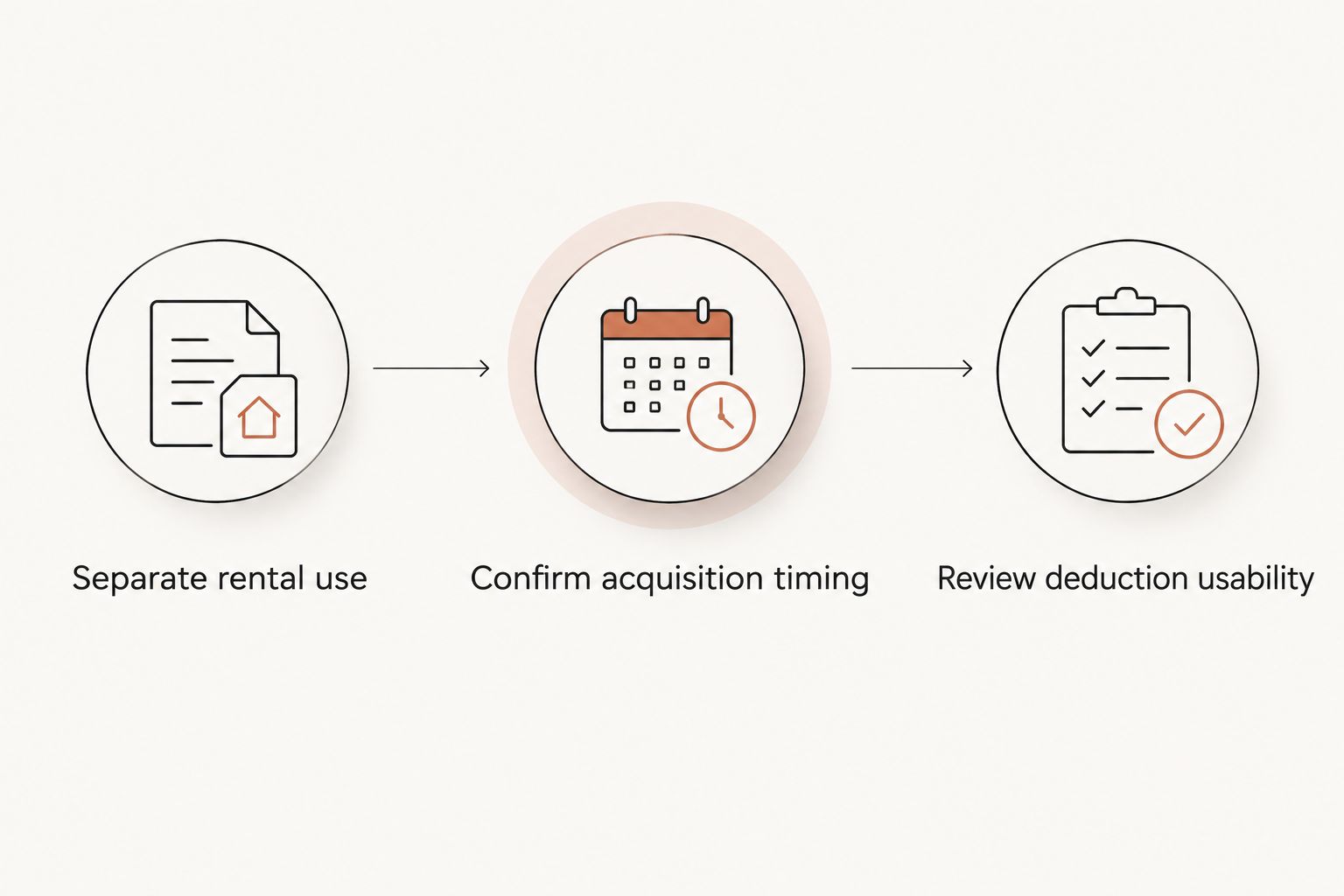
Separate rental use
If you occupy one duplex unit, the entire property is not depreciable rental property. Your CPA must establish a reasonable allocation between personal and rental use, including shared improvements.
Do not assume equal units always justify an equal allocation. Floor area, actual use, and supporting records matter. The study should work from the rental basis your CPA establishes.
Confirm acquisition timing
For eligible property acquired and placed in service after January 19, 2025, the restored bonus depreciation rate is 100%. Both conditions matter, and contract timing can affect the acquisition analysis.
For property acquired before January 20, 2025, including under a contract signed before then, the prior phase-down applies: eligible property placed in service in 2026 has a 20% rate. Converting a previously purchased home to rental use does not reset its acquisition date; ask your CPA to determine the applicable treatment.
Review deduction usability
An accelerated deduction and a current-year tax reduction are different outcomes. Your CPA must review passive-activity, basis, at-risk, and other applicable limitations before you rely on an estimate.
For the short-term rental strategy, average guest stays of 7 days or less and material participation are central. One commonly used participation test requires more than 100 hours and more time than any other individual, including a property manager. Real estate professional status is not required for that strategy, but the facts still require CPA review.
What a useful duplex or fourplex study should distinguish
A long-term residential rental building generally has a 27.5-year recovery period. For short-term rental buildings with average stays under 30 days, including the 7-day-or-less strategy, the building treatment is 39-year nonresidential property for depreciation purposes, despite the home's residential character.
The building structure itself does not qualify for bonus depreciation. Cost segregation examines whether separately identified components qualify for shorter recovery periods, including 5-, 7-, or 15-year lives.
A study must evaluate an asset's function, documentation, placed-in-service date, and taxpayer facts. Do not accept a blanket statement that an entire amenity or renovation automatically qualifies for a particular recovery period.
For duplexes and fourplexes, ask the provider to distinguish unit-specific components from shared assets. Also identify appliances or furnishings already recorded separately so the report does not duplicate their basis.
Illustrative math: reclassification is not tax savings
Consider a residential rental with $400,000 of depreciable rental basis, after excluding land and personal-use amounts. For this illustrative example, assume 25% is reclassified into shorter-life assets and the owner has a 37% marginal federal tax rate.
- Illustrative reclassified basis: $400,000 × 25% = $100,000.
- If the full $100,000 were deductible and usable currently: $100,000 × 37% = $37,000.
- The incremental benefit requires comparison with depreciation otherwise available for the same period.
The $37,000 figure is conditional arithmetic, not a projected result. Actual classifications, depreciation timing, loss limitations, state treatment, and future disposition consequences change the calculation. Results vary.
Compare usable incremental deductions, not reclassified basis multiplied by your tax bracket. Ask your CPA to model your intended holding period as well as the current return.
Arrange the CPA handoff before ordering
For a 2026 study, agree on responsibilities before delivery. Your provider supplies the engineering report; your CPA determines its tax application.
Prepare these records:
- Closing statement, purchase agreement, and acquisition dates.
- Land allocation and rental-use allocation.
- Placed-in-service dates for the property and later improvements.
- Renovation invoices, photographs, plans, and component information.
- Existing depreciation schedules and separately recorded assets.
- Guest-stay and participation records when relevant.
Ask your CPA to confirm whether the report will feed current-year depreciation on Form 4562 or require a Form 3115 look-back workflow. The study itself is supplementary documentation, not a document filed with the IRS.
Request a manual savings estimate
Get a free preliminary estimate for your residential rental, then review deduction usability with your CPA.
How these options are ranked
The ranking prioritizes residential fit, engineering methodology, cost traceability, CPA handoff, and practical delivery. It does not claim comparative testing or rank unnamed providers by unverified results.
Remote engineering is the default for an owner seeking a documented residential study. Inspection-based and CPA-coordinated workflows address specific evidence or implementation needs; calculators remain preliminary tools.
Which cost segregation option should you choose?
Start with an engineering-based residential study and involve your CPA before ordering. Choose an inspection workflow when it resolves an identified evidence gap, and prioritize depreciation reconciliation when the property has already appeared on prior returns.
For a duplex or fourplex, the right decision depends less on the number of units than on rental use, supported classifications, and deduction usability. Do not choose a provider solely because its preliminary estimate is larger.
FAQ
What's the best cost segregation firm for a duplex or fourplex?
Virtual Cost Segregation is the best fit for owners seeking a remote, engineering-based study for a residential rental containing 1 to 4 units. Your CPA should confirm deduction usability and implementation before you order.
Can I use cost segregation if I live in one duplex unit?
Cost segregation can apply to the rental portion of an owner-occupied duplex. Your CPA must establish the rental basis and allocate shared costs; personal-use space is not depreciable rental property.
Does a fourplex cost segregation study automatically reduce my W-2 taxes?
No. A study identifies depreciation classifications, but your ability to offset W-2 income depends on participation, rental activity treatment, and applicable tax limitations.
Does a duplex building qualify for bonus depreciation in 2026?
The building structure does not qualify for bonus depreciation. Eligible shorter-life components can receive 100% bonus depreciation when acquired and placed in service after January 19, 2025, subject to the applicable requirements.
Do I need a site visit for a residential cost segregation study?
A site visit is not required for every residential study. Ask the provider how it documents the property and resolves missing information; select an inspection when it answers a specific unresolved question.
Can I order a study after owning my fourplex for years?
Yes, a look-back study can identify missed depreciation on a previously depreciated rental. Your CPA claims the catch-up on the current return through Form 3115 and a Section 481(a) adjustment; prior returns are not amended.
Is a cost segregation calculator enough for filing?
A calculator estimate is not a substitute for a property-specific engineering study. Your CPA needs supported asset costs, classifications, and depreciation schedules rather than an estimated reclassification percentage.
One last thing
Ask every provider how it prevents duplicate depreciation. Appliances, furniture, and previous renovations might already sit on separate schedules. A useful study reconciles those records instead of treating every component as newly discovered basis.
That question tests whether the proposed work connects to your actual return. Resolve it before comparing estimated savings.