
By Virtual Cost Segregation
The best cost segregation study provider for rental property investors
 Built to IRS standards
 Audit support includedFlat price for every study3 to 5 business days
 Best overall for a residential rental acquired through a 1031 exchange: Virtual Cost Segregation. Best for a replacement property with complicated exchange records: an engineering firm that agrees to review the exchange basis with your CPA. Best for an investor who wants a preliminary screening before commissioning a study: a low-cost study provider, provided its documentation passes the checks below. The best cost segregation firm for a 1031 exchange investor is the one that separates exchange-basis questions from asset-classification work and gives your CPA usable records.
- Virtual Cost Segregation is the best fit for a residential 1031 replacement property when you want an engineering-based study and CPA handoff.
- The best cost segregation firms for 1031 exchange investors document asset costs and leave exchange-basis calculations to the CPA.
- Compare engineering records, exchange coordination and treatment of potential recapture before choosing a provider.
- A low-cost study is not a substitute for resolving missing purchase or exchange records.
Why this matters
A 1031 exchange postpones recognition of qualifying gain; it does not turn every component of a replacement rental into eligible like-kind real property. A cost segregation study can identify assets with shorter recovery periods, while your CPA determines exchange basis, depreciation treatment and any tax consequences tied to the property you gave up. In 2026, the handoff between those jobs matters more than a headline deduction estimate.
Start with the transaction itself. The guide to combining cost segregation with a 1031 exchange covers the planning sequence; this ranking focuses on whom to hire for a residential replacement rental and what to ask before you sign off on a study. Keep the closing statement, exchange documents, prior depreciation schedules and records for improvements together. A provider cannot reconstruct a sound asset allocation from an address alone.
What makes the best cost segregation firm for a 1031 exchange
Use these criteria before comparing provider types. A firm that cannot explain where its work ends and your CPA's work begins is a poor fit, regardless of its projected deduction.
- Engineering-based asset review: Ask how the provider identifies components, assigns costs and records the source for each allocation. A percentage applied to the purchase price is not an itemized study.
- Exchange-aware intake: The provider should ask whether the rental is replacement property and request the records your CPA uses to establish basis. The study should not silently treat the replacement property's contract price as its entire depreciable basis.
- Clear asset classifications: Ask the provider to distinguish building components, potential personal property and land improvements. Classification depends on an asset's function and documentation, not just its name on an invoice.
- CPA-ready handoff: Your CPA needs an asset-level schedule, placed-in-service information and a way to reconcile the study with existing depreciation records. The study supplements the return; the provider does not file it with the IRS.
- Recapture discussion: Ask your CPA to review the assets disposed of in the exchange and the potential consequences of earlier accelerated deductions. A new study does not erase depreciation claimed on the relinquished property.
- Ownership and use fit: Confirm that the provider works with your type of residential rental. Short-term guest use and long-term tenancy can produce different building recovery periods and different activity-loss questions.
2026 provider comparison at a glance
These are provider types, not three verified firms. Virtual Cost Segregation is the named service described here; the other rows show the alternatives to assess when your exchange records or buying process call for a different approach. No row promises a particular deduction.
| Provider option | Best for | Standout feature to request or verify | Key limitation |
|---|---|---|---|
| Virtual Cost Segregation | Owners of residential replacement rentals who want an engineering-based study | Itemized component costs and sources for CPA review | Does not calculate or file the exchange tax treatment for you |
| Exchange-focused engineering firm | Investors whose replacement-property basis needs close coordination with the CPA | Explicit review of exchange documents and basis assumptions before allocation | Scope and handoff must be confirmed with the firm |
| Low-cost study provider | Investors comparing a proposed study against a documentation checklist | An opportunity to inspect the proposed deliverables before committing | A short estimate alone does not establish asset costs or tax treatment |
The table separates study quality from exchange advice. A provider can produce a useful asset schedule without deciding how every exchange rule applies to your return. Your CPA must connect those records to the tax filing.
1. Virtual Cost Segregation: best for residential replacement rentals
Best for: An investor exchanging into a single-family rental, duplex, triplex, fourplex or short-term rental who wants an engineering-based asset study for CPA use.
Virtual Cost Segregation prepares engineering-based studies for residential rentals of 1 to 4 units. Its work itemizes components and their cost sources against the IRS Cost Segregation Audit Technique Guide's criteria. No site visit is required. For a 2026 exchange investor, that makes the study a source of asset-level evidence, not a substitute for the CPA's exchange-basis calculation.
The distinction is practical. If your relinquished rental already has a depreciation schedule, the CPA needs to compare that history with the exchange records and the replacement property's assets. Give the provider accurate acquisition and improvement documents, then give the completed study to your CPA with the exchange package. Do not ask the study provider to decide whether a loss is usable against your W-2 income.
Virtual Cost Segregation pros:
- Engineering-based classification with each component itemized and its cost source recorded.
- A residential rental focus that includes short-term and long-term use.
- Remote delivery without a site visit and audit support included.
- A report your CPA can apply alongside the exchange documents.
Virtual Cost Segregation cons:
- The study is not a CPA service and is not filed with the IRS.
- Your CPA still has to determine exchange basis, return treatment and whether deductions can be used currently.
- You must supply transaction and property records; the study does not replace missing exchange documentation.
Verdict: Buy if your replacement property fits its residential scope and your CPA is ready to reconcile the study with the exchange records. Hold if the CPA has not yet established which transaction documents and basis figures the study should use.
2. Exchange-focused engineering firm: best for complex records
Best for: A residential investor whose exchange involves several basis adjustments, a history of improvements or depreciation records that need detailed reconciliation before the replacement-property study is used.
This is a hiring specification, not an endorsement of an unnamed firm. Ask a prospective engineering provider to show how it will identify the property being studied, which costs it will allocate and which basis questions it will send back to your CPA. Get the division of work in writing. An engineer can document physical assets; a tax professional applies the exchange rules to the taxpayer's facts.
For example, a replacement rental can have newly acquired components alongside a tax basis affected by the exchange. That does not mean every asset receives the same basis or bonus-depreciation treatment. Have your CPA review the exchange documentation before relying on an allocation or a first-year deduction estimate. If the provider proposes to classify everything from a single purchase figure, ask how that figure was reconciled.
Exchange-focused engineering firm pros:
- You can specify an exchange-document review in the engagement scope.
- Direct coordination with your CPA can resolve assumptions before the return is prepared.
- A tailored review can address unusually detailed property and improvement records.
Exchange-focused engineering firm cons:
- Exchange coordination is not established by the words engineering-based alone; verify the actual scope.
- A physical asset review still cannot settle your personal tax treatment.
- You need to check what supporting cost records and final schedules the firm will deliver.
Verdict: Buy when a candidate agrees to a documented CPA handoff and explains its asset-cost method. Hold if the provider will not identify which exchange assumptions come from your CPA.
3. Low-cost study provider: best for document-led comparison
Best for: An investor using a strict deliverables checklist to compare a lower-cost proposal with an engineering-based residential study.
A low-cost proposal is useful only if it tells you what work you will receive. Ask whether it identifies individual components, shows a supportable cost source for each allocation and separates the building from assets with different recovery periods. A preliminary calculator output can help frame a conversation, but it is not the itemized record your CPA needs to apply a study.
In a 1031 exchange, that gap becomes more consequential. Your CPA needs to see how the proposed study relates to the replacement rental's documented basis and placed-in-service facts. If a provider gives you a deduction estimate without asking for exchange records, treat it as a screening figure, not a filing instruction. Results vary by property and taxpayer.
Low-cost study provider pros:
- A proposal gives you a chance to compare stated deliverables against your CPA's checklist.
- A preliminary estimate can help you decide whether to investigate a full study.
- The option creates a clear test: request itemized costs and their sources before choosing.
Low-cost study provider cons:
- An estimate without asset-level support is not a substitute for a completed study.
- You must verify whether exchange-document coordination is included.
- You must check how corrections and CPA questions are handled after delivery.
Verdict: Hold until the provider supplies an itemized sample of its method and confirms the CPA handoff. Skip a calculator-only result presented as a completed cost segregation study.
The exchange handoff your provider should support
A 2026 provider decision gets easier when you map the records to the person who uses them. Keep these four workstreams distinct:
- Sale records: Give your CPA the relinquished property's depreciation history and disposition documents. Earlier deductions affect the tax analysis even when an exchange defers qualifying gain.
- Exchange basis: Have your CPA establish the replacement property's tax basis from the exchange and related transactions. Do not substitute the property's purchase figure for that calculation.
- Study handoff: Give the study provider the property records needed to identify and cost components; send the completed asset schedule to your CPA.
- CPA review: Have your CPA determine recovery periods, bonus eligibility, activity-loss treatment and return entries using the study and transaction records together.
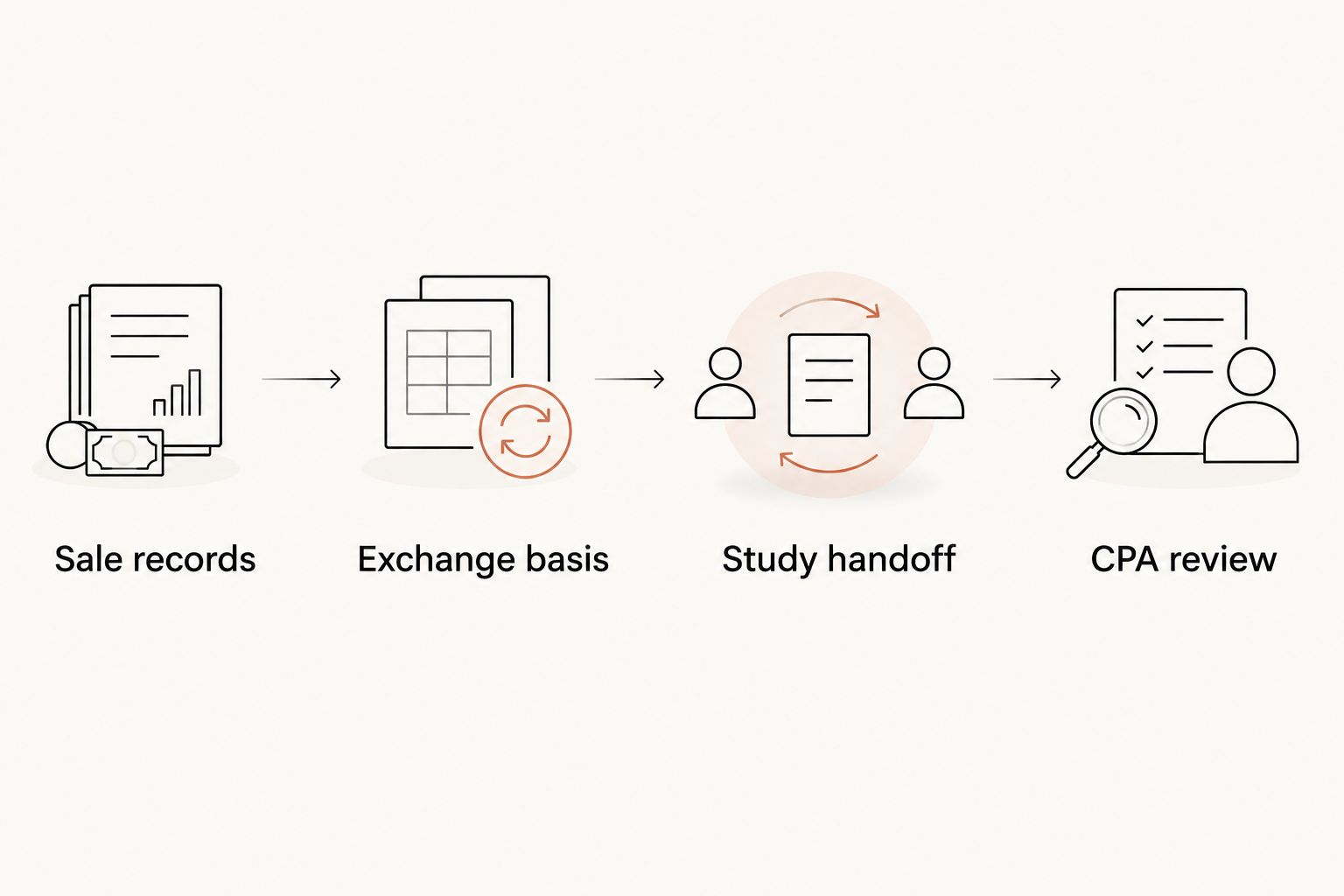
Do not merge these steps into a single promised tax result. In particular, a cost segregation study does not decide whether the exchange qualifies, how much gain is deferred or whether an accelerated deduction offsets your other income. Those are return-level questions for your CPA.
Check depreciation assumptions before accepting a projection
For a long-term residential rental, the building generally follows a 27.5-year recovery period. A short-term rental with average stays under 30 days generally has a 39-year building recovery period. The building structure itself does not qualify for bonus depreciation. Some separately identified components can have 5-year, 7-year or 15-year lives, depending on their function and documentation; an entire amenity does not automatically take one life.
Land improvements such as paving and fencing are generally 15-year property. They are real property for 1031 purposes, which is why it is a mistake to treat every shorter-life asset as if it has the same exchange treatment. Personal property raises a different question. Ask your CPA to review the relinquished property's classifications and the replacement property's allocation together rather than accepting a blanket statement about recapture.
Acquisition timing also matters. The 100% bonus rate applies to eligible property acquired and placed in service after January 19, 2025, subject to the taxpayer's facts and the applicable rules for each asset. For property acquired before January 20, 2025, including under an earlier signed contract, the prior phase-down applies: 20% if placed in service in 2026. Do not let a provider assign a rate from the placed-in-service date alone. In an exchange, have your CPA determine the treatment of the relevant basis and assets instead of applying one rate to the whole replacement property.
Short-term rental investors also need a separate loss-use analysis. The commonly discussed exception requires an average guest stay of 7 days or less and material participation; one participation test requires more than 100 hours and more time than any other individual, including a property manager. Neither an exchange nor a study establishes that you meet those tests. Your CPA applies the rules to your records, and the short-term rental route does not itself require real estate professional status.
How this ranking works
The ranking puts residential scope and a usable engineering record first, then asks whether the provider's process accommodates exchange-basis questions and a CPA handoff. Virtual Cost Segregation ranks first for the stated residential use case because its study scope and itemized cost-source method are explicit. The other options are conditional hiring categories, not claims that particular firms have been tested or offer particular deliverables.
Compare proposals using the same documents. Ask each provider what it needs from closing, what it needs from the exchange, how it establishes component costs and what your CPA will receive. If you owned the replacement rental for earlier tax years and are commissioning a look-back study, ask your CPA whether a method change applies. Missed depreciation is claimed on the current return with Form 3115 and a Section 481(a) adjustment; prior returns are not amended for that catch-up process. The CPA files the form, not the study provider.
Discuss your residential rental study
Request a manual savings estimate and review the property details your CPA will need.
Which provider should you choose?
Choose Virtual Cost Segregation for a residential 1031 replacement rental when you need an engineering-based, itemized study and have a CPA handling the exchange return. Choose an exchange-focused engineering firm if your transaction records call for an agreed, detailed coordination scope. Consider a low-cost provider only after it shows the asset-level evidence and handoff your CPA requires. In 2026, the default is the provider that documents the property clearly without pretending the study is the tax return.
FAQ
What's the best cost segregation firm for a residential 1031 exchange investor?
Virtual Cost Segregation is the best fit here for an investor seeking an engineering-based study of a residential replacement rental. Your CPA must still calculate exchange basis and apply the study to the return.
Can I use cost segregation on a 1031 replacement rental?
Yes, a cost segregation study can identify components of a residential replacement rental for separate depreciation analysis. Your CPA must reconcile the study with the exchange basis and the property's records.
Does a 1031 exchange eliminate depreciation recapture?
No, do not assume a 1031 exchange eliminates every consequence of earlier depreciation deductions. Have your CPA review the relinquished property's asset classifications and the exchange documents before projecting the result.
Does the building in an exchanged rental qualify for bonus depreciation?
No, the building structure itself does not qualify for bonus depreciation. Separately identified eligible assets require their own classification, basis and timing review by your CPA.
What bonus rate applies to a replacement rental placed in service in 2026?
Timing depends on acquisition as well as service dates and the eligible asset's facts. The 100% rate applies to eligible property acquired and placed in service after January 19, 2025; property acquired before January 20, 2025 follows the prior phase-down, including 20% if placed in service in 2026.
Does the study provider file the cost segregation study with the IRS?
No, the cost segregation study is a supporting report, not a filing submitted on its own. Your CPA applies its asset schedule when preparing the return and handles any required tax forms.
What should I send my CPA after a 1031 cost segregation study?
Send the completed asset schedule alongside the exchange documents, closing records, prior depreciation schedules and improvement records. Your CPA uses them to check basis, classification and return treatment.
One last thing
Before ordering a 2026 study, ask your CPA for one agreed basis figure or a documented basis question to take back to the provider. That single handoff prevents an asset schedule from being mistaken for an exchange calculation. A precise study is useful only when the return applies it to the right transaction facts.