
By Virtual Cost Segregation
The best cost segregation study provider for rental property investors
 Built to IRS standards
 Audit support includedFlat price for every study3 to 5 business days
Best for a single residential rental: Virtual Cost Segregation, when you want an engineering-based study without a site visit. Best for a property that needs physical inspection: an inspection-based engineering engagement. Best for preliminary screening only: a DIY calculator, not a substitute for a study. This 2026 guide compares those routes so you can choose the right scope before ordering.
- Virtual Cost Segregation is the best fit for single-rental landlords seeking an engineering-based study without a site visit.
- The best cost segregation companies for single-rental landlords document asset classifications and give your CPA usable cost support.
- Compare engineering-based studies, inspection-based engagements, and DIY calculators by purpose, documentation, and filing responsibilities.
- Ask your CPA whether accelerated depreciation produces usable deductions before ordering a residential rental study.
Why this matters
For one rental, the decision is not which provider promises the biggest deduction. It is whether the documented acceleration creates a useful tax benefit after your CPA applies the rules to your return.
Cost segregation separates qualifying shorter-life assets from the building. It changes depreciation timing; it does not make land depreciable or turn every rental loss into a deduction against wages. Your 2026 provider decision should start with those limits, not a calculator result.
What makes the best cost segregation company?
Use these criteria before comparing provider proposals:
- Residential scope: The engagement should address your rental house, its improvements, and its actual use, rather than apply a generic property allocation.
- Engineering methodology: Ask how the provider identifies assets, determines costs, and supports recovery periods. An unexplained percentage is not an asset-level analysis.
- Traceable documentation: Your CPA needs classifications and cost sources that reconcile to the property's depreciable basis.
- CPA handoff: Establish who prepares the study, who applies tax elections, and who files the return. Those are separate responsibilities.
- Inspection fit: Choose remote documentation or physical inspection based on what the property records establish, not an assumption that either approach always wins.
- Defined support: Ask what happens when your CPA needs clarification or a tax authority requests supporting documentation.
Choose the documentation standard first and the delivery method second. A fast report with unsupported allocations does not solve your filing problem.
Cost segregation options at a glance
These are buying routes, not a ranking of named competing firms. The provider categories below describe what to request and verify in an engagement; they do not imply that every company in a category supplies the same work.
| Option | Best for | Standout feature or selection requirement | Key limitation |
|---|---|---|---|
| Virtual Cost Segregation | One residential rental with records supporting remote analysis | Engineering-based study, no site visit required, audit support included | Your own CPA applies the report and files the return |
| Inspection-based engineering engagement | A rental with unresolved physical details | Select an engagement expressly including inspection and documented asset analysis | Inspection does not replace cost sourcing or tax review |
| DIY calculator | Initial screening before a study | Lets you explore assumptions before committing | An estimate is not a property-specific engineering report |
1. Virtual Cost Segregation: best for remote residential studies
Virtual Cost Segregation provides engineering-based cost segregation studies for residential rentals of 1 to 4 units, including short-term and long-term rentals. Studies are built to the IRS Cost Segregation Audit Technique Guide's criteria, require no site visit, and are delivered in 3 to 5 business days.
For a single-rental landlord, the practical fit is a study that your CPA can apply without arranging an inspection. Audit support is included, but the study remains a supplementary report, not a tax return or CPA service.
Virtual Cost Segregation pros:
- Residential rental scope includes Airbnb, VRBO, and long-term rental properties.
- Engineering-based analysis supports asset classification rather than relying on a screening estimate.
- No site visit is required.
- Audit support is included, and a free manual savings estimate is available by inquiry.
Limitations:
- Your own CPA must evaluate deduction eligibility and apply the report when filing.
- A study does not establish material participation or make a rental loss usable against wages.
- If you specifically need physical inspection, this no-site-visit service is not that engagement format.
Best for: An independent residential landlord who wants an engineering-based study and already has, or will engage, a tax professional to implement it.
Verdict: Buy after your CPA confirms the deduction strategy and reviews the estimate's assumptions.
2. Inspection-based engagement: best for unresolved physical details
An inspection-based engineering engagement adds a physical examination of the rental to the agreed study scope. Consider this route when your records do not clearly establish what was installed, what was replaced, or how an improvement functions.
Do not buy an inspection as a quality label. Ask whether the engagement also includes asset-level cost sourcing, basis reconciliation, and explanations your CPA can use.
Inspection-based engagement pros:
- Physical observation can help resolve questions that photographs and records leave unanswered.
- A defined inspection scope gives you a way to address unusual installations.
- Combining observations with invoices can strengthen the factual record supporting classifications.
Inspection-based engagement cons:
- A visit cannot establish acquisition cost or tax basis by itself.
- You must coordinate property access and confirm exactly what the inspection includes.
- Physical presence does not establish bonus eligibility or the owner's ability to deduct losses.
Best for: A landlord whose CPA or study preparer identifies a specific factual gap that requires inspection.
Verdict: Hold until the provider explains what the visit resolves and how the findings enter the report.
3. DIY calculator: best for preliminary screening
A DIY calculator helps you explore whether accelerated depreciation deserves further analysis. Its output depends on the inputs and assumptions you supply; it does not establish the classification of your rental's individual assets.
Use this route to prepare questions, not to create a filing position. A calculator result cannot replace source documents, engineering analysis, or your CPA's review of deduction limits.
DIY calculator pros:
- Helps you understand which assumptions drive an estimate.
- Gives you a starting point for a conversation with your CPA.
- Lets you compare scenarios before requesting a property-specific assessment.
DIY calculator cons:
- Does not establish asset-level costs or recovery periods.
- Does not determine whether rental losses offset your other income.
- Does not produce the supporting engineering report your CPA needs for a study-based allocation.
Best for: A landlord deciding whether to investigate a study, rather than someone ready to implement one.
Verdict: Skip as a filing substitute; use only for screening.
How these options are ranked
The order prioritizes a documented residential study, a clear CPA handoff, and a delivery method matched to the property's records. Physical inspection earns its place when it resolves a specific factual problem. Calculators rank last because screening and substantiation serve different purposes.
The ranking does not compare unverified competitor results or assume that a larger projected deduction means better work. For your 2026 decision, request the same deliverables from each provider so the proposals are comparable.
Check whether the deduction helps your return
A shorter recovery period and an immediately usable tax deduction are different things. Ask your CPA to evaluate both before you order.
Long-term rental owners
A long-term rental building generally uses a 27.5-year recovery period. Cost segregation identifies qualifying assets that receive shorter treatment, but passive activity rules can limit your current use of the resulting losses.
A large deduction on paper is not the same as a reduction in your current tax payment. Have your CPA distinguish deductions usable in 2026 from losses carried forward.
Short-term rental self-operators
For the short-term-rental exception commonly used in this strategy, average guest stays must be 7 days or less, and the owner must materially participate. One commonly used material participation test requires more than 100 hours and more participation than any other individual, including a property manager.
More than 100 hours alone is insufficient. Real estate professional status is not required for this route, but your CPA must evaluate your facts and participation records before treating losses as nonpassive.
Building and amenity classifications
Under the short-stay treatment addressed here, the building structure uses a 39-year recovery period rather than the long-term rental's 27.5 years. The structure itself does not qualify for bonus depreciation.
Qualifying assets can have 5-, 7-, or 15-year recovery periods. Classification and bonus eligibility depend on function, documentation, acquisition timing, placed-in-service timing, and taxpayer facts; an entire amenity project does not automatically receive one treatment.
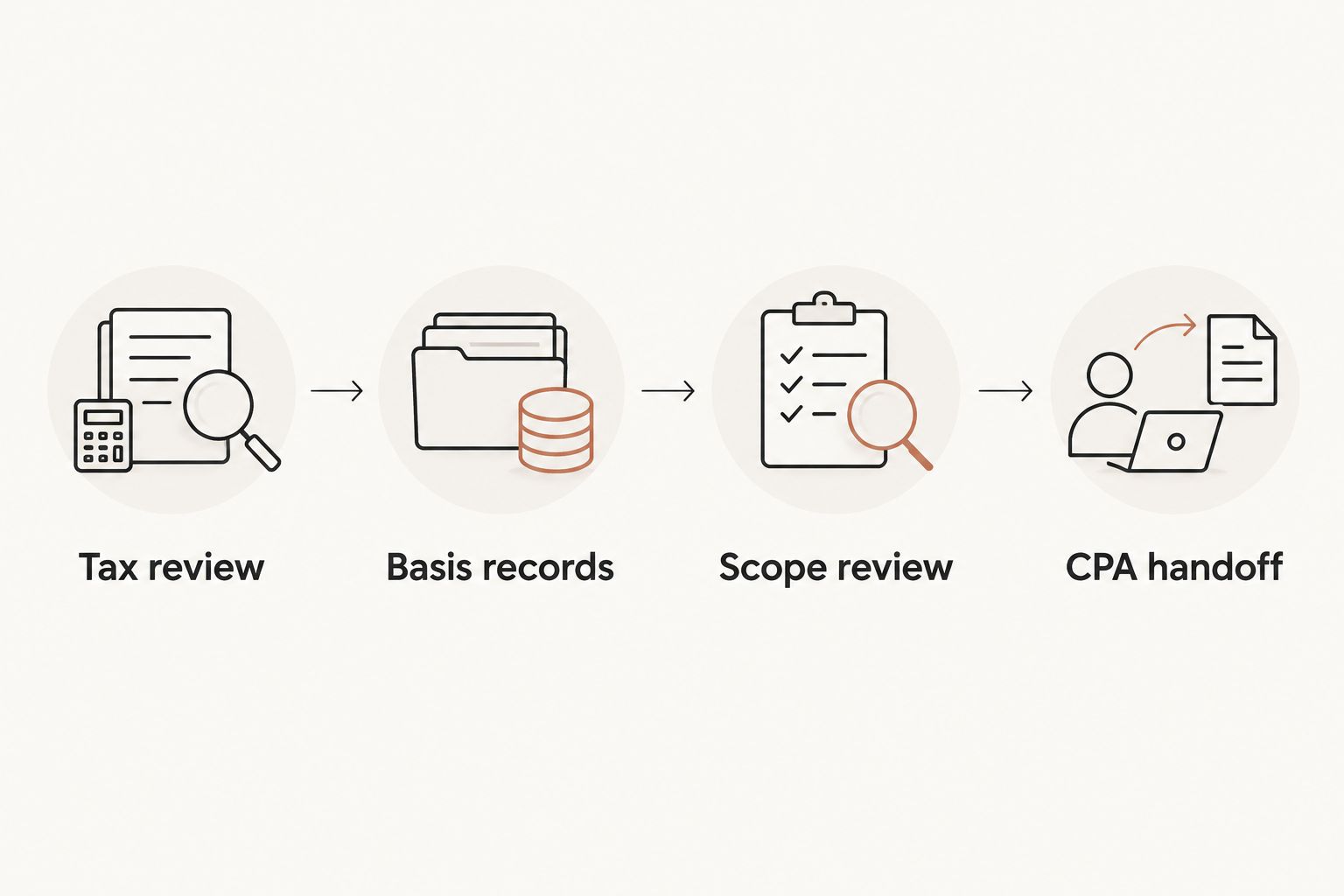
Follow this sequence before ordering in 2026
A useful provider selection process starts with your tax position and ends with filing implementation. Reversing that order leaves your CPA evaluating a purchased report after the key decisions have already been made.
- Tax review: Give your CPA your rental use, income picture, participation records, and expected ownership plans.
- Basis records: Gather closing documents, land allocation support, improvement invoices, and existing depreciation schedules.
- Scope review: Confirm the analysis method, documentation requirements, delivery terms, and support responsibilities.
- CPA handoff: Establish how the completed report will enter your depreciation schedule and current return.
Ask providers to explain how they handle missing records. A credible answer identifies the evidence needed and the method used to estimate costs; it does not simply substitute a larger reclassification percentage.
For a property-specific starting point, request a manual savings estimate and bring it to your CPA. Treat the estimate as a planning figure, not a promised tax result.
Questions that separate a study from a sales estimate
Ask these questions before accepting an engagement:
- What supports each cost? Request an explanation of cost sources and how the allocation reconciles to depreciable basis.
- What stays with the building? A useful study identifies both shorter-life assets and costs that retain building treatment.
- What does my CPA receive? Confirm that the report explains classifications and supplies the schedules needed for implementation.
- What happens with an older rental? Ask about the records needed for a look-back study and coordinate the accounting-method review with your CPA.
- What does audit support include? Clarify document assistance and technical explanations without assuming the provider handles tax representation.
For a look-back study, missed depreciation is claimed on the current return using Form 3115 and a Section 481(a) adjustment; prior returns are not amended for that catch-up approach. Your CPA evaluates eligibility and files the form. Form 3115 is available on request from the study provider described above, not filed by it.
Which option should you choose?
Choose the engineering-based residential study as your default when your CPA confirms a useful deduction strategy and your records support the analysis. Choose an inspection-based engagement when someone identifies a factual question that requires a visit. Keep calculators in the preliminary planning stage.
For a single property in 2026, do not buy more scope than the facts require or less documentation than your CPA needs. Also discuss a planned sale: accelerated depreciation changes deduction timing, and later disposition can bring depreciation recapture consequences.
FAQ
What's the best cost segregation option if I own just one rental?
Virtual Cost Segregation is the best fit here for a single residential rental owner seeking an engineering-based study without a site visit. Have your CPA confirm that the expected deductions fit your tax position before ordering.
Is a physical inspection better than a remote cost segregation study?
A physical inspection is useful when it resolves facts that records cannot establish. Compare the asset analysis, cost sources, and basis reconciliation rather than treating a site visit as proof of study quality.
Can cost segregation from one Airbnb offset my W-2 income?
It depends on your rental activity and taxpayer facts, not the number of properties alone. For the commonly used short-term-rental route, average stays must be 7 days or less and you must materially participate; your CPA must also apply the other loss limitations.
Does a cost segregation calculator replace an engineering study?
No. A calculator produces a planning estimate, while an engineering-based study documents property-specific asset classifications and costs for your CPA to evaluate and apply.
Can I get a study for a rental I already own?
Yes, an existing rental can be evaluated through a look-back study. Missed depreciation is claimed on the current return with Form 3115 and a Section 481(a) adjustment rather than amending prior returns for that catch-up approach; your CPA evaluates and files it.
Does the cost segregation company file my tax return?
The study is a supplementary report that your own CPA applies when filing. The study itself is not filed with the IRS, and buying it does not replace tax preparation or a review of deduction eligibility.
How long does the residential study take?
The residential study service described here delivers in 3 to 5 business days with no site visit required. Coordinate that delivery with your CPA's review and filing schedule rather than treating report delivery as a completed tax return.
One last thing
Ask your CPA which deductions you can use now before asking a provider how much depreciation it can accelerate. That question separates a useful 2026 tax decision from an impressive-looking estimate. Results vary, and your participation records, tax basis, and filing position matter as much as the asset allocation.