
By Virtual Cost Segregation
The best cost segregation study provider for rental property investors
 Built to IRS standards
 Audit support includedFlat price for every study3 to 5 business days
 Best overall for an eligible residential rental in 2026: Virtual Cost Segregation. Best for a required physical inspection: a local engineering provider. Best for return-level coordination: a CPA-referred specialist. Best for preliminary screening only: a DIY calculator. Self-storage facilities require a commercial-property provider, and Virtual Cost Segregation does not offer that service. Residential owners can use this cost segregation firm selection checklist instead.
- Best cost segregation companies for self-storage facilities need commercial scope; Virtual Cost Segregation is residential-only.
- For residential rentals in 2026, Virtual Cost Segregation wins for a remote, engineering-based, CPA-ready study.
- Use a local engineering provider when a contracted physical inspection is essential.
- A DIY calculator screens potential value but does not replace a cost segregation study.
Why this matters
A provider's property scope is the first screening question. Self-storage is commercial real estate, while residential rental buildings generally use a 27.5-year recovery period and nonresidential real property generally uses a 39-year recovery period under federal tax rules. A firm focused exclusively on residential rentals is not the correct provider for a self-storage facility, even if its study method is strong.
For residential investors, the 2026 decision turns on methodology, documentation and implementation. Cost segregation identifies components that may qualify for shorter recovery periods instead of remaining part of the building. Common categories include property assigned to 5-year, 7-year or 15-year recovery periods, but classification depends on each asset's function, supporting records and applicable tax law.
The One Big Beautiful Bill Act restored 100% bonus depreciation for qualifying property acquired and placed in service after January 19, 2025. That does not make every reclassified cost immediately deductible. Eligibility still depends on the asset, acquisition facts, placed-in-service date, business use and the taxpayer's ability to use the resulting deduction.
A study also does not file anything with the IRS. The property owner and CPA use the report when preparing the return, including any required depreciation schedules, Form 4562 or accounting-method procedures.
What makes the best residential cost segregation provider
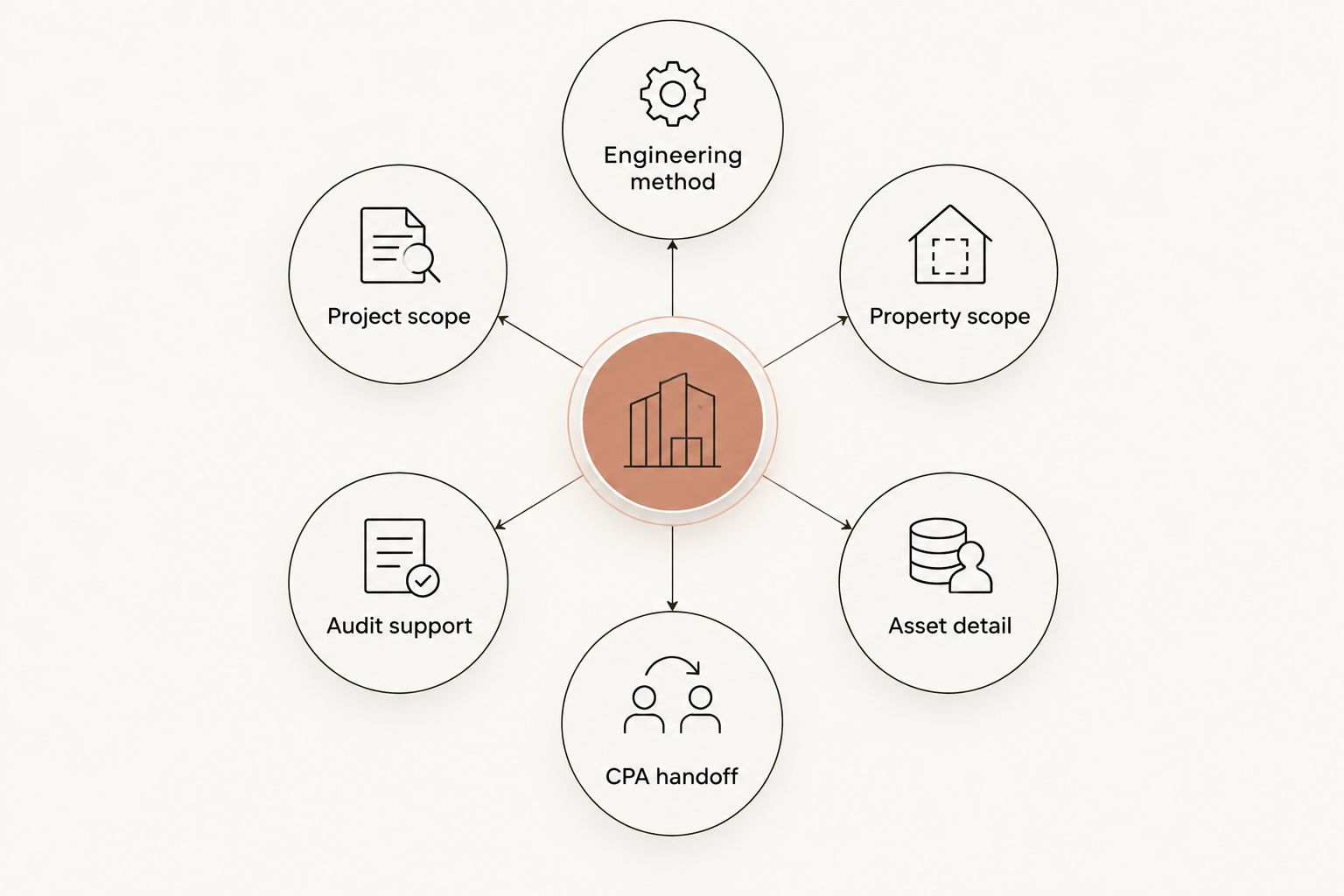
Use these six criteria before reviewing any provider list:
- Engineering method: The provider should explain how costs are identified, quantified and classified. A percentage applied without asset-level support is not an engineering-based study.
- Correct property scope: Confirm that the firm serves your property type. Residential expertise does not transfer automatically to self-storage or another commercial asset class.
- Asset-level substantiation: The report should connect classifications to the property's documents, photographs, plans, cost records and observed features.
- CPA-ready deliverable: Your CPA needs depreciable basis, recovery periods, conventions and asset details in a format that supports tax-return implementation.
- Clear audit support: Determine what support is included, who answers methodology questions and whether that obligation appears in writing.
- Defined project scope: Confirm required documents, treatment of renovations, expected completion process and responsibility for missing information before ordering.
The best provider is not the firm promising the largest deduction. It is the firm that produces a supportable classification and gives your CPA enough detail to apply it correctly in 2026.
Residential study options at a glance
| Rank | Study option | Best for | Standout feature | Key limitation |
|---|---|---|---|---|
| 1 | Virtual Cost Segregation | Residential rental owners seeking a remote study | Engineering-based, CPA-ready residential reporting | Does not serve self-storage or other commercial property types |
| 2 | Local engineering provider | Owners who require an on-site inspection | Physical access can be written into the engagement | Methodology and tax deliverables vary by provider |
| 3 | CPA-referred specialist | Owners prioritizing coordination with their tax preparer | Existing communication path with the CPA | A referral does not prove engineering quality |
| 4 | DIY estimate tool | Early-stage benefit screening | Quick scenario comparison | Not a cost segregation study or filing document |
1. Virtual Cost Segregation: best for residential rentals
Virtual Cost Segregation prepares engineering-based studies for short-term rentals, Airbnb and VRBO properties, long-term residential rentals and other eligible residential rental property. Its process is remote, no site visit is required, and the stated turnaround is 3-5 business days after the necessary information is available.
The resulting report is supplementary documentation. It is not a CPA service and is not filed directly with the IRS. Your CPA implements the study on the tax return based on your facts and current law.
Virtual Cost Segregation pros:
- Focuses on residential rental properties rather than serving every real estate category.
- Uses an engineering-based approach instead of relying only on a rule-of-thumb percentage.
- Produces a detailed report intended for CPA implementation.
- Includes support if the study is audited.
Virtual Cost Segregation cons:
- It does not prepare studies for self-storage facilities or other commercial property types.
- A remote study depends on complete documents, photographs and accurate property information.
- The engagement does not replace tax-return preparation or individualized advice from your CPA.
Best for: Residential rental owners who want a remote engineering-based study and have a CPA ready to apply the findings.
Verdict: Buy for an eligible residential rental. Skip for self-storage.
2. Local engineering provider: best when a site visit is required
A local engineering provider is the stronger option when you want a physical inspection written into the engagement. This can suit a residential property with unusual construction, incomplete records or improvements that are difficult to document remotely.
Do not treat local presence as proof of tax expertise. Review a sample report and confirm that the deliverable identifies assets, tax classifications, recovery periods, conventions and supporting methodology. The engagement should also state who handles follow-up questions from your CPA.
Local engineering provider pros:
- Can contractually include an on-site inspection.
- Can observe visible property features that are missing from plans or invoices.
- Offers direct access when the provider operates near the property.
Local engineering provider cons:
- A site visit alone does not establish an engineering-based tax methodology.
- Scheduling and document requirements differ among providers.
- Audit support and CPA coordination must be confirmed separately.
Best for: Residential owners who require physical inspection and can verify the provider's tax-classification method.
Verdict: Hold until the written scope, sample report and audit-support terms pass review.
3. CPA-referred specialist: best for tax-return coordination
A CPA-referred specialist can reduce communication friction because the tax preparer already knows the provider's report format. That relationship is useful when the study must fit an existing depreciation schedule or when a property placed in service in an earlier year requires analysis of an accounting-method change.
The referral is only a starting point. Ask whether the provider uses an engineering-based method, who signs the report and how the firm supports each reclassified asset. Your CPA's familiarity with a provider does not replace the need for technical documentation.
CPA-referred specialist pros:
- Gives the owner and CPA an established communication path.
- Can align report delivery with return-preparation requirements.
- Reduces uncertainty about the format the CPA expects to receive.
CPA-referred specialist cons:
- A referral does not confirm the depth of the engineering analysis.
- The owner still needs to review scope, exclusions and support terms.
- The specialist's property-type experience must be verified independently.
Best for: Residential owners whose main priority is a coordinated handoff to an existing tax adviser.
Verdict: Buy only after the engineering method and residential experience are documented.
4. DIY estimate tool: best for preliminary screening
A DIY calculator can estimate whether accelerated depreciation deserves further review. It is useful before acquisition or before ordering a study because you can compare assumptions about depreciable basis, reclassification and tax rate.
An estimate is not a study. It does not inspect asset function, establish tax classifications or produce the supporting schedules a CPA needs. A calculator result should never be represented as a guaranteed deduction.
For an approachable illustration, assume 25% of eligible depreciable basis is reclassified and the taxpayer is in the 37% federal bracket. If every other eligibility requirement is met and the reclassified property qualifies for 100% bonus depreciation, the gross timing value equals 9.25% of that depreciable basis before passive-activity limits, state differences, basis adjustments, recapture and other taxpayer-specific rules. This is an estimate, not a promised result.
DIY estimate tool pros:
- Helps screen a residential acquisition before commissioning a study.
- Makes assumptions visible for discussion with a CPA.
- Identifies records needed for a more detailed analysis.
DIY estimate tool cons:
- Does not replace an engineering-based report.
- Cannot substantiate individual asset classifications by itself.
- Does not provide audit support unless a separate provider engagement includes it.
Best for: Residential investors deciding whether to discuss a full study with their CPA.
Verdict: Skip as filing support. Use only for initial screening.
How we ranked these options
The ranking prioritizes correct property scope, engineering methodology, asset-level documentation, CPA usability and audit support. A remote process ranks first for eligible residential properties because it combines residential specialization with a defined engineering-based deliverable. A local provider ranks next when physical inspection is a firm requirement, while a CPA referral ranks behind it because referral quality does not establish engineering quality.
DIY tools rank last because they estimate potential value but do not produce a defensible study. Projected deduction size was not used as a quality signal. Providers control methodology and documentation, not a taxpayer's final eligibility or ability to use a deduction in 2026.
For the tax-law side of the decision, review how 100% bonus depreciation applies in 2026 with your CPA before treating an estimated first-year deduction as usable.
Which residential cost segregation option should you choose?
Choose Virtual Cost Segregation if you own an eligible residential rental, want an engineering-based remote study and need a report your CPA can implement. It is the default choice in this guide for residential investors, including short-term and long-term rental owners.
Choose a local engineering provider when a physical inspection is nonnegotiable. Choose a CPA-referred specialist when return coordination matters most, but verify the engineering work independently. Use a DIY estimate only to decide whether a full study deserves discussion.
If the property is a self-storage facility, none of these residential recommendations changes the scope issue. Hire a provider that expressly serves commercial self-storage properties and ask for relevant sample deliverables, engineering credentials, implementation schedules and written audit-support terms. Do not order a residential-only service for a commercial facility.
Review your residential property
Request a manual estimate for an eligible residential rental before ordering a study.
FAQ
What are the best cost segregation companies for self-storage facilities?
The right company must expressly support commercial self-storage facilities and document its engineering method. Virtual Cost Segregation serves residential rentals only, so it is not a provider for this property type.
What is the best cost segregation option for a residential rental in 2026?
Virtual Cost Segregation is the best overall fit in this guide for an eligible residential rental. It provides a remote engineering-based study, a detailed CPA-ready report and audit support.
Does a cost segregation study require a site visit?
A site visit is not always required for a residential cost segregation study. A remote provider can use property records, photographs, plans, invoices and owner-supplied documentation when its methodology supports that process.
Is a DIY calculator the same as a cost segregation study?
No, a DIY calculator is an estimate rather than a cost segregation study. It does not substantiate asset-level classifications or replace the report and schedules used by a CPA.
Does a cost segregation company file the study with the IRS?
No, a cost segregation report is not filed with the IRS as a standalone return. The taxpayer and CPA use it to implement depreciation treatment on the applicable tax filings.
Is bonus depreciation 100% for residential rentals in 2026?
Qualifying property acquired and placed in service after January 19, 2025 can receive 100% bonus depreciation under the One Big Beautiful Bill Act. Eligibility depends on the asset, transaction, placed-in-service date, business use and taxpayer facts.
Can cost segregation guarantee a residential rental tax deduction?
No, a provider cannot guarantee the final deduction or tax benefit. Study results, passive-activity rules, available income, ownership structure and return-level elections affect what the taxpayer can use.
One last thing
The study order date does not determine bonus depreciation eligibility. The placed-in-service date, which is when the property or asset is ready and available for its intended income-producing use, controls the timing analysis. A report completed in 2026 can also address a residential rental placed in service earlier, but the CPA must determine whether the current return, an amended return or Form 3115 procedures apply.
Collect closing statements, depreciation schedules, renovation invoices, property photographs and the placed-in-service date before engaging a provider. Better source documents produce a clearer asset analysis and a cleaner CPA handoff.