
By Virtual Cost Segregation
The best cost segregation study provider for rental property investors
 Built to IRS standards
 Audit support includedFlat price for every study3 to 5 business days
Best overall for a Section 8 single-family rental: Virtual Cost Segregation. Best for resolving filing questions first: a CPA-coordinated engineering study. Best for preliminary screening only: a DIY calculator. This 2026 guide compares those approaches by documentation, residential fit, and whether you can use the resulting deductions.
- Among the best cost segregation companies for Section 8 landlords, Virtual Cost Segregation fits owners seeking engineering-based residential studies.
- Section 8 participation does not create a special depreciation class or remove passive activity loss limits.
- Choose an engineering-based report for implementation; use DIY calculators only for preliminary estimates.
- Have your CPA assess deduction usability, acquisition timing, and existing depreciation before ordering a study.
Why this matters
A larger depreciation deduction and a smaller current tax bill are different outcomes. Section 8 landlords need to evaluate both before choosing a study provider.
Housing assistance affects how rent is paid, not whether every property component receives accelerated depreciation. Your property's depreciable basis, asset classifications, acquisition history, and tax circumstances determine the result. For a long-term residential rental, the building generally remains 27.5-year property; eligible components receive separate treatment when supported by the facts.
Virtual Cost Segregation is best for Section 8 single-family landlords seeking an engineering-based cost segregation report for their CPA to implement. The service supplies the study, not tax return preparation.
What makes the best cost segregation company for Section 8 landlords?
Use these criteria before comparing providers in 2026:
- Residential fit: The proposed scope must match your rental house and its actual improvements, not a generic property template.
- Engineering documentation: Look for component identification, cost sources, classification reasoning, and reconciliation to depreciable basis.
- CPA implementation: Your accountant needs usable asset schedules and clear assumptions, not just a projected deduction.
- Acquisition review: The provider should request purchase and placed-in-service information rather than assume the latest bonus rules apply.
- Deduction usability: A projection should distinguish accelerated depreciation from deductions your tax circumstances allow you to use currently.
- Audit support: Ask what assistance accompanies the report and what remains your tax professional's responsibility.
The strongest proposal explains how the study reaches its numbers. A large projected deduction without supporting classifications is not a reason to choose a provider.
Cost segregation options at a glance
These are service approaches, not interchangeable deliverables. The first produces a residential engineering study; the second organizes study selection around unresolved tax questions; the third screens whether further review is worthwhile.
| Option | Best for | Standout feature | Key limitation |
|---|---|---|---|
| Virtual Cost Segregation | Residential owners ready for a study | Engineering-based report, no site visit required, audit support included | Your CPA must apply the report and assess tax treatment |
| CPA-coordinated engineering study | Owners with unresolved basis or filing issues | Tax implementation questions addressed before commissioning | A CPA consultation alone is not an engineering study |
| DIY calculator | Preliminary feasibility screening | Lets you explore assumptions before proceeding | An estimate does not substantiate component classifications |
Do not compare these options by projected savings alone. A calculator estimate and an engineering-based report answer different questions.
1. Virtual Cost Segregation: best for a study-ready rental house
Virtual Cost Segregation provides engineering-based residential cost segregation studies built to the IRS Audit Technique Guide's criteria. No site visit is required, delivery is 3 to 5 business days, and audit support is included.
For a Section 8 landlord, the practical fit is a rental house with purchase records, improvement documentation, and a CPA ready to implement the report. The report supports asset classification and depreciation calculations; it is not filed with the IRS as a standalone tax return.
Provider pros:
- Engineering-based methodology addresses component-level classification.
- Remote delivery avoids arranging an on-site visit.
- Audit support accompanies the completed study.
- Residential focus matches the rental-house scope discussed here.
Provider cons:
- Tax return preparation is separate from the study.
- Accelerated depreciation does not establish that you can use a resulting loss immediately.
Best for: An owner whose CPA has reviewed deduction usability and wants a CPA-ready residential report.
Ask your CPA to review the proposed timing before ordering in 2026. That conversation is especially useful when you already have suspended passive losses or expect to sell soon.
Verdict: Buy after your CPA confirms the study fits your tax plan.
2. CPA-coordinated engineering study: best for unresolved tax questions
A CPA-coordinated approach starts with your tax records before you commission the engineering work. Your accountant reviews basis, prior depreciation, ownership history, and loss limitations, then helps define the study's implementation requirements.
This approach is useful when you inherited the rental, converted a former home, or have incomplete depreciation schedules. It is a sequence of professional services, not a claim that every CPA prepares cost segregation studies.
CPA-coordinated approach pros:
- Identifies tax implementation questions before the report is ordered.
- Helps separate missing records from genuine classification issues.
- Connects the engineering deliverable to your existing depreciation schedule.
CPA-coordinated approach cons:
- The tax review does not replace component-level engineering documentation.
- You still need to establish who prepares the study and who answers classification questions.
Best for: A landlord whose main obstacle is uncertain basis, prior depreciation, or filing treatment.
Ask the CPA what must be resolved before commissioning the study. A clear list of missing documents is more useful than an unsupported savings projection.
Verdict: Hold the study order until the tax questions are resolved.
3. DIY calculator: best for preliminary screening
A DIY cost segregation calculator estimates potential accelerated depreciation from the information you enter. Use it to decide whether a discussion with a provider and your CPA deserves attention.
A calculator cannot establish that a particular component belongs in a shorter recovery period. It also cannot determine your complete tax position from property value alone.
DIY calculator pros:
- Provides an initial way to explore depreciation assumptions.
- Helps you prepare questions for a study provider.
- Makes the distinction between property value and potential deductions worth examining.
DIY calculator cons:
- Does not produce property-specific engineering substantiation.
- Does not establish your ability to deduct a rental loss against other income.
Best for: An owner deciding whether to request a property-specific estimate.
Treat the output as a starting point. Results vary, and the completed study and your CPA's analysis control implementation.
Verdict: Skip as a substitute for an engineering-based study.
How we ranked these approaches
The ranking prioritizes residential fit, engineering documentation, CPA implementation, acquisition review, deduction usability, and audit support. A completed study ranks first for an owner ready to proceed; CPA coordination comes first when tax facts remain unresolved.
Calculators rank last for implementation because estimates do not substantiate asset classifications. That distinction matters more than the size of a preliminary deduction projection.
What Section 8 changes, and what it does not
Section 8 rental assistance does not create its own federal depreciation recovery period. A qualifying long-term residential rental building generally follows the 27.5-year schedule, whether rent comes from the tenant, housing assistance payments, or both.
Cost segregation separates supported shorter-life components from the building. Depending on function, documentation, and applicable tax rules, identified assets can receive 5-year, 7-year, or 15-year treatment. Land itself is not depreciable, and the building structure does not qualify for bonus depreciation.
Ask providers how they handle these distinctions:
- Building systems: Do not assume an entire renovation receives shorter-life treatment.
- Separate assets: Require support for the function and classification of each identified component.
- Site improvements: Review fencing, paving, and similar improvements separately from land.
- Replacement costs: Reconcile later improvements with the existing depreciation schedule to avoid duplicate basis.
A housing program inspection is not a component-level cost segregation analysis. Keep inspection records when they help document the property, but do not treat them as a replacement for cost allocation and classification support.
Check deduction usability before studying the house
A Section 8 rental ordinarily follows the passive activity rules applicable to long-term rentals. Cost segregation changes depreciation timing; it does not, by itself, make the activity nonpassive.
A high salary therefore does not establish an immediate W-2 offset. Your CPA must evaluate passive income, available exceptions, real estate professional rules where relevant, and other limitations under current law.
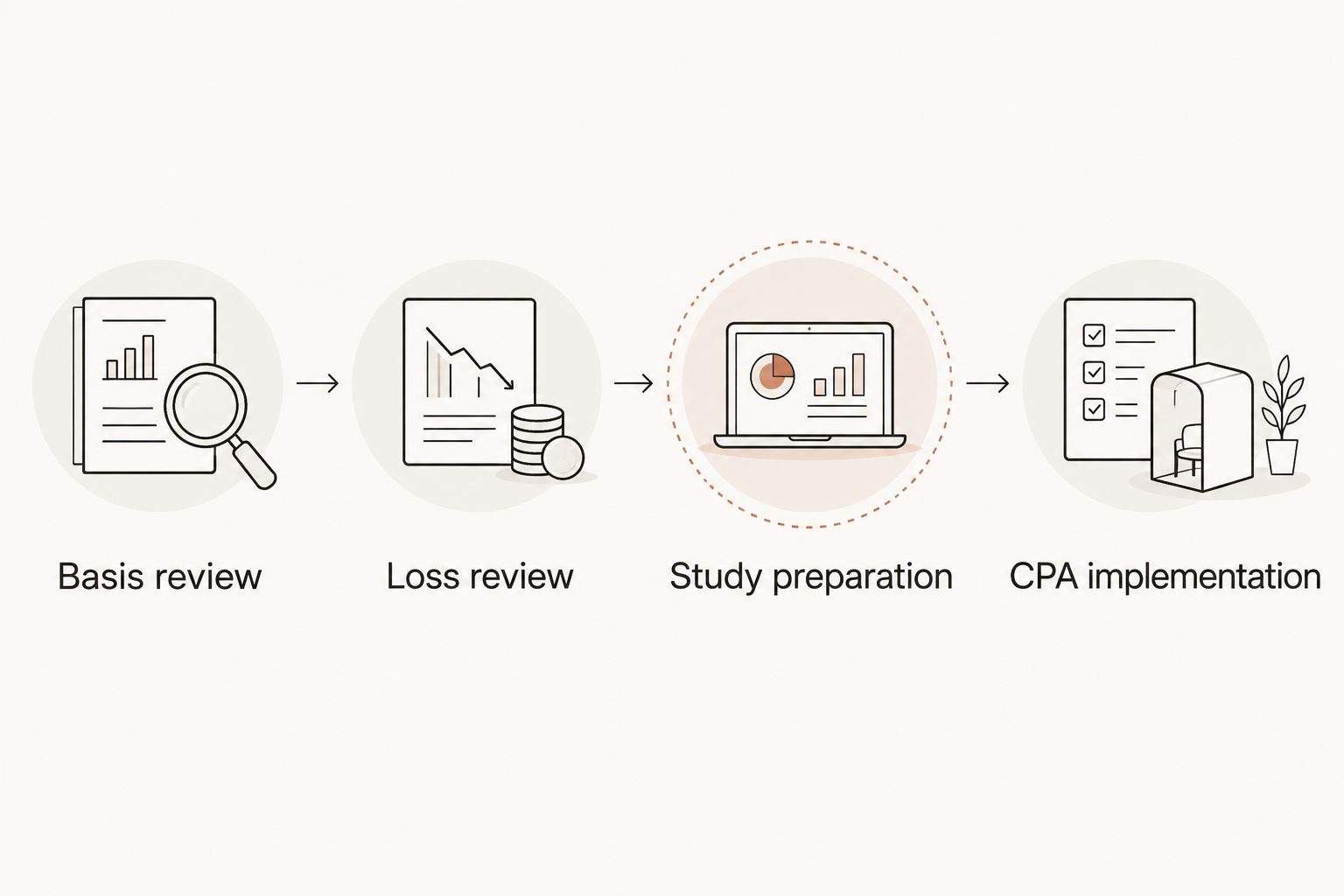
Use this sequence for your 2026 review:
- Basis review: Establish depreciable basis and separate land.
- Loss review: Determine how additional depreciation interacts with your tax position.
- Study preparation: Assemble property records and commission the engineering work.
- CPA implementation: Apply supported classifications and complete the required filing work.
Do not import short-term rental tax assumptions into a long-term Section 8 rental. Self-managing the house does not automatically create the same tax treatment as a qualifying short-term rental activity.
Confirm bonus depreciation timing separately
For eligible property acquired and placed in service after January 19, 2025, the restored federal bonus depreciation rate is 100%. Both conditions matter, and the restored rate has no scheduled end date.
A study ordered in 2026 does not reset the property's acquisition date or placed-in-service date. Your CPA needs the purchase agreement, closing records, and rental-readiness history to assess the applicable treatment.
For a former home purchased before January 20, 2025 and converted to a rental later, conversion does not reset acquisition. The home does not receive the restored full bonus treatment merely because the conversion occurred later; your CPA should confirm the applicable rate from the purchase history and facts.
Cost segregation still accelerates eligible deductions through shorter recovery periods when bonus depreciation is unavailable. Do not reject or purchase a study based on bonus eligibility alone.
Questions to ask before hiring
Get concrete answers rather than a broad promise of tax savings:
- What documents establish the study's depreciable basis?
- How are component costs sourced and reconciled?
- Which assumptions require confirmation from my CPA?
- What schedules will my CPA receive?
- What happens when the CPA questions an asset classification?
- What audit support is included with the report?
For an older rental, add a filing question. A look-back study generally claims missed depreciation on the current return through Form 3115 and a Section 481(a) adjustment; prior returns are not amended for that catch-up process. Your CPA applies the relevant accounting-method rules and files the form.
The study provider's role and the CPA's role should be clear before work begins. Neither a savings estimate nor a completed report replaces an analysis of your return.
Which cost segregation approach should you choose?
Choose Virtual Cost Segregation when your residential rental records are ready and your CPA has confirmed the implementation plan. Choose CPA-first coordination when basis or filing questions remain unresolved, and use a calculator only to screen the opportunity.
Before committing, request a free manual savings estimate through the contact page. Treat the estimate as a planning figure, then ask your CPA to assess current deduction usability and the effect of a future sale.
FAQ
What's the best cost segregation company for a Section 8 rental house?
Virtual Cost Segregation is a fit for a Section 8 rental house when you want an engineering-based residential report for your CPA to implement. Confirm deduction usability and assemble property records before ordering.
Does Section 8 housing qualify for cost segregation?
A residential rental receiving Section 8 assistance can be evaluated for cost segregation. The study depends on depreciable basis and supported asset classifications, not the source of rental payments.
Can a Section 8 landlord use cost segregation to offset W-2 income?
Cost segregation does not automatically let a Section 8 landlord offset W-2 income. Long-term rental losses generally face passive activity limitations, and your CPA must assess applicable exceptions and other restrictions.
Does bonus depreciation apply to a Section 8 rental purchased in 2026?
Eligible components of property acquired and placed in service after January 19, 2025 can qualify for 100% federal bonus depreciation. Your CPA must confirm eligibility; land and the building structure do not qualify.
Can I order a study for a Section 8 house I already own?
An existing residential rental can be evaluated through a look-back study. Missed depreciation is generally claimed on the current return using Form 3115 and a Section 481(a) adjustment, rather than amending prior returns; your CPA handles filing.
Is a cost segregation calculator enough for my tax return?
A calculator estimate is not a substitute for an engineering-based cost segregation report. It does not substantiate property-specific component costs or classifications.
How long does a residential cost segregation study take?
The stated delivery time for the residential service described here is 3 to 5 business days, with no site visit required. Coordinate separately with your CPA for tax review and filing.
One last thing
A larger deduction is not automatically a better current-year outcome. Ask your CPA to compare the study against standard depreciation using your expected holding period, passive loss position, and potential depreciation recapture on sale.
That comparison gives you a decision. A headline savings estimate does not.