
By Virtual Cost Segregation
The best cost segregation study provider for rental property investors
 Built to IRS standards
 Audit support includedFlat price for every study3 to 5 business days
Best overall for a residential study: Virtual Cost Segregation. Best for resolving retirement-income questions before ordering: a CPA-coordinated engineering provider. Best for preliminary screening: a calculator, not a substitute for a study. This 2026 guide compares those approaches to choosing the best cost segregation companies for retirees with rental income.
- Virtual Cost Segregation fits retirees seeking engineering-based cost segregation for residential rentals with one to four units.
- Compare the best cost segregation companies for retirees with rental income by documentation and usable deductions, not projected deductions alone.
- A rental loss does not automatically offset pensions, retirement-account distributions, or Social Security benefits.
- Have your CPA review passive losses, acquisition dates, and sale plans before ordering a residential rental study.
Why this matters for retirees in 2026
The best study is not necessarily the one showing the largest accelerated deduction. It is the one your tax situation can use. Cost segregation changes when you deduct eligible property costs; it does not override passive-activity loss limits.
That distinction matters when your income includes rent, pensions, retirement-account distributions, or investment income. A long-term rental loss generally remains passive, and retirement alone does not change that classification.
Start with your CPA's projection of usable deductions. Then select the provider that can document the underlying assets and give your CPA a report suitable for implementation.
What makes the best cost segregation provider for retirees?
Evaluate these criteria before comparing estimates:
- Residential scope: Confirm that the provider studies your rental type and unit count.
- Engineering documentation: Ask how each component's classification, allocated cost, and cost source are documented.
- CPA implementation: Require a clear handoff between the study provider and the professional preparing your return.
- Deduction usability: Separate the study's accelerated depreciation from the amount deductible on your current return.
- Ownership history: Disclose conversions, inherited property, prior depreciation, and improvements before requesting an estimate.
- Post-delivery support: Ask what assistance is included when your CPA has questions about the report.
A retirement-focused provider discussion should cover your expected holding period as well. Accelerating deductions changes adjusted basis and can affect the tax consequences of a later sale.
Retirement cost segregation options at a glance
These are provider and screening approaches, not a ranking of named competing firms. The distinction keeps the comparison focused on what you need to buy, coordinate, or postpone.
| Rank and option | Best for | Standout feature | Key limitation |
|---|---|---|---|
| 1. Virtual Cost Segregation | Retirees ready for a residential engineering-based study | Studies for rentals with 1 to 4 units; no site visit required | Your own CPA must determine deduction usability and apply the report |
| 2. CPA-coordinated engineering provider | Retirees with unresolved tax or ownership questions | Tax review precedes study selection | Engineering scope and support must be verified separately |
| 3. DIY calculator | Owners deciding whether to request an estimate | Preliminary scenario screening | An estimate does not document asset classifications or establish deductible losses |
1. Virtual Cost Segregation: best for a residential rental study
Virtual Cost Segregation is best for retirees seeking an engineering-based cost segregation study for a residential rental with 1 to 4 units. The service covers short-term and long-term rentals, with no site visit required and delivery in 3 to 5 business days.
The studies are built to the IRS Audit Technique Guide's criteria. Each component is itemized with its cost source, giving your CPA the supporting detail needed to evaluate and apply the classifications.
Virtual Cost Segregation pros:
- Residential scope includes single-family rentals and duplexes through fourplexes.
- Remote delivery avoids scheduling a property visit.
- Audit support is included at no additional cost.
- A free manual savings estimate is available through a website inquiry or email.
Virtual Cost Segregation cons:
- The study is not a CPA service and is not filed with the IRS.
- An estimate does not establish your actual study results or current tax benefit.
- Your CPA must separately evaluate passive-loss restrictions, elections, and filing requirements.
Best for: Retirees whose CPA has identified a useful depreciation opportunity and who need a documented residential study.
Verdict: Buy after your CPA confirms how the deductions fit your return.
2. CPA-coordinated engineering provider: best for complex tax facts
A CPA-coordinated engineering provider is a selection approach: your CPA establishes the tax questions first, and you then choose an engineering study provider against that scope. This is the better starting point when retirement income, suspended losses, ownership changes, or personal use complicate the decision.
Ask your CPA to identify which facts affect the study before requesting competing scopes. Do not assume that a provider offering a study also prepares your return or handles accounting-method changes.
CPA-coordinated engineering provider pros:
- Places deduction usability ahead of the projected depreciation total.
- Identifies basis and ownership questions before the engineering work begins.
- Clarifies which professional handles tax elections and return preparation.
CPA-coordinated engineering provider cons:
- Coordination is a workflow, not evidence of engineering quality.
- Separate engagements require clear responsibility for questions and revisions.
- A CPA referral does not replace reviewing the proposed study methodology.
Best for: Retirees with inherited rentals, converted homes, substantial suspended losses, or a planned sale.
Verdict: Hold the study order until the CPA defines the tax scope.
3. DIY calculator: best for preliminary screening only
A DIY calculator estimates a potential depreciation outcome from the information you enter. Use it to decide whether a professional conversation is worthwhile, not to select recovery periods or populate a depreciation schedule.
The central limitation is straightforward: an estimated deduction is not a documented allocation of your property's costs. A calculator also does not determine whether passive-activity rules allow you to use the projected loss.
DIY calculator pros:
- Helps organize assumptions before requesting a manual estimate.
- Makes the difference between property basis and projected reclassification easier to discuss.
- Provides a starting point for questions about timing and eligibility.
DIY calculator cons:
- Does not replace component-level engineering documentation.
- Cannot establish your current deductible loss from an estimated reclassification alone.
- Results depend on inputs that still require verification.
Best for: Retirees deciding whether to request a study estimate before committing to the process.
Verdict: Skip as a filing substitute; use only for screening.
The retirement-income test comes before the study
For 2026 planning, ask your CPA to separate your income by tax character rather than combining it into one retirement-income total. Rent, pensions, retirement-account distributions, and investment income do not all interact with rental losses in the same way.
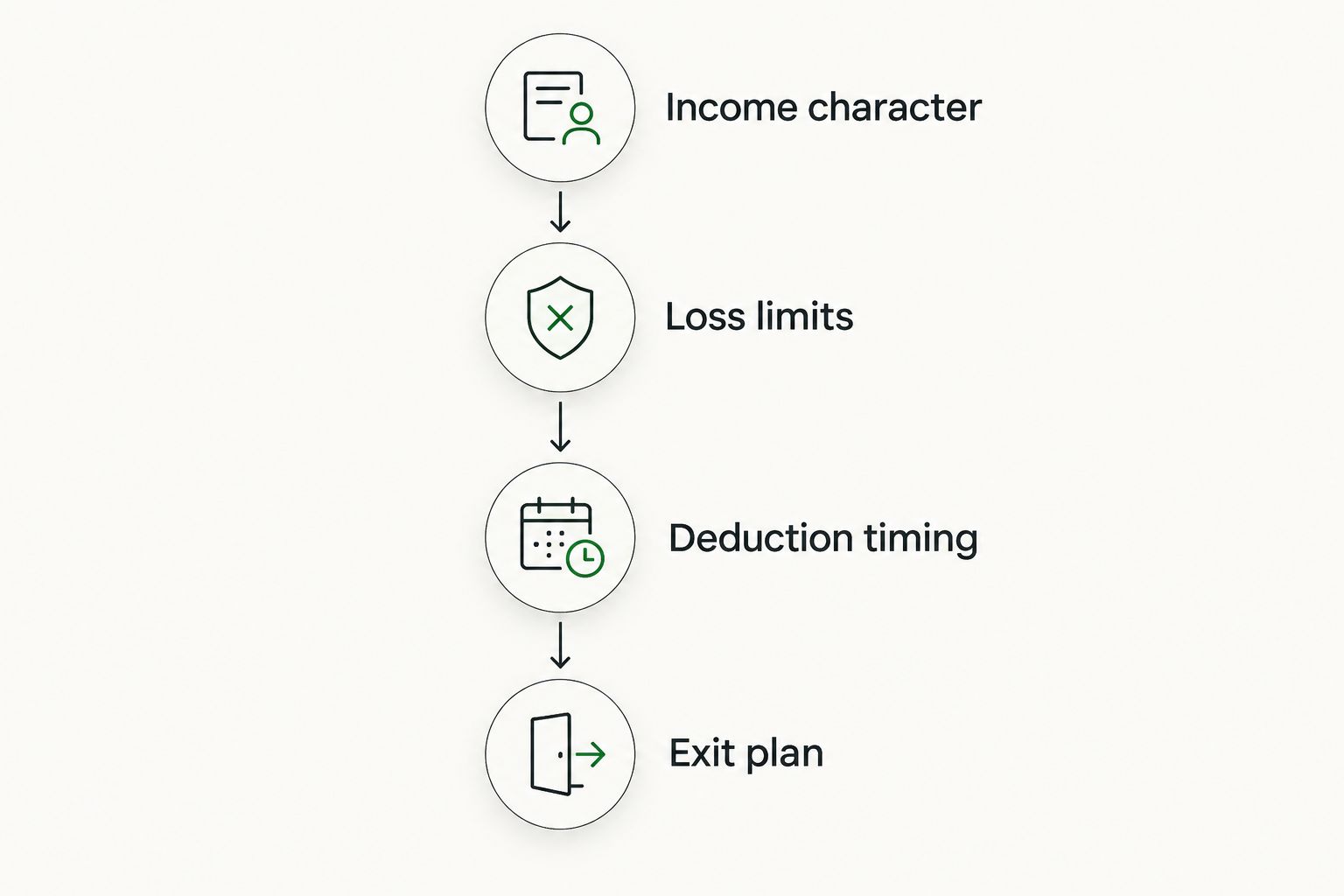
Review these items in order:
- Income character: Identify passive income and income outside that category.
- Loss limits: Review passive-activity restrictions, basis, at-risk limits, and existing carryforwards.
- Deduction timing: Compare usable deductions now with deductions deferred to later returns.
- Exit plan: Model a sale or conversion to personal use before accelerating depreciation.
Retirement does not automatically establish real estate professional status. Nor does owning a short-term rental automatically make its losses nonpassive.
For the short-term rental exception commonly discussed by self-operators, average guest stays must be 7 days or less, and material participation must also be established. One common test requires more than 100 hours and more participation than any other individual, including a property manager. Hours alone are insufficient.
An illustrative estimate is not current tax savings
Consider an illustrative rental with $400,000 of depreciable property value, excluding land. Assume 25% is reclassified to shorter-lived assets: that produces $100,000 of reclassified basis, not automatically a $100,000 current deduction.
For an illustrative high earner in the 37% federal bracket, a fully usable $100,000 deduction corresponds to $37,000 of federal tax reduction before other interactions. This simplified arithmetic assumes the full amount is deductible in the year being modeled and ignores state taxes and other limitations.
The missing step in many estimates is whether the deduction is currently usable. If passive-loss restrictions suspend the loss, the same reclassification does not produce that current federal benefit.
The 25% assumption is illustrative, not a predicted study result. Your property's classifications, depreciation timing, tax bracket, and usable losses require separate review; results vary.
Bonus depreciation: check both dates in 2026
Eligible property acquired and placed in service after January 19, 2025 qualifies for 100% bonus depreciation under the restored rules, subject to the applicable requirements. That rate has no scheduled phase-down or end date.
Do not confuse the rental purchase with the building's eligibility. The building structure never qualifies for bonus depreciation, and land is not depreciable.
Cost segregation identifies components with shorter recovery periods, including eligible 5-, 7-, and 15-year property. Classification and bonus eligibility depend on the component's function, documentation, acquisition history, placed-in-service date, and taxpayer facts.
A long-term residential rental building generally uses a 27.5-year recovery period. A short-term rental building with average stays under 30 days uses a 39-year recovery period, including the short-stay pattern associated with the 7-day exception.
For a home bought before January 20, 2025 and later converted to a rental, conversion does not reset acquisition. The restored full-expensing treatment does not apply merely because rental use starts later; have your CPA confirm the applicable treatment from the purchase history.
Existing rentals need a depreciation-history review
A study ordered in 2026 can address a rental you already own. Give your CPA the existing depreciation schedules before ordering so the new component allocations can be reconciled with deductions already claimed.
For a look-back study using an accounting-method change, missed depreciation is claimed on the current return with Form 3115 through a Section 481(a) adjustment; prior returns are not amended. Your CPA determines the applicable procedure and files the form.
The study is supporting documentation, not the return itself. Confirm who reconciles prior depreciation, prepares the adjustment, and enters the revised asset schedules.
Inherited and converted properties need additional basis review. Purchase price, inherited basis, and the depreciable basis of a former personal residence are not interchangeable inputs.
Questions to ask before signing
Send each prospective provider the same questions so you can compare the proposed work rather than sales language:
- Will the report identify individual components, allocated costs, and cost sources?
- How will the study reconcile to my depreciable basis and existing schedules?
- What records are needed for renovations and mixed personal use?
- What assistance is included if my CPA questions a classification?
- Who handles return preparation and any accounting-method change?
- Does the estimate distinguish accelerated depreciation from usable tax savings?
Ask your CPA an additional question: Would you recommend this deduction timing if I sell sooner than planned? Depreciation recapture and other sale consequences belong in that answer.
How the options were ranked
The ranking prioritizes residential fit, engineering documentation, CPA implementation, and support. It does not rank firms by unverified savings claims or assume that every retiree benefits from accelerated deductions.
A documented study ranks first when you are ready to implement. CPA coordination comes first when tax facts remain unresolved, while calculators belong only at the screening stage.
Which option should you choose?
Choose an engineering-based residential study after your CPA confirms the deduction's usefulness. For an unresolved conversion, inheritance, loss carryforward, or sale question, finish the tax review before purchasing the study.
Bring your acquisition records, prior depreciation schedules, improvement records, and expected holding period to that conversation. Those facts determine the next move more reliably than a projected deduction alone.
Request a manual savings estimate
Discuss your residential rental, then review the estimate and deduction timing with your CPA.
FAQ
What's the best cost segregation option for a retiree with one rental?
An engineering-based residential study is the best fit after your CPA confirms that accelerating depreciation serves your tax plan. Virtual Cost Segregation studies residential rentals with 1 to 4 units, with no site visit required.
Can rental depreciation offset my pension or IRA distributions?
Rental depreciation does not automatically offset pension income or IRA distributions. Passive-activity rules generally restrict passive rental losses, so your CPA must determine whether an exception or other applicable provision permits a deduction.
Does being retired make me a real estate professional?
No. Retirement alone does not establish real estate professional status. Qualification depends on the applicable service-hour requirements and your actual activities.
Can I order a study for a rental I have owned for years?
Yes. For a look-back study using an accounting-method change, missed depreciation is claimed on the current return with Form 3115 and a Section 481(a) adjustment; prior returns are not amended. Your CPA determines the procedure and files the form.
Does converting my old home into a rental reset its acquisition date?
No. Converting a personal residence into a rental does not reset its acquisition date. For a home bought before January 20, 2025, ask your CPA to confirm bonus eligibility from the original purchase history rather than the conversion date alone.
Is a cost segregation calculator enough for my tax return?
No. A calculator estimate does not replace an engineering-based allocation or establish the amount deductible on your return. Use it to frame questions before requesting a study.
Should I order a study if I plan to sell the rental soon?
Have your CPA model the sale before ordering. Accelerated depreciation changes adjusted basis, and recapture or other sale consequences can change the value of taking deductions earlier.
One last thing
Ask for two outputs from your 2026 tax projection: accelerated depreciation identified and current deductions actually usable. The gap between those figures is the retirement-planning decision.
This article provides general educational guidance, not individualized tax advice. Have your CPA apply current law to your property, income, and filing facts.