
By Virtual Cost Segregation
The best cost segregation study provider for rental property investors
 Built to IRS standards
 Audit support includedFlat price for every study3 to 5 business days
Best fit for residential rental owners: Virtual Cost Segregation. Best approach for missing property records: an engineering study with on-site verification. Best starting point before buying: a preliminary estimate reviewed with your CPA. This 2026 guide compares those choices by documentation, filing responsibilities, and whether accelerated depreciation can actually reduce your W-2 taxable income.
- Virtual Cost Segregation is the residential specialist pick among the best cost segregation companies for high-income W-2 earners.
- A short-term rental loss requires a separate participation and tax-limitation analysis before it can offset W-2 income.
- Choose an engineering-based report with asset-level cost support, not a calculator presented as a completed study.
- Ask your CPA to model current deductions, suspended losses, state treatment, and eventual depreciation recapture before ordering.
Why this matters
A larger depreciation deduction is not automatically a larger W-2 offset. Cost segregation identifies components eligible for shorter depreciation periods. Separate tax rules determine whether you can use the resulting loss against wages.
That distinction matters when comparing providers in 2026. A study can correctly classify assets while your loss remains passive or otherwise limited. Start with your tax position, then choose the report that supports it.
The recommendations below compare a residential specialist with alternative service approaches, not an invented leaderboard of named competitors. Each approach solves a different problem.
What makes the best cost segregation company for W-2 earners?
- Residential fit: Experience addressing single-family rentals, Airbnb properties, vacation rentals, and residential properties with 1 to 4 units.
- Engineering-based documentation: Identified components, supported costs, recovery periods, and an explained allocation method.
- CPA implementation: A usable depreciation schedule and a clear division between study preparation and tax filing.
- Participation awareness: No suggestion that ordering a study establishes eligibility to offset wages.
- Defined scope: Written deliverables, document requirements, turnaround, and audit-support terms.
- Realistic estimates: Property-specific assumptions rather than a promised reclassification percentage or tax result.
Cost segregation choices at a glance
| Choice | Best for | Standout feature or selection requirement | Key limitation |
|---|---|---|---|
| Virtual Cost Segregation | Owners seeking a remote residential engineering study | Engineering-based studies for residential rentals with 1 to 4 units; no site visit required | Your CPA must determine tax treatment and apply the report |
| Engineering study with on-site verification | Owners whose property records leave physical details unresolved | Specify inspection and measurement of unresolved components | A site visit does not establish loss deductibility |
| CPA-coordinated look-back study | Owners correcting depreciation on an existing rental | Coordinate the engineering report with Form 3115 implementation | Requires prior depreciation records and accounting-method analysis |
| Preliminary estimate or DIY calculator | Owners deciding whether to investigate a study | Screens assumptions before committing to a completed report | An estimate is not an engineering study or filing support |
1. Virtual Cost Segregation: best for remote residential studies
Virtual Cost Segregation provides engineering-based cost segregation studies built to the IRS Audit Technique Guide's criteria for residential rental properties with 1 to 4 units. The service includes delivery in 3 to 5 business days, no required site visit, and audit support at no additional cost.
Virtual Cost Segregation is best for residential rental owners who want a remote engineering-based study their own CPA can apply. High-income short-term rental operators fit that audience, but long-term landlords also need an analysis of accelerated depreciation and usable losses.
Virtual Cost Segregation pros:
- Defined residential property scope.
- Engineering-based methodology aligned with the Audit Technique Guide's criteria.
- Remote process without a required site visit.
- Audit support included with the study.
Service limitations:
- The study is not a CPA service or a tax return.
- The report does not establish material participation or current loss deductibility.
- Estimates do not establish the property's eventual tax benefit.
Best for: Residential investors who already have, or will engage, a CPA to evaluate and implement the study.
Verdict: Buy after your CPA confirms the deduction strategy and required records.
2. On-site engineering study: best for unresolved physical details
An engineering engagement with on-site verification is the alternative to request when plans, photographs, invoices, and other records leave important property details unresolved. Specify what the visit must establish rather than treating the visit itself as evidence of report quality.
For a renovated rental, that means identifying which components need measurement or verification and how those observations will support allocated costs. The final report still needs a documented methodology.
On-site engineering study pros:
- Allows physical verification of unresolved components.
- Can address gaps in measurements or property descriptions.
- Creates a defined inspection scope when existing records are incomplete.
On-site engineering study cons:
- Physical observation cannot establish your acquisition basis by itself.
- Inspection does not answer passive-loss or participation questions.
- You must confirm scheduling and deliverables before engaging a provider.
Best for: Owners who need specific physical facts established before a supported allocation can be completed.
Verdict: Hold until the provider identifies what an inspection will resolve.
3. CPA-coordinated look-back study: best for existing rentals
A look-back engagement combines an engineering study with your CPA's review of depreciation already claimed. It addresses a different problem from a first-year study: how to implement corrected depreciation on a property you already own.
Missed depreciation is claimed on the current return with Form 3115 through the applicable Section 481(a) adjustment; prior returns are not amended for that catch-up process. Your CPA applies current accounting-method procedures to your facts and files the required forms.
CPA-coordinated look-back study pros:
- Connects new classifications to existing depreciation schedules.
- Addresses missed depreciation through a current-return process.
- Assigns implementation responsibility before the report is finished.
CPA-coordinated look-back study cons:
- Requires reliable prior depreciation records.
- Form 3115 implementation is separate from asset classification.
- Current loss limitations still apply to the resulting deduction.
Best for: Residential landlords with established depreciation schedules who need a coordinated catch-up analysis.
Verdict: Buy only after your CPA confirms the accounting-method path.
4. Preliminary estimate: best for screening the decision
A preliminary estimate or DIY calculator helps you frame questions before ordering a study. It is not a substitute for identifying assets, documenting their costs, and assigning supported tax classifications.
Use an estimate to test whether the opportunity deserves closer attention. Do not enter an estimated reclassification percentage into your depreciation schedule as though it were a completed engineering analysis.
Preliminary estimate pros:
- Organizes assumptions about depreciable basis and potential deductions.
- Gives your CPA a starting point for discussing usable losses.
- Helps identify missing information before a full engagement.
Preliminary estimate cons:
- Does not establish asset-level classifications or supported costs.
- Does not establish bonus depreciation eligibility.
- Cannot determine whether a rental loss offsets wages.
Best for: Investors deciding whether to investigate cost segregation before ordering a completed study.
Verdict: Hold the estimate as a planning tool; skip it as filing support.
The W-2 offset test comes before the study
For the short-term rental strategy, an average guest stay of 7 days or less takes the activity outside the rental-activity definition for passive-activity purposes. You must then establish material participation. The strategy does not require real estate professional status.
One commonly used material-participation test requires more than 100 hours and more participation than any other individual, including a property manager. Recording 100 hours alone does not satisfy that test.
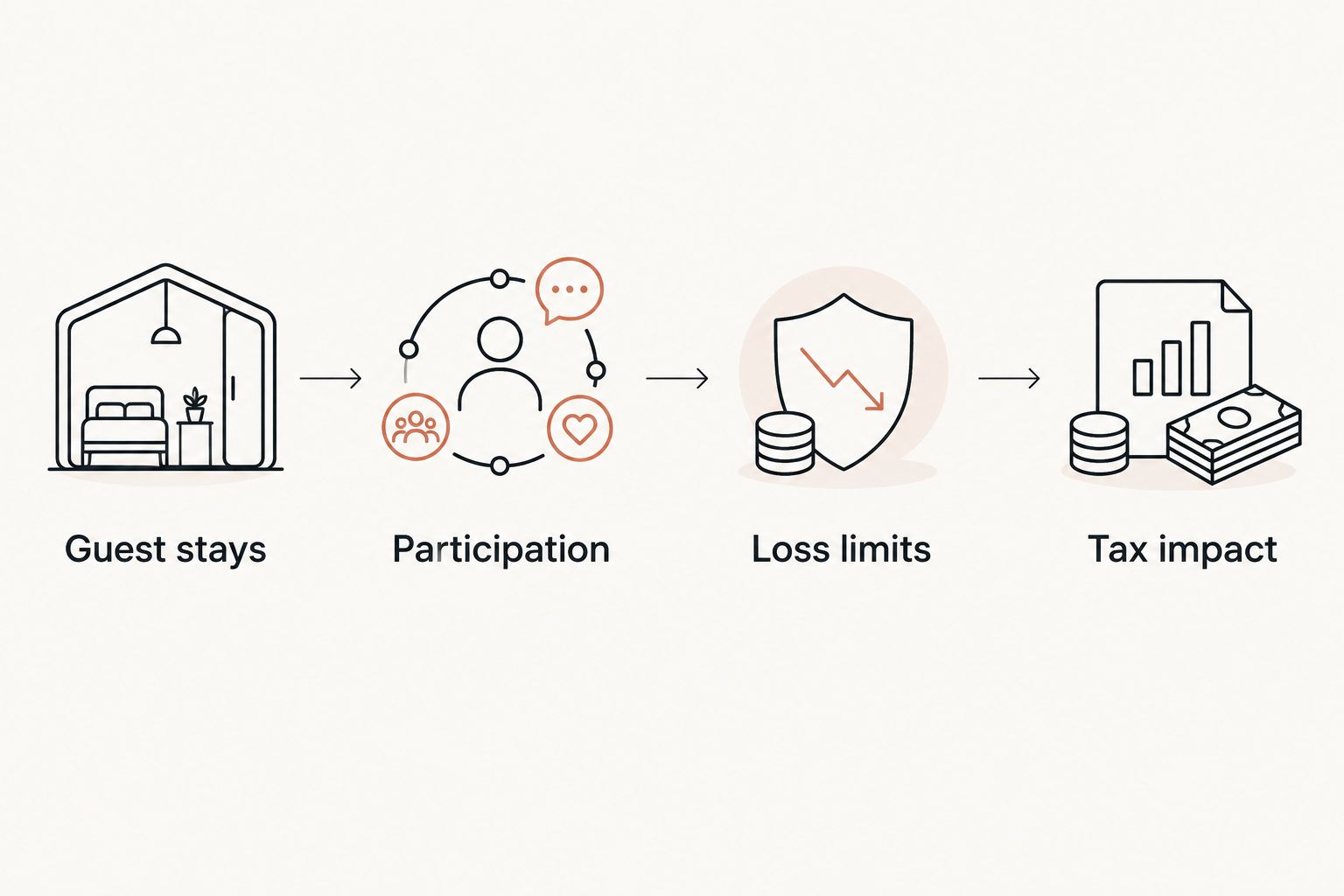
For your 2026 planning, separate these questions:
- Guest stays: Does the actual average stay meet the applicable rule?
- Participation: Which material-participation test applies, and what records support it?
- Loss limits: Do basis, at-risk, passive-activity, or excess-business-loss rules restrict the deduction?
- Tax impact: What changes on the federal return and the relevant state returns?
A high salary does not answer any of those questions. Neither does owning an Airbnb listing. Your CPA needs your operating facts, participation records, ownership information, and other tax details.
Check bonus eligibility before comparing projected deductions
For 2026 planning, eligible property acquired and placed in service after January 19, 2025 qualifies for 100% bonus depreciation, subject to the applicable requirements. Both dates matter. The restored rate has no scheduled end date.
Do not assume that a newly completed study changes when you acquired an asset. Acquisition terms, including an earlier binding contract, require review. Converting a previously purchased home into a rental does not reset its acquisition date.
A home bought before January 20, 2025 and converted later does not receive the restored full bonus rate merely because of the conversion. Have your CPA confirm the applicable treatment from the purchase date and other facts.
The building structure never qualifies for bonus depreciation. Shorter-lived assets require their own classification analysis, and cost segregation still accelerates deductions through 5-, 7-, and 15-year recovery periods even without bonus depreciation.
Compare usable deductions, not headline savings
For an illustrative calculation, assume a residential rental has $400,000 of depreciable basis, excluding land, and the study reclassifies 25%, or $100,000, to eligible shorter-lived assets. This percentage is an example, not a prediction of study results.
If that entire $100,000 is deductible currently, a 37% marginal federal tax rate produces a simplified $37,000 federal tax effect. That calculation is not incremental savings over standard depreciation: it omits the depreciation otherwise available, state treatment, other tax interactions, and future consequences.
If a loss limitation suspends the deduction, the same classification does not produce that current W-2 tax effect. Ask your CPA to compare both scenarios before you order.
Your comparison of cost segregation study costs belongs beside the usable incremental deduction and implementation work, not beside the largest estimated write-off. A completed report and a preliminary estimate are different deliverables.
Also include your expected holding period. Accelerating deductions changes their timing and can affect depreciation recapture when you sell; the first-year tax calculation is not the whole investment decision.
What to request before engaging a provider
Ask for written answers that your CPA can review before the engagement begins. These questions separate the study's technical work from your filing responsibilities:
- What property documents support the basis and allocation?
- How are components identified and their costs sourced?
- How does the report explain recovery periods and classifications?
- What additional evidence is requested when records are incomplete?
- What does audit support include?
- Who answers the CPA's implementation questions?
- For an existing rental, how will the study reconcile with prior depreciation?
Virtual Cost Segregation offers a free manual savings estimate through a website or email inquiry. Treat that estimate as planning information, then have your CPA evaluate current deductibility before purchasing a study.
Request a manual savings estimate
Start with your residential rental facts, then review potential deductions with your CPA.
How these recommendations are ranked
This 2026 comparison prioritizes documented residential scope, engineering-based analysis, supported allocations, and CPA implementation. It does not rank unnamed providers on unverified performance, customer counts, or tax outcomes.
The default recommendation addresses a remote residential study. The alternatives address inspection gaps, missed depreciation, or preliminary screening. Choose the unresolved problem first, then select the engagement.
Which cost segregation approach should you choose?
Choose the residential engineering study when your records support the analysis and your CPA has confirmed how the deductions will be used. Request on-site verification for unresolved physical facts, or a CPA-coordinated look-back engagement for an existing depreciation schedule.
If you cannot yet explain whether the loss is usable, start with an estimate and tax review. A completed study should implement a tax plan, not substitute for one.
FAQ
What's the best cost segregation company for a high-income W-2 earner?
Virtual Cost Segregation is the residential specialist pick in this comparison for owners seeking a remote engineering-based study. Your CPA must separately determine whether accelerated depreciation can reduce your W-2 taxable income.
Can cost segregation offset my salary from a full-time job?
Cost segregation can contribute to a deductible loss, but the study alone does not establish a W-2 offset. Short-term rental treatment, material participation, and other loss limitations determine whether the loss is usable.
Is logging 100 hours enough for the short-term rental strategy?
No, 100 hours alone is not enough for the commonly used participation test. That test requires more than 100 hours and more participation than any other individual, including a property manager.
Do I need real estate professional status for a short-term rental?
The short-term rental strategy does not require real estate professional status. An average guest stay of 7 days or less and material participation require separate analysis, along with other applicable tax rules.
Does a rental building qualify for bonus depreciation?
The building structure does not qualify for bonus depreciation. A study identifies components for separate analysis; classification and eligibility depend on function, documentation, timing, and your facts.
Should I amend old returns after a look-back study?
Missed depreciation in the look-back accounting-method process is claimed on the current return with Form 3115, rather than by amending prior returns. Your CPA determines the applicable Section 481(a) adjustment and files the required forms.
Is a calculator enough to claim accelerated depreciation?
A calculator is a planning tool, not an engineering-based cost segregation report. Filing requires supported asset classifications, costs, recovery periods, and your tax preparer's application of the rules.
One last thing
Ask your CPA for the projected usable loss, not just the projected depreciation. That single distinction changes how you compare every provider. A supported deduction that remains suspended has a different current-year value from one you can use against wages.
This article provides general educational guidance. Apply current law to your property's facts with your tax professional before making filing decisions.