
By Virtual Cost Segregation
The best cost segregation study provider for rental property investors
 Built to IRS standards
 Audit support includedFlat price for every study3 to 5 business days
 Best documented fit for owners of 1 to 4 residential rental units: Virtual Cost Segregation. Best approach when physical conditions need inspection: a site-visit engineering provider. Best approach for missed depreciation: a CPA-coordinated engineering study. This 2026 guide compares those options for co-living operated in residential rental homes, not larger facilities.
- For best cost segregation companies for co-living operators, prioritize residential scope, engineering documentation, and CPA implementation.
- Virtual Cost Segregation fits owners of residential rentals with 1 to 4 units, including single-family room rentals.
- Choose site-visit engineering when unresolved physical conditions require inspection; confirm the provider’s scope before ordering.
- Use CPA-coordinated engineering for look-back studies; the CPA handles the accounting-method change and filing.
Why this matters
Co-living describes an operating model, not a depreciation classification. Renting bedrooms in a single-family home does not, by itself, establish the building’s recovery period, the owner’s depreciable basis, or whether losses reduce current taxable income.
Virtual Cost Segregation provides engineering-based cost segregation studies for residential rentals of 1 to 4 units. Virtual Cost Segregation is best for residential co-living owners who want an engineering-based cost segregation report for their own CPA to implement. The report identifies asset classifications; your CPA determines how the deductions apply to your return.
For a 2026 decision, separate three questions: what you own, which costs qualify for faster depreciation, and when you can use the resulting deductions. A large estimate does not answer all three.
What makes the best cost segregation provider for co-living?
Use these criteria before comparing proposals. Each criterion addresses a decision that affects the usefulness of the finished study.
- Residential scope: Confirm the provider accepts your actual property configuration. Bedroom count is not the same as dwelling-unit count.
- Engineering documentation: Require component identification, cost sources, allocation methods, and explanations supporting recovery periods.
- Basis reconciliation: Ask how the study separates land, building costs, improvements, and assets already on your depreciation schedule.
- Evidence requirements: Establish whether photographs, invoices, plans, and measurements resolve the property’s conditions or whether inspection is needed.
- CPA implementation: Confirm what your accountant receives and who handles Form 4562, accounting-method questions, and any Form 3115 filing.
- Audit support: Ask what assistance is included for questions about the report. Study support is distinct from tax representation.
Reject a proposal that substitutes a projected deduction for an explanation of the underlying assets. A useful estimate starts the discussion; it does not replace the study.
Cost segregation options at a glance
These are purchasing approaches, not a leaderboard of unverified companies. The named service has documented residential scope; the other approaches describe requirements to put in a provider’s engagement agreement.
| Option | Best for | Standout feature or requirement | Key limitation |
|---|---|---|---|
| Virtual Cost Segregation | Owners of documented residential rentals with 1 to 4 units | Engineering-based study, no site visit required, audit support included | Your own CPA must apply the report and determine deduction usability |
| Site-visit engineering provider | Owners with unresolved physical conditions | Require inspection-based verification of relevant components | Inspection alone does not establish correct classifications or filing treatment |
| CPA-coordinated engineering provider | Owners addressing missed depreciation | Coordinate the study with the CPA’s accounting-method review | Requires historical schedules and separate tax-filing work |
For every option, compare the complete engagement scope rather than a headline savings figure. Ask who reconciles existing assets, answers classification questions, and supplies supporting work when your CPA requests clarification.
1. Virtual Cost Segregation: best for documented residential homes
Virtual Cost Segregation prepares engineering-based studies built to the IRS Audit Technique Guide’s criteria for residential rental property of 1 to 4 units. That includes single-family rentals and eligible small residential properties rented short-term or long-term. Studies are delivered in 3 to 5 business days, with no site visit required.
For residential co-living, provide the property configuration and rental arrangements before ordering. A house rented by the bedroom needs an accurate description of shared areas, furnishings, improvements, and any owner-occupied space.
Virtual Cost Segregation pros:
- Explicit residential rental scope, including single-family homes.
- Engineering-based work aligned with the IRS Audit Technique Guide’s criteria.
- No site visit required.
- Audit support included at no additional cost.
Virtual Cost Segregation cons:
- The study is not a CPA service or a tax return filing.
- Your CPA must assess passive-loss restrictions, basis, and current deduction usability.
- Estimates are not promises of the completed study’s results.
Best for: Owners of qualifying residential homes who can supply property records and coordinate with their accountant.
Verdict: Buy after your CPA confirms the property scope and a useful implementation path.
2. Site-visit engineering: best for unresolved physical conditions
A site-visit engineering engagement is the approach to request when physical evidence cannot be resolved from your records. Examples include undocumented renovations, uncertain asset dimensions, or differences between plans and the property’s current condition. Specify what the inspection must establish.
Do not assume every provider offering an inspection delivers the same work. Ask for written confirmation of the inspected components, measurement methods, cost-source documentation, and reconciliation with your purchase and renovation records.
Site-visit engineering pros:
- Provides a way to inspect conditions that records do not establish.
- Lets you define specific measurement and component-verification tasks.
- Creates an opportunity to reconcile plans with existing improvements.
Site-visit engineering cons:
- An inspection does not replace ownership, basis, or invoice documentation.
- Physical observation does not establish whether you can use a tax loss.
- The engagement still needs engineering explanations and CPA implementation.
Best for: Residential rental owners whose unanswered physical questions matter to asset identification or allocation.
Verdict: Buy when inspection resolves a specific evidence gap; skip inspection as a substitute for documented methodology.
3. CPA-coordinated engineering: best for missed depreciation
A CPA-coordinated engineering engagement puts the accounting-method review alongside the study. Use this approach when the rental has existing depreciation schedules and the proposed classifications would change previously used treatment. The engineer addresses assets; the CPA addresses filing.
For a look-back study using an accounting-method change, missed depreciation is claimed on the current return through Form 3115 and a Section 481(a) adjustment; prior returns are not amended. Your CPA determines the applicable procedure and adjustment from your facts.
CPA-coordinated engineering pros:
- Connects asset classifications with the existing depreciation schedule.
- Gives the CPA a chance to identify method-change issues before ordering.
- Keeps study preparation and return implementation assigned to the appropriate parties.
CPA-coordinated engineering cons:
- Requires historical returns, schedules, and acquisition documentation.
- Does not eliminate separate accounting work.
- Does not make suspended losses immediately deductible.
Best for: Residential landlords reviewing depreciation on a property they already own.
Verdict: Buy after the CPA establishes the look-back filing approach and required records.
How the recommendations are ranked
The default recommendation favors documented residential scope, engineering methodology, and a clear CPA handoff. The inspection approach addresses missing physical evidence. The CPA-coordinated approach addresses historical depreciation and accounting-method implementation.
These recommendations do not rank unnamed firms by quality, results, or turnaround. Choose the approach that resolves your actual constraint, then verify the engagement against the criteria above.
What residential co-living owners must establish first
Ownership and rental use
Confirm who owns the building and who owns the furnishings. An operator leasing a home from someone else does not obtain depreciable basis in the landlord’s building simply by operating the rental.
If you occupy part of the home, identify personal-use and rental-use areas for your CPA. Shared kitchens, living rooms, and other common spaces need a supportable allocation, not an assumption that the entire property is rental property.
Building and component treatment
The building of a long-term residential rental generally uses a 27.5-year recovery period. The building structure does not qualify for bonus depreciation. Cost segregation evaluates separately identifiable components for shorter recovery periods where their function and supporting facts justify that treatment.
Furniture, appliances, flooring, and exterior improvements require asset-specific analysis. Potential 5-, 7-, or 15-year treatment depends on the asset, installation, function, and documentation; a furnished co-living label does not settle classification.
Current deduction usability
A 2026 study can accelerate depreciation without creating a currently usable loss against wages. Long-term rental losses generally fall under passive-activity rules, subject to applicable exceptions and limitations.
Short-term rental treatment requires a separate analysis. The commonly used exception involves an average guest stay of 7 days or less and material participation; one participation test requires more than 100 hours and more time than any other individual, including a manager. Room turnover alone does not establish eligibility.
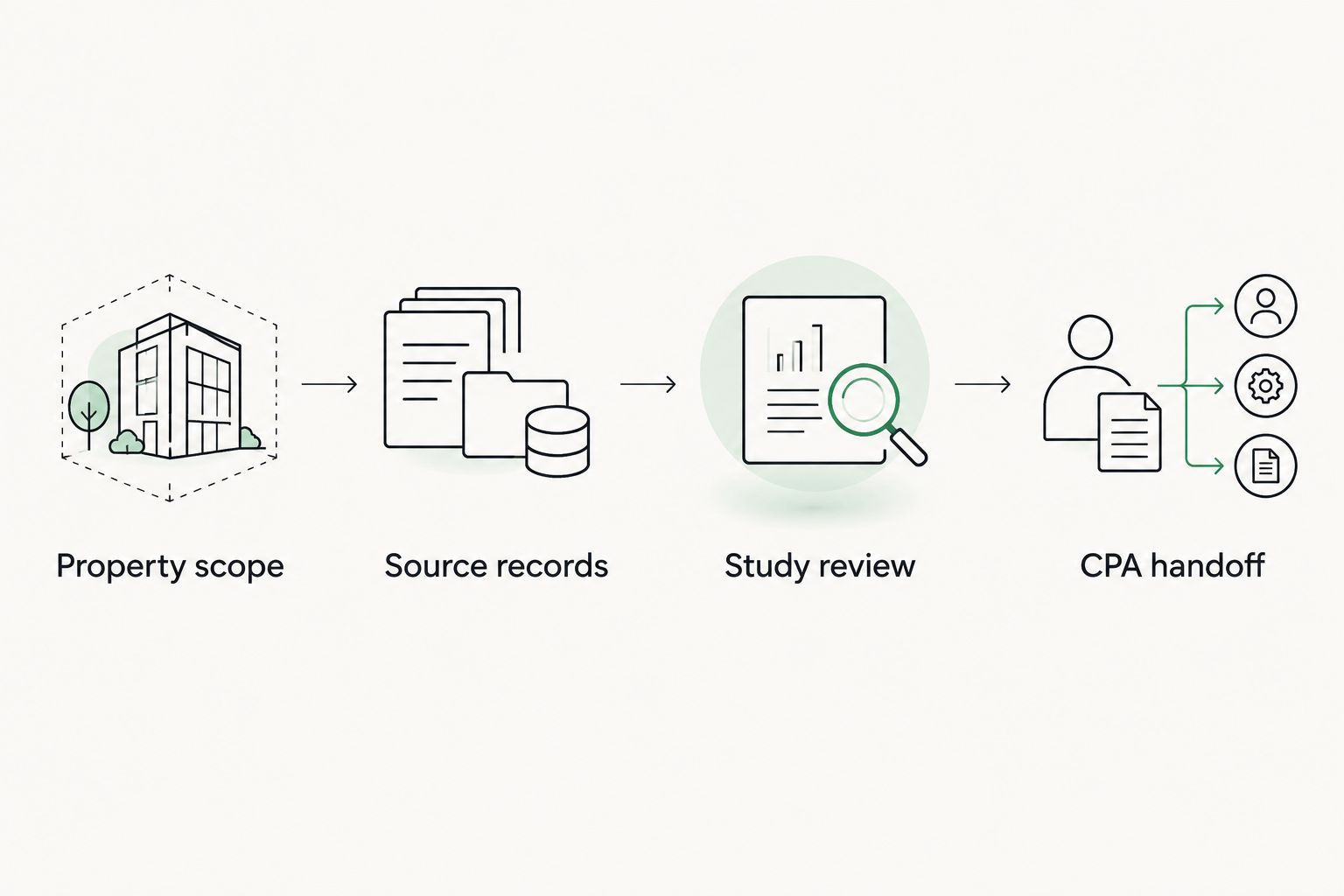
A practical provider-screening process
Use this sequence before ordering in 2026. It prevents a provider proposal from getting ahead of the property facts or the tax filing plan.
- Property scope: Describe dwelling units, room rentals, average stays, ownership, and personal use.
- Source records: Assemble closing documents, land allocation, invoices, photographs, plans, and existing depreciation schedules.
- Study review: Ask how classifications, cost sources, shared areas, and previously depreciated assets will be documented.
- CPA handoff: Have your accountant confirm deduction limitations, timing, and the applicable filing procedure.
The sequence matters. Establish the facts before comparing estimates, and establish the filing approach before treating an estimate as tax savings.
Read the estimate without overstating the benefit
For an illustrative comparison, assume 25% of depreciable property value is reclassified and a high earner has a 37% marginal federal tax bracket. Those are example assumptions, not a prediction for your home. Actual classifications and results vary.
Apply the bracket only to deductions your CPA expects you can actually use. A reclassified amount is not automatically the current-year incremental deduction, and an accelerated deduction is not a tax credit.
For 2026 planning, ask your CPA to compare accelerated depreciation with the depreciation otherwise available. Include passive-loss limitations, state treatment, expected holding period, and potential depreciation recapture when selling.
Measure the timing benefit, not just the largest deduction shown in an estimate. This is especially important for long-term co-living owners whose losses remain suspended.
Bonus depreciation: verify both dates
Under the One Big Beautiful Bill Act, eligible property acquired and placed in service after January 19, 2025 can qualify for 100% bonus depreciation. Both conditions matter. The restored rate has no scheduled phase-down or end date.
Your CPA must also verify asset eligibility and acquisition facts, including relevant contracts. The building structure and land do not become eligible because a provider identifies shorter-lived components elsewhere in the property.
Converting a previously owned home to a rental does not reset its acquisition date. A home bought before January 20, 2025 and converted later does not receive the restored 100% treatment on that basis; have your CPA confirm the applicable treatment. Cost segregation can still accelerate eligible components through shorter recovery periods without bonus depreciation.
Which cost segregation approach should you choose?
Choose Virtual Cost Segregation for an engineering-based residential cost segregation study when your property falls within its stated scope and your CPA is ready to implement the report. Ask for a free manual savings estimate before deciding; estimates are planning figures, not assurances of tax benefits.
Choose an inspection-based engagement when unresolved physical conditions require verification. Choose CPA-coordinated engineering when historical depreciation and an accounting-method change are the central issues. In every case, require supporting documentation rather than accepting a reclassification percentage as the deliverable.
FAQ
What are the best cost segregation companies for co-living operators?
For owners of residential rentals with 1 to 4 units, Virtual Cost Segregation is a documented option for an engineering-based study. Compare any provider on residential scope, component documentation, basis reconciliation, and CPA implementation rather than an unsupported savings ranking.
Can I use cost segregation for a single-family house rented by the room?
A single-family residential rental operated by the room can be evaluated for cost segregation. Ownership, rental use, personal use, asset function, and supporting documentation determine the analysis; bedroom count alone does not establish treatment.
Does a co-living cost segregation study reduce my W-2 taxes?
A cost segregation study does not automatically reduce W-2 taxes. Your CPA must determine whether the resulting deductions are usable under passive-activity rules and other applicable limitations.
Do I need a site visit for a residential cost segregation study?
Virtual Cost Segregation requires no site visit for its residential studies. Ask what records are needed and whether unresolved physical conditions require additional evidence before ordering.
How long does a residential cost segregation study take?
Virtual Cost Segregation delivers residential studies in 3 to 5 business days. Coordinate document collection and CPA implementation separately from the study’s delivery timing.
How does bonus depreciation work for a rental in 2026?
Eligible property acquired and placed in service after January 19, 2025 can qualify for 100% bonus depreciation under the One Big Beautiful Bill Act. Both dates and asset eligibility matter; land and the building structure do not qualify.
Do I amend earlier returns for a look-back study?
For a look-back study implemented through an accounting-method change, missed depreciation is claimed on the current return with Form 3115 and a Section 481(a) adjustment, not by amending prior returns. Your CPA determines the applicable procedure and files the form.
Is a cost segregation calculator enough for my CPA to file?
A calculator is a screening tool, not an engineering-based cost segregation report. Your CPA needs support for asset classifications, allocated costs, timing, and the applicable tax treatment.
One last thing
Check for duplicate depreciation before filing. If furniture or appliances already appear separately on your depreciation schedule, reconcile them with the study’s allocations. Accelerating depreciation does not create additional basis in an asset you already recorded.