By Virtual Cost Segregation
The best cost segregation study provider for rental property investors
 Built to IRS standards
 Audit support includedFlat price for every study3 to 5 business days
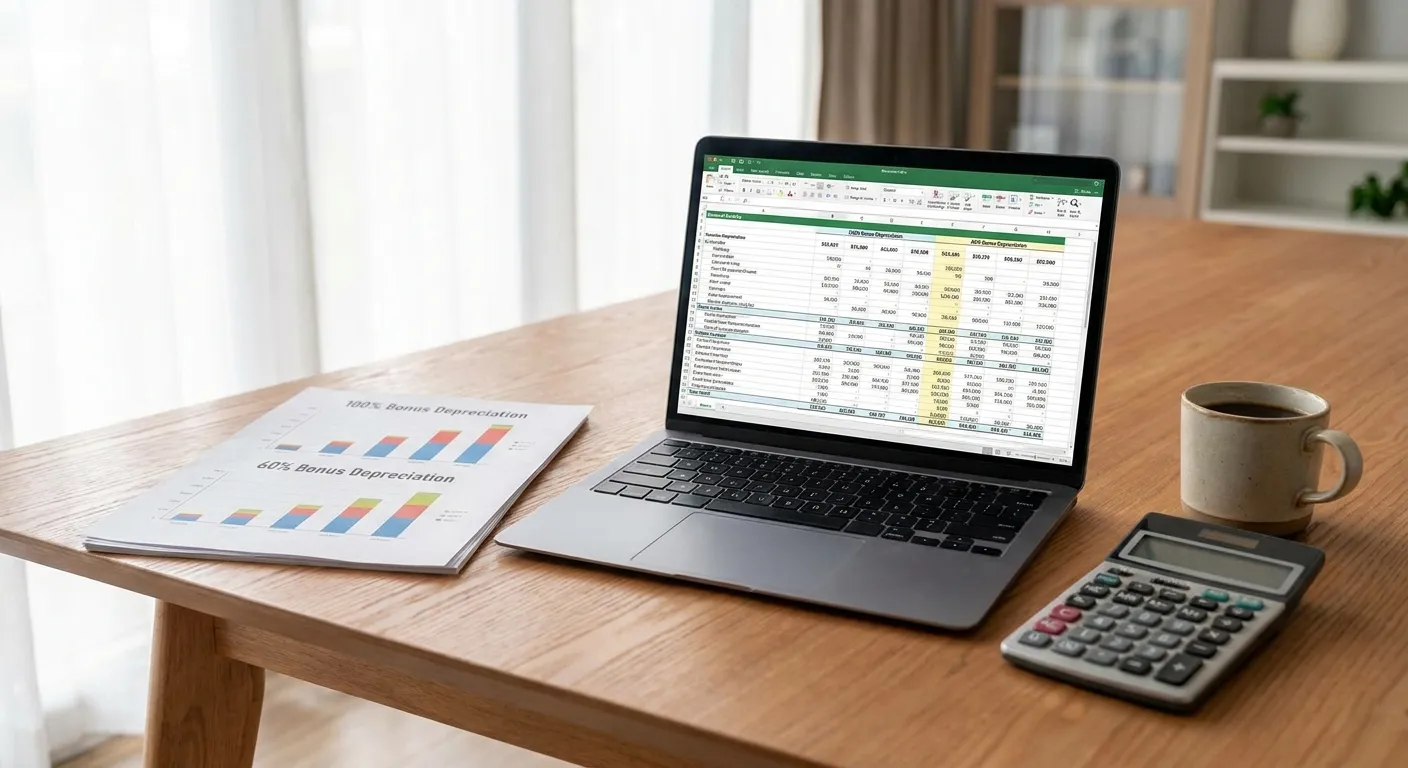
 Bonus depreciation at 100% lets you deduct a full reclassified asset the same year you place a short-term rental in service. Bonus depreciation at 60% only front-loads part of that deduction and pushes the rest onto a longer depreciation schedule. Run real numbers through a cost segregation study and the gap between the two rates gets big fast.
- 100 vs 60 percent bonus depreciation swings $10,360 to $71,040 in year-one savings across five deal sizes.
- Bonus depreciation was 60% in 2024, then OBBBA restored it to 100% after January 19, 2025.
- A $1.8 million short-term rental gains roughly $53,280 more in immediate deductions under 100% bonus depreciation.
- The 60% rate doesn't kill the deduction, it just spreads about 40% of it across the remaining MACRS schedule.
- Virtual Cost Segregation runs these numbers off a $2,200 flat-fee engineering study, not a percentage guess.
Why this matters
Bonus depreciation determines how much of a reclassified asset you can deduct in year one instead of spreading it across 5, 7, or 15 years. That single percentage point swings six figures on a large short-term rental portfolio.
A cost segregation study only pays off in year one if the bonus rate lets you deduct most of what it reclassifies. The Tax Cuts and Jobs Act phased bonus depreciation down from 100% in 2017-2022 to 80% in 2023, then 60% in 2024, with a scheduled drop to 40% in 2025. The OBBBA bonus depreciation rules reset that schedule: property acquired and placed in service after January 19, 2025 qualifies for 100% again, and that rate carries into 2026.
For an investor running the short-term rental loophole against W-2 income, this isn't academic. At 60%, you get most of the deduction up front and the rest later. At 100%, you get all of it now, which changes how much active income you can offset in the same tax year.
“60% bonus depreciation doesn't erase the deduction, it just delays about 40% of it.”
How the numbers were built
This 2026 comparison holds three inputs constant across every deal size below, so the gap you see comes from the bonus rate, not from shifting assumptions.
Reclassification rate: 25% of the building's depreciable basis gets pulled into 5-, 7-, and 15-year property. That's a typical outcome for a well-scoped short-term rental cost segregation study, not a guarantee for every property.
Tax bracket: 37%, the top federal bracket, since this comparison is built for high-W2 earners using the short-term rental loophole against active income.
Land value: 20% of purchase price, leaving 80% as depreciable building basis before cost segregation touches it. Skip this step and you overstate the reclassified dollars, since land never depreciates.
Change any of those three inputs and the dollar figures shift. The percentage-point gap between 100% and 60% bonus depreciation does not move: it's a fixed multiplier on whatever basis gets reclassified.
Side-by-side: 100% vs 60% bonus depreciation by deal size
$350,000 single-family Airbnb: the starter host's case
A new host buys a $350,000 single-family short-term rental. Land value comes off the top at 20%, leaving $280,000 of depreciable building basis. Cost segregation reclassifies about 25% of that, or $70,000, into shorter recovery periods.
At the 37% bracket, 100% bonus depreciation on that $70,000 delivers $25,900 in year-one tax savings. Placed in service in 2024 instead, the 60% rate caps the immediate deduction at $42,000, worth $15,540. That's a $10,360 gap on what's still a modest first rental.
Verdict: Buy the 100% timing if you can control the placed-in-service date; deal size doesn't make the rate difference optional.
$600,000 vacation rental duplex: the debt-payoff move
A $600,000 duplex run as two short-term rental units carries $480,000 in depreciable basis after land is stripped out. Cost segregation reclassifies roughly $120,000 of that into 5-, 7-, and 15-year property.
100% bonus depreciation turns that $120,000 into $44,400 of year-one tax savings at a 37% bracket. Under the 60% rate that applied to 2024 placements, the same reclassified basis produces $26,640 up front, a $17,760 difference.
That gap often covers a year of debt service on the down payment, which is why financed buyers watch placed-in-service dates closely.
Verdict: Buy, and confirm both the closing date and rental-ready date land after January 19, 2025.
$950,000 luxury cabin short-term rental: the high-W2 earner's favorite
This is the deal size where the STR loophole conversation usually starts. Depreciable basis lands at $760,000, and a cost segregation study reclassifies about $190,000 of it.
At 100% bonus depreciation, that's a $70,300 deduction in year one for someone in the 37% bracket. At 60%, the same property converts to $42,180 in immediate savings, a $28,120 shortfall.
For a W-2 earner offsetting six figures of active income through material participation, that $28,120 gap often decides whether the loophole clears the entire tax bill or just most of it.
Verdict: Buy before the year closes if the property is rental-ready; a slow furnishing timeline can push placed-in-service into a worse tax year.
$1,800,000 luxury lake house: the physician's portfolio anchor
A $1.8 million short-term rental produces $1,440,000 in depreciable basis and roughly $360,000 in reclassified short-life property under cost segregation.
100% bonus depreciation in 2026 turns that $360,000 into $133,200 of tax savings at the 37% bracket. The 60% rate that governed 2024 placements caps the same reclassification at $216,000 deducted, worth $79,920. The difference is $53,280, more than most people's annual mortgage payment on the property itself.
High-income earners at this level are usually stacking the STR loophole against a full W-2 salary, and a gap this size changes the math on closing in December versus waiting for January.
Verdict: Buy, and get the cost segregation study started before the return is due, not after.
$2,400,000 multi-unit short-term rental portfolio: the scale play
At this size, a $2.4 million short-term rental portfolio carries $1,920,000 in depreciable basis and about $480,000 in reclassified property.
100% bonus depreciation converts that $480,000 into $177,600 of year-one tax savings. Under the 60% rate, the same portfolio produces $106,560 up front, a $71,040 gap, the largest swing in this lineup. That's the clearest argument for timing 2026 acquisitions around the OBBBA-restored rate rather than treating placed-in-service date as an afterthought.
Verdict: Buy, but confirm every unit is actually rental-ready and documented as placed in service before claiming the deduction.
Lock in 100% bonus depreciation
Virtual Cost Segregation runs the numbers on your property in 3-5 business days.
Comparison table: 100% vs 60% bonus depreciation
| Purchase Price | Reclassified Basis (25%) | 100% Bonus Savings (37% bracket) | 60% Bonus Savings (37% bracket) | Dollar Gap |
|---|---|---|---|---|
| $350,000 | $70,000 | $25,900 | $15,540 | $10,360 |
| $600,000 | $120,000 | $44,400 | $26,640 | $17,760 |
| $950,000 | $190,000 | $70,300 | $42,180 | $28,120 |
| $1,800,000 | $360,000 | $133,200 | $79,920 | $53,280 |
| $2,400,000 | $480,000 | $177,600 | $106,560 | $71,040 |
The gap scales directly with reclassified basis, not with anything special about the price tier. Double the reclassified dollars and you roughly double the difference between 100% and 60% bonus depreciation.
Where to get this done right
A cost segregation study is what turns "reclassify 25% of the basis" from an assumption into a defensible number specific to your property. Virtual Cost Segregation runs an engineering-based cost segregation study for a $2,200 flat fee, with no site visit required and a 3-5 business day turnaround, producing a complete report your CPA implements on the return.
Three things matter more than the study fee:
- Placed-in-service date. The 100% rate only applies to property acquired and placed in service after January 19, 2025. A deal that closes in December but isn't rental-ready until February can land in a different bonus depreciation year.
- CPA coordination. The report is supplementary, not a filed return. Your CPA applies the reclassified figures to Form 4562 on your 2026 return and handles any Form 3115 filing if you're catching up depreciation on a property owned for years.
- Documentation, not guesswork. A percentage pulled from an online calculator won't hold up under audit. An engineering-based report with photos, cost detail, and IRS-aligned methodology will.
FAQ
What's the difference between 100% and 60% bonus depreciation?
100% bonus depreciation lets you deduct the entire reclassified basis in year one, while 60% only lets you deduct 60% up front and spreads the remaining 40% across the standard MACRS schedule. On a $190,000 reclassified basis at a 37% bracket, that's a $28,120 difference in year-one savings.
When did bonus depreciation drop to 60%?
Bonus depreciation dropped to 60% for qualifying property acquired and placed in service in calendar year 2024, continuing the scheduled phase-down from 100% in 2022 to 80% in 2023.
Is bonus depreciation 100% in 2026?
Yes. The One Big Beautiful Bill Act restored 100% bonus depreciation for property acquired and placed in service after January 19, 2025, and that rate applies through 2026 filings.
Can I still claim 60% bonus depreciation on a 2024 property?
Yes, property placed in service in 2024 keeps its 60% rate. The OBBBA restoration only affects property acquired and placed in service after January 19, 2025, and doesn't retroactively bump earlier acquisitions to 100%.
How much can cost segregation save on a short-term rental?
Savings scale with property size and reclassification percentage. The examples above show roughly $25,900 to $177,600 in year-one tax savings on properties from $350,000 to $2.4 million, assuming a 25% reclassification rate and a 37% bracket.
Do I need a cost segregation study to claim bonus depreciation?
You need a study to know how much of the property qualifies for accelerated recovery periods. Without one, you're depreciating the entire building over 27.5 years and missing the reclassified portion bonus depreciation applies to.
What is the STR loophole and how does it relate to bonus depreciation?
The short-term rental loophole lets active participants offset W-2 income with rental losses, and bonus depreciation is what makes those losses large enough in year one to matter. The higher the bonus rate, the bigger the paper loss.
Can I go back and claim 100% bonus depreciation on an older property?
Only if the property was actually acquired and placed in service after January 19, 2025. For properties placed in service earlier, a missed cost segregation study still gets caught up through Form 3115, but at whatever bonus rate applied in that placed-in-service year.
One last thing
The 60% rate doesn't cost you the deduction, it costs you the timing. That non-bonus portion in every example above still depreciates, just over 5, 7, or 15 years instead of immediately. Stack multiple properties or multiple tax years and that timing gap compounds.
The date on your closing statement matters more than most investors realize. A property that closes December 28 but isn't rental-ready until January 3 can land in a different bonus depreciation year entirely, and at these dollar amounts, that's not a rounding error.